Crate training is standard advice in the US, UK and Australia, endorsed by welfare organizations and recommended by most trainers and vets.
In Sweden and Finland, routinely crating a dog is illegal.
Both of those things are true, and the gap between them is worth understanding before you buy a crate — because it tells you exactly where the line sits between a crate that helps a dog and a crate that harms one.
Short answer: a crate is a short-term tool, not a place a dog lives. Introduce it over two or three weeks with the door open and food inside, put it where the family is, and keep the daily total low. Puppies manage roughly their age in months plus one, in hours. Adults do fine with about four hours as a working ceiling. If your dog panics behind a closed door, use a pen or a gated room instead and stop trying to make the crate work.
Why two countries banned it
Swedish regulations state that dogs may not be kept in cages, with exceptions for transport, hunting, competitions and shows, and veterinary care. Even within those exceptions, dogs must be let out at least every two to three hours, and the minimum enclosure size that escapes the regulation starts at around two square meters — considerably larger than a standard American or Australian crate.
The objection is not to the box. It is to duration.
A former animal protection veterinarian for the City of Helsinki put the position plainly: crating dogs to stop them misbehaving or damaging the house is not an acceptable long-term solution. For dogs that must be left, she recommended a dedicated room — spacious, not a bathroom or a closet, furnished so the dog cannot hurt itself — and noted that dogs are usually quieter alone in a limited, safe area than roaming a whole apartment.
That last observation matters. The benefit people attribute to crates — a calmer, safer dog — comes largely from reducing the space, not from bars.
The number that decides it
The behavior literature makes the same distinction. Steven Lindsay, in his handbook of applied dog behavior, argues that routinely caging a dog at night and again during the day, for totals of sixteen to eighteen hours or more, is an extremely problematic practice that should not be encouraged, and probably underlies many adjustment problems including aggression.
His summary of what crate training should be is the most useful sentence written on the subject: the purpose is to get the dog out of the crate as soon as possible, and to use the crate as little as possible.
Run the arithmetic on your own household. Crated overnight for nine hours, then crated for a seven-hour workday, is sixteen hours in a box. That is the practice both countries legislated against, and it is common in households that consider themselves responsible.
What a crate is genuinely good for
House training. Most puppies will not soil where they sleep, and a correctly sized crate uses that instinct to build bladder control. This is the strongest use case, it is time-limited, and it works. See our potty training guide.
Enforcing sleep. Young puppies need roughly sixteen to eighteen hours a day and will not take it voluntarily in a busy house. A crate with the lights dimmed is how most owners get a puppy to nap — and an overtired puppy is the single most common cause of the biting that makes owners desperate.
Safety when unsupervised. A puppy that chews cables is safer in a crate for twenty minutes than loose in a kitchen.
Veterinary recovery. After surgery, restricted movement is often a medical instruction. A dog already comfortable in a crate has a far easier recovery.
Travel. A secured crate is the safest way for a dog to travel in a car, and it is required by most airlines.
Emergencies. Evacuations, boarding, and unexpected vet stays all go better for a dog that finds a crate normal rather than terrifying.
Notice the pattern: every legitimate use is short, specific, or temporary. None of them is “eight hours while I am at work, indefinitely.”
Chewing has causes that confinement does not address. See how to stop destructive chewing.
Adding up the hours honestly
Most owners have never totaled it. Write down the overnight stretch and the daytime stretch, add them, and compare against this.
| Age | Longest single stretch | Sensible daily total | Better option for longer |
|---|---|---|---|
| 8–10 weeks | About 2–3 hours | Naps plus overnight only | Pen beside you, someone home |
| 3 months | About 4 hours | Under 12 hours including night | Pen with a separate potty area |
| 6 months | 4–5 hours | Under 12 hours including night | Gated room |
| Adult | About 4 hours | Under 10 hours including night | Gated room, dog walker, daycare |
| Senior | 2–3 hours | Lower again | Loose in a safe room; joints and bladder both argue for it |
If your arithmetic lands above these numbers, the answer is rarely a better crate. It is a pen, a gated room, a midday visit, or a change to the schedule.
What a crate is not for
Punishment. Sending a dog to the crate after it does something wrong destroys the association you spent weeks building.
Separation anxiety. This is the most damaging misuse, and it comes from good intentions. A dog with separation-related panic that is fixated on escape does not calm down when confined — it becomes more frantic, and dogs have broken teeth and nails and injured themselves badly trying to get out. If your dog panics in a crate, the crate is not the answer. See our guide to separation anxiety and what the research shows.
A substitute for exercise or company. A crate manages a dog. It does not meet any of its needs.
A permanent solution to destruction. Chewing has a cause — boredom, teething, anxiety, under-stimulation. Crating stops the damage without touching the cause, and the moment the dog is out, it resumes.
Full-time containment for an adult dog. If your adult dog needs to be crated whenever you are home and awake, something else needs solving.
Choosing one
Size: the dog should be able to stand without ducking, turn around, and lie fully stretched out. No more than that for house training — a crate big enough to have a bathroom at one end and a bed at the other defeats the mechanism entirely.
Buy the adult size with a divider panel. This is the practical answer most guides skip. One purchase, moved outwards as the puppy grows, instead of buying two or three crates.
Wire crates are well ventilated, collapsible, and easy to cover with a blanket for a den effect. The most versatile choice for home use.
Plastic airline-style crates are more enclosed and often preferred by dogs that like the dark. Required for air travel.
Soft fabric crates are for dogs already reliably crate-trained. A determined puppy is through one in an afternoon.
Placement matters more than the model. Put it where the family is — a corner of the living room, or beside your bed at night. A crate in an isolated utility room turns confinement into social isolation, which is exactly the welfare concern the bans target.
Our guide to training equipment covers what else is worth buying.
Free tool
Puppy Potty Training Planner
Builds an hour-by-hour schedule including crate periods and night trips for your puppy’s exact age.
Setting it up
- Bedding you can wash and the dog cannot swallow. A flat mat beats a thick fluffy bed for any dog that chews when bored.
- Cover three sides, leave one open. The den effect is most of the appeal for dogs that like a crate at all.
- Water for anything over an hour. A clip-on bowl rather than a free-standing one that ends up in the bedding.
- Nothing with a collar or a long toy inside. Collars and tags catch on bars. Take the collar off before the door closes.
- One safe chew, sized so it cannot be swallowed. The crate should predict something to do, not just a closed door.
- Away from radiators, direct sun and drafty doorways. A dog cannot move out of a hot spot when it is shut in one.
- In the room the family uses. A crate in a utility room turns confinement into isolation, which is the part welfare bodies object to.
Training it properly
The most common failure is going too fast: crate arrives on Monday, dog is shut in on Tuesday, dog now hates the crate. Rebuilding from there takes far longer than doing it slowly.
Step 1 — door off, or fixed open. Put the crate in a family room with a comfortable bed inside. Toss food in and let the dog walk in and out freely. Say nothing, ask for nothing. Several days of this.
Step 2 — feed meals inside. Bowl just inside at first, then progressively at the back. Door stays open.
Step 3 — close the door for seconds. Dog inside eating, close the door, open it before the dog finishes. Build to a few seconds after the food is gone.
Step 4 — sit beside it. Door closed, you visible, a stuffed frozen chew inside. Five minutes, then ten.
Step 5 — leave the room briefly. Out of sight for ten seconds, back before the dog notices. Then thirty. Then two minutes.
Step 6 — build real duration, always with something good to do inside.
Two rules throughout. Let the dog out when it is quiet, never in response to crying — opening the door to a screaming dog teaches screaming. And never use it as punishment.
Time limits
A useful ceiling for puppies is their age in months plus one, in hours — a three-month-old puppy manages about four hours — and less than that while awake and active.
For adult dogs, four hours is a reasonable working maximum, and the Swedish requirement of a break every two to three hours is a better standard to aim at than a legal minimum to argue about.
Never crate a dog that is showing it needs to eliminate. Forcing a puppy to soil its bed breaks the instinct the whole method depends on, and once broken it does not come back easily.
The most common use of a crate is overnight, and the first weeks are the hardest part. See our guide to puppy crying at night.
Troubleshooting
The dog goes in happily but panics when the door shuts. The door is a separate thing to train. Close it for one second while the dog eats, open it, repeat. Build in seconds, not minutes.
It cries every night for weeks. Weeks is too long for normal settling. Move the crate closer to you, cut the duration back, and check the potty schedule before assuming it is a training problem.
It soils the crate despite being house trained. Either the crate is too big, the stretch is too long, or something medical is going on. Rule out a urinary problem with your vet before adjusting the schedule.
It settles at night and refuses the same crate during the day. Daytime confinement means missing out on activity, which is a harder sell. Add a stuffed frozen chew for daytime use only, and keep those sessions short.
You have to push or lure the dog in every time. That is the dog telling you the association is negative. Go back to the door-open stage and let it earn the crate rather than being placed in it.
Nothing has improved after a month. Stop and switch to a pen or a gated room. Persisting past this point is how dogs end up with damaged teeth and nails, and there is no benefit worth that.
Alternatives worth considering
Crates are not the only way to limit space, and for many households they are not the best one.
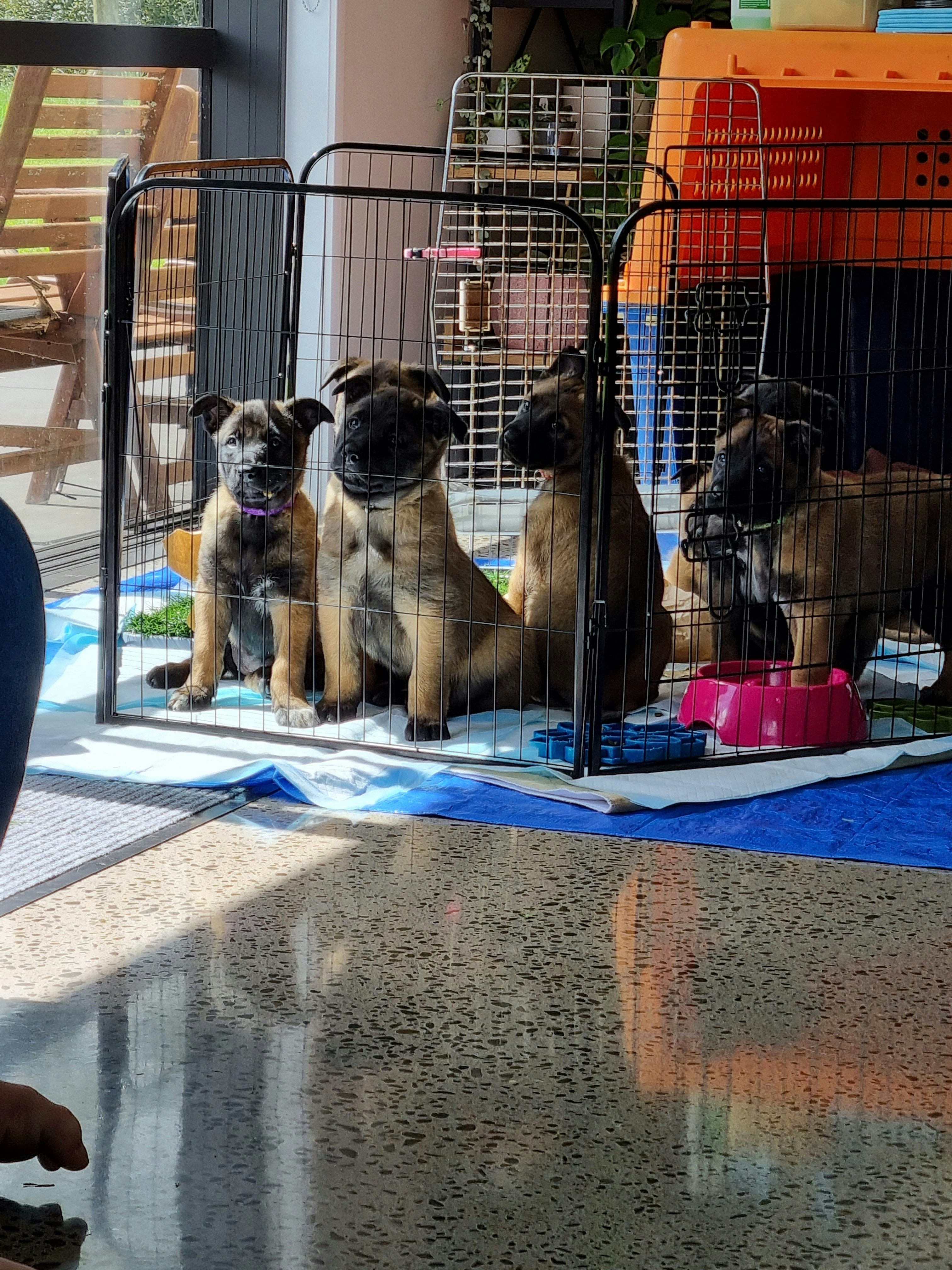
A puppy pen gives room to move, a separate potty area, and space for water and toys. Better than a crate for longer absences, and it is closer to what Swedish and Finnish guidance recommends.
A dog-proofed room with a baby gate. The Helsinki recommendation: a proper room, furnished so the dog cannot hurt itself, rather than a bathroom or a closet.
Baby gates alone, restricting the dog to one or two safe rooms. Often enough for a settled adult dog.
An open crate inside a pen — the arrangement most trainers who take the welfare objections seriously end up recommending. The dog gets the den it chooses to use, plus room to move and no door.
That last option resolves most of the debate. The value is in the den; the harm is in the duration and the lock.
Signs it is going wrong
- Persistent whining, barking, or howling that is not settling after several weeks
- Drooling, panting, or trembling in the crate
- Damaged nails, bleeding paws, or broken teeth from biting the bars
- Soiling in the crate by a dog that is otherwise house trained
- Refusing to enter voluntarily even for food
- Frantic behavior the moment the door closes
Any of these means stop, not push harder. A dog that panics in a crate needs a pen or a room, and possibly a behaviorist — especially if it also struggles when left alone at all.
Phasing it out
The end of crate training is the point of crate training, and most guides never mention how to get there.
- Start when house training is reliable and chewing has settled, usually somewhere between one and two years depending on the dog.
- Test in short windows first. Leave the dog loose in one room for ten minutes while you are in the house, then thirty, then while you step outside.
- Expand the space before you expand the time. One room loose for an hour is easier than the whole house for ten minutes.
- Use a camera for the first real absences. Guessing about what happens while you are out is how problems get missed for months.
- Leave the crate open as a bed. Many dogs keep using it voluntarily, which is the outcome you were aiming at from the beginning.
- Go back a step without treating it as failure if something gets chewed. One bad afternoon is information about the pace, not a verdict on the dog.
An honest conclusion
A crate used for a few hours a day, introduced slowly, placed where the family is, and phased out as the dog matures is a reasonable tool with real benefits.
A crate used for sixteen hours a day, or as a way to manage a problem nobody is addressing, is the thing two countries banned.
Most dogs do not need a crate for life. Many do not need one at all. If yours settles loose in the house, is clean, and is safe unsupervised, you have already arrived where crate training was trying to take you.
Watch the training in action
PawMastery on YouTube — 149,000+ subscribers following along with real training sessions.
For where crate work fits into the wider first year, see our puppy training schedule by age.
Frequently asked questions
Is crate training cruel?
It depends entirely on duration and introduction. Short, well-conditioned crating has real benefits. Routine confinement for sixteen to eighteen hours a day is the practice welfare authorities in Sweden and Finland legislated against.
How long can a dog stay in a crate?
For puppies, roughly their age in months plus one, in hours, as a maximum. For adults, around four hours is a reasonable working limit. Swedish rules require a break every two to three hours even where crating is permitted.
Why is crate training illegal in Sweden?
Swedish regulations prohibit keeping dogs in cages except for transport, hunting, shows and veterinary situations, with breaks required every two to three hours. The objection is to prolonged confinement, not to the object itself.
Should I crate my dog at night?
For a young puppy, yes, with the crate beside your bed and a night-time potty break. For an adult dog that settles quietly, there is usually no need.
My dog cries in the crate. What do I do?
Go back several steps and build up more slowly, and let the dog out during a quiet moment rather than in response to crying. If the distress is severe or persistent, use a pen or a room instead.
Can I crate a dog with separation anxiety?
Usually not. A dog fixated on escaping can injure itself badly when confined. This needs a behavior plan rather than a crate.
What size crate do I need?
Large enough to stand, turn, and lie stretched out, and no larger during house training. Buy the adult size with a divider and move it as the puppy grows.
Is a playpen better than a crate?
For longer absences, usually yes. It limits space without removing the ability to move, and it allows a separate potty area.
When should I stop using a crate?
Once the dog is reliably house trained and safe unsupervised, usually somewhere between one and two years. Many owners leave the crate open as a bed afterwards.
Should I put water in the crate?
For anything longer than about an hour, yes, in a clip-on bowl. Withholding water to make house training easier is not a reasonable trade.
No. Neither dog can move away from the other, and a disagreement in a confined space has nowhere to go. One crate each.
Should I cover the crate?
Covering three sides suits most dogs and helps at night. Watch the temperature, and leave one side open so the dog can see out and the air moves.
Is it too late to crate train an adult rescue dog?
No, and take it slower than you would with a puppy. A dog that spent time in kennels may have strong feelings about a closed door, so keep it open for the first couple of weeks and let the dog choose to use it.
If your dog shows severe distress in a crate, injures itself, or cannot be left alone at all, stop crating and speak to your veterinarian about a referral to a qualified behaviorist. Crate use is regulated differently across countries — check the rules where you live.
For a dog who has just come out of kennels, the crate often does more work than any other piece of equipment. How it fits into the wider settling-in period is covered in our guide to the 3-3-3 rule for rescue dogs.