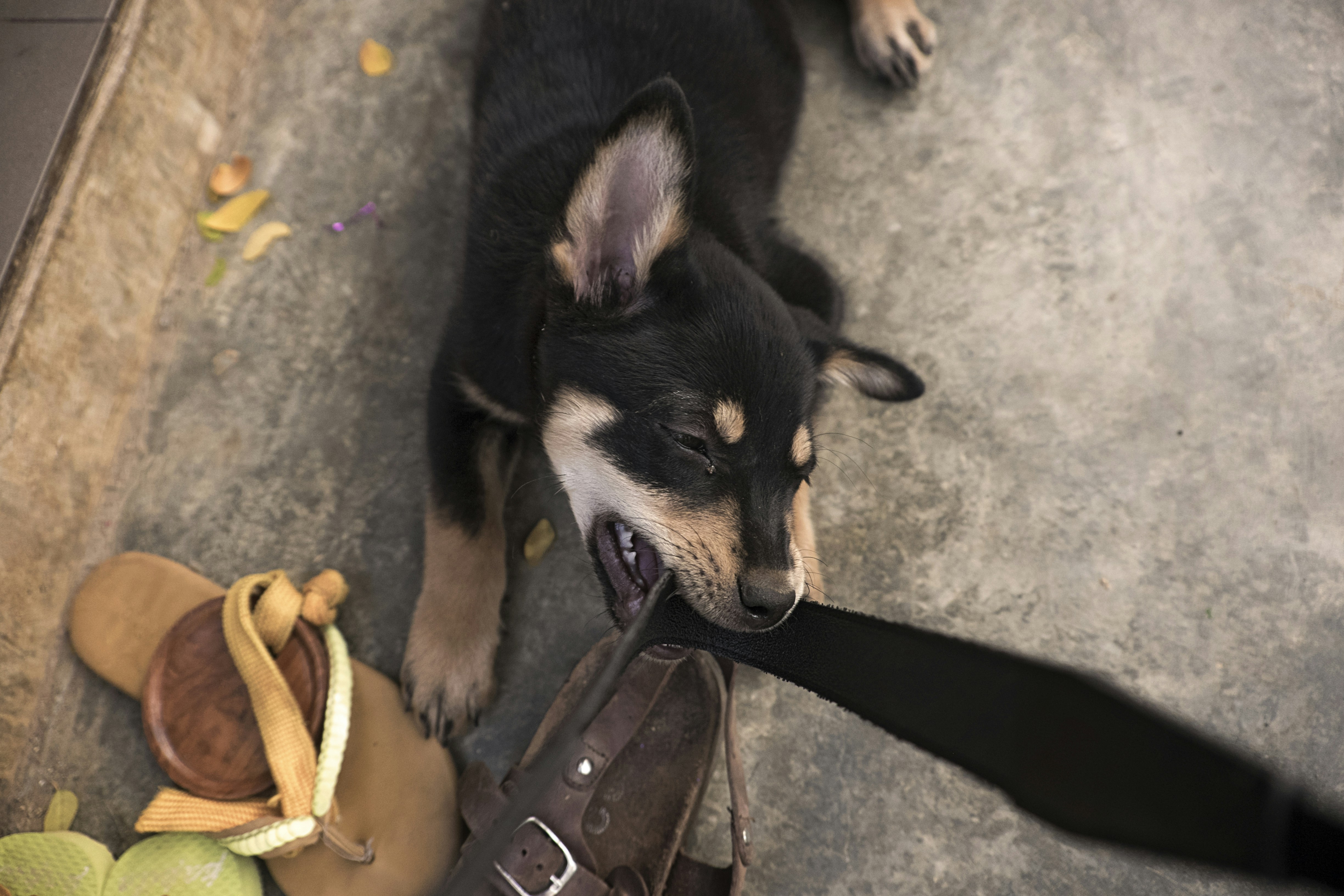
Your dog howls, chews the door frame, or wets the floor the moment you leave. Almost everyone calls that separation anxiety, and almost everyone then treats it as one condition with one solution.
The research says otherwise. A study of 762 dogs with separation-related problems found that the signs cluster into four distinct forms, driven by different emotions, and that frustration is often more important than anxiety. Treating an exit-frustrated dog as though it were panicking is one reason so many owners work for months and see nothing change.
This guide covers how to tell which form you are dealing with, what to rule out first, and what actually works.
Separation-related distress is one of five distinct problems commonly grouped under one word. See our guide to the five types of dog anxiety to confirm which you are dealing with.
How common is it?
More common than most owners realize. Estimates put it at 14 to 20% of the pet dog population, and depending on how broadly the signs are defined, studies have reported between 22.3% and 55% of the general dog population showing at least some of them. Among dogs referred to behavior specialists, separation-related problems make up 14 to 40% of cases.
It matters because the consequences are serious. This is one of the most common reasons dogs are given up to shelters or, in the worst cases, euthanised, and the distress is real for the dog as well as the household.
The finding that changes the approach
Researchers at the University of Lincoln surveyed owners of more than 2,700 dogs and analysed 54 separate signs across 762 dogs with separation-related problems.
They found seven underlying factors: exit frustration, social panic, elimination, redirected frustration, reactive communication, immediate frustration, and noise sensitivity. Those factors grouped the dogs into four distinct profiles.
Their central conclusion is the useful part for owners: separation anxiety is better understood as a symptom of underlying frustrations than as a diagnosis in its own right. Treatment plans usually focus on helping the dog cope with the pain of separation. The data suggests that dealing with the specific form of frustration matters more.
The four forms
1. Exit frustration. The dog focuses on the exit itself. Scratching and chewing at doors, digging at door frames, damaging window sills and blinds, trying to get out rather than trying to cope. The damage is concentrated at exit points, not spread through the house.
2. Redirected reactive. The dog cannot get out, becomes increasingly reactive to what it can hear outside, and takes the arousal out on whatever is available. Chewed furniture, shredded cushions, barking at every passing sound. The destruction is oral and scattered rather than aimed at doors.
3. Reactive inhibited. The quieter presentation, and the easiest to miss. The dog does not destroy much. It stays still, oriented toward the door or the window, sometimes vocalizing, sometimes not. Owners of these dogs often report no problem at all, because the house looks fine when they get home.
4. Boredom-related. The dog is not distressed by being alone so much as by having nothing to do while alone. It becomes more reactive to external events as time passes, and the frustration eventually comes out as destruction.
These are not neat boxes and many dogs show a mixture. But the distinction between a dog trying to escape, a dog with nothing to do, and a dog in genuine panic changes what you should work on first.
One overlap is common enough to check first: a dog reacting to fireworks or thunder rather than to your absence. See our guide to dogs scared of fireworks and thunder.
Rule out the imposters first
Several other problems look identical from the doorway. Working through these first saves months.
Incomplete house training. If your dog also has accidents when you are home, that is a house training gap, not separation distress. Research studies on separation anxiety routinely exclude dogs that eliminate indoors regardless of whether the owner is present, for exactly this reason. See our potty training guide.
Boredom and under-stimulation. An under-exercised young dog left for eight hours will find something to do. If the destruction is spread through the house and happens hours into your absence rather than in the first thirty minutes, this is more likely than panic.
Noise sensitivity. Some dogs are not reacting to your absence at all. They are reacting to fireworks, thunder, or building work, and your absence just means nobody is there to help. Noise sensitivity was one of the seven factors identified in the research, and it frequently travels with separation problems.
Medical causes. Sudden house soiling in an adult dog can indicate a urinary or gastrointestinal problem. Pain lowers tolerance for everything. Any behavior that changed suddenly deserves a veterinary exam before a behavior plan.
Normal puppy behavior. A twelve-week-old puppy crying when left is not disordered. It is a puppy that has never been alone in its life and has not been taught how yet.
Knowing what stress actually looks like makes the footage far more useful. Our guide to reading dog body language covers the signals to watch for.
If damage is the main sign, where it happens matters: chewing at doors and windows points here, while scattered destruction points elsewhere. See how to tell the five types of chewing apart.
Put a camera on it
This is the single most useful thing you can do, and it costs almost nothing.
Record your dog for the first forty-five minutes after you leave. Most owners have never seen what actually happens, and almost everyone is surprised.
What to look for:
- When does it start? Distress usually begins within the first thirty minutes, often the first five. Problems that begin two hours in point toward boredom.
- Where is the dog? At the door, at the window, in its bed, pacing a route?
- What is damaged, and where? Exit points suggest exit frustration. Scattered furniture suggests redirected frustration.
- Does it settle? Some dogs are frantic for ten minutes and then sleep. That is a very different picture from a dog that never settles.
- Is there panting, drooling, or pacing? These are stress signs that leave no trace on the furniture.
An intact house does not mean a calm dog
Worth stating clearly, because it is the most commonly missed part of this whole subject.
Video analyses of dogs with separation anxiety have shown that these dogs spend a significant proportion of their time in stationary orientation toward their environment, without interacting with toys or food. The active signs — destruction, barking, house soiling — are simply the ones owners can detect afterwards.
A dog that stands facing the door for two hours, not eating, not sleeping, not playing, is not fine. It just leaves no evidence.
If the main complaint is noise rather than damage, it is worth confirming which kind of barking you are dealing with first. See our guide to the six types of barking and what each one needs.
Mental work lowers baseline arousal, which supports everything else. See how to tire out a dog without walking more.
What actually helps
The approach with the best evidence behind it is systematic desensitization combined with counter-conditioning: teaching the dog, in very small steps, that your absence is unremarkable and predicts good things.
It is slow. There is no fast version, and any method promising one is suppressing behavior rather than changing how the dog feels.
1. Find the actual threshold
Not how long your dog can be left before it destroys something. How long before it shows the first sign of unease on camera.
For many dogs this is seconds, not minutes. If your dog begins to worry at ten seconds, that is your starting point. Working at five minutes because that feels like a reasonable number guarantees failure.
2. Break the departure routine
Most dogs start worrying long before you reach the door, because your keys, shoes, coat, and bag have become reliable predictors.
Uncouple them. Pick up your keys and sit down. Put your shoes on and make coffee. Put your coat on and watch television. Do this dozens of times a day until the cues stop meaning anything. This step alone visibly reduces pre-departure stress in many dogs.
3. Use a departure cue
An underused technique with good support in the clinical literature: a specific signal that means I am leaving and I will be back.
Pick something you use only for real departures — a particular phrase, or a specific chew given only when you leave. Its value comes from consistency: the dog learns that this signal reliably ends with your return, which makes unpredictable departures less alarming.
4. Build absence in tiny increments
- Walk to the door and come back. Repeat until it is boring.
- Open the door and close it. Repeat.
- Step outside for one second. Return before the dog reacts.
- Three seconds. Ten. Thirty. One minute. Two.
Vary the durations rather than climbing steadily. Thirty seconds, ten, forty-five, five. A predictable ramp teaches the dog to anticipate the point where things get hard.
Always return before distress starts. Every absence that ends in panic sets you back further than a short one moves you forward.
5. Manage absences while you train
This is the part people skip, and it is why so many plans fail.
If your dog panics for four hours every workday, twenty minutes of evening training cannot compete. For the training period, your dog should not be left beyond its threshold at all: a sitter, daycare, a neighbor, a family member, or taking the dog with you.
It is inconvenient and often expensive, and it is also the difference between progress and a year of running on the spot.
The crate question comes up constantly here and deserves a fuller answer. See crate training: what it is good for and what it is not.
The full reasoning, and how to introduce dogs properly if you do decide to, is in our guide to bringing home a second dog.
What does not work
Punishment. Coming home to damage and telling the dog off adds fear of your return to fear of your departure. Reviews of the risk factors specifically list avoidance of punishment as protective. Reward-based approaches are what veterinary behavior organizations recommend.
Getting a second dog. A common suggestion and rarely a solution. Dogs with separation-related problems are usually attached to a person, not simply lonely. You may end up with two dogs with the problem instead of one.
Crating a panicking dog. A crate helps a dog that finds it safe. For a dog with exit frustration, confinement removes the escape option it is fixated on, and dogs have injured themselves badly trying to get out. If your dog is frantic in a crate, the crate is not the answer.
Exhausting the dog first. A long walk before you leave is good practice and will not fix panic. A tired dog that is terrified is still terrified.
The blanket advice to ignore your dog completely. Low-key departures and returns are sensible. Systematically withdrawing affection is not supported and can make an anxious dog worse.
Medication: the honest picture
Owners often treat medication as a last resort or as an admission of failure. For moderate to severe cases it is neither.
Two medications are approved in the United States for this condition specifically. More importantly, a placebo-controlled trial combining fluoxetine with a behavior modification plan measured whether the dogs’ underlying emotional state improved, not just whether the behavior stopped. Dogs on the combined treatment showed a measurably less pessimistic cognitive bias, which indicates a genuine change in how they felt rather than simple suppression of the behavior.
That distinction matters. Medication is not sedation. In appropriate cases it lowers the dog’s baseline enough that the behavior work can actually get through.
It is not a standalone treatment. The evidence supports medication alongside a behavior plan, prescribed and monitored by a veterinarian who has examined your dog.
The groundwork starts on night one. See puppy crying at night for how to build alone-time without creating panic.
Prevention: what the risk factors show
A review of the research identified factors associated with developing separation-related problems, and factors that appear protective.
Associated with higher risk: being male, being sourced from a shelter or found as a stray, and being separated from the litter before 60 days of age. The evidence here is mixed rather than definitive, but the litter finding is consistent enough to be worth knowing when choosing a puppy.
Protective factors: a wide range of experiences outside the home and with other people between five and ten months of age, stable household routines, regular short absences from the dog, and the avoidance of punishment.
Read that list again if you have a new puppy. Regular short absences are protective. A puppy that is never left alone for its first six months has not been spared anything; it has simply never learned the skill. Our guide to the first month with a puppy covers how to start this from day two, in seconds.
The five-to-ten-month window overlaps with the period covered in our socialization guide, and the two jobs support each other.
When to get professional help
Sooner than most people do. Contact your veterinarian, and ask for a referral to a veterinary behaviorist, if:
- Your dog is injuring itself — bleeding paws, damaged teeth or nails, injuries from escape attempts
- The problem started suddenly in an adult dog
- There has been no improvement after six to eight weeks of consistent work
- You cannot manage absences below threshold and the dog is panicking daily
- Neighbors are complaining about sustained howling
- You are starting to think about rehoming
That last one is not an exaggeration of the stakes. Separation-related problems are among the most common reasons dogs are relinquished, and cases that get proper help early rarely reach that point.
Where individual expert help is not available, one review makes a practical recommendation worth repeating: advice to owners should be clear, simple, and contain five or fewer instructions, because complicated plans do not get followed. If your plan has fifteen steps, cut it to four you will actually do.
Free tool
Dog Training Progress Calculator
Separation-related distress takes months rather than weeks. Get a realistic range for your situation and a diagnosis if you have stalled.
What recovery looks like
Weeks to months for mild cases. Six months to a year for severe ones. Progress is not linear, and a house move, a schedule change, or a frightening event can set things back.
Realistic success is a dog that can be left for a normal working absence without distress. For some dogs, particularly those with a long history, the honest target is a dog that copes well with a managed routine — a midday visit, or daycare twice a week — rather than one that is fine with anything.
That is a good outcome. A dog whose limits are known and respected has a decent life, and so does the household.
Watch the training in action
PawMastery on YouTube — 149,000+ subscribers following along with real training sessions.
Frequently asked questions
How do I know if my dog has separation anxiety or is just bored?
Timing and location. Distress usually starts within the first thirty minutes and often the first five, and the dog focuses on exit points or on you. Boredom-related destruction tends to start later and be scattered. A camera answers this in one session.
How long can I leave my dog alone?
For a healthy adult dog with no separation problems, four to six hours is a common guideline, with a toilet break for longer. For a dog with separation-related problems, the answer is however long it can manage without distress — which may be thirty seconds at the start.
Will getting another dog help?
Usually not. These dogs are typically attached to a specific person rather than lonely in general, and you risk having two dogs with the problem.
Should I crate my dog when I leave?
Only if the crate is genuinely a safe place for that dog. For a dog fixated on escaping, confinement can make things considerably worse and cause injury.
Does my dog destroy things out of spite?
No. Dogs do not damage property to punish you for leaving. What looks like spite is panic or frustration, and the guilty look on your return is a response to your body language, not evidence of understanding.
Is medication necessary?
Not for mild cases. For moderate to severe ones, the evidence supports medication combined with a behavior plan, and a controlled trial found it improved the dogs’ underlying emotional state rather than just suppressing the signs. That is a veterinary decision.
Can an older dog develop this suddenly?
Yes, and a sudden onset in an adult dog warrants a veterinary examination first. Pain, sensory decline, and cognitive changes in older dogs can all present this way.
Do calming products work?
Evidence varies widely by product and most are weak on their own. None substitute for the behavior work. Discuss any supplement with your vet, particularly alongside medication.
My dog is fine when my partner leaves but not me. Why?
Separation-related problems are usually about a specific attachment figure rather than solitude. This is common and it is also useful information for a behaviorist.
Separation-related problems are a welfare issue and can have medical causes, particularly when they appear suddenly. This article is general information and is not a treatment plan for your dog. If your dog is injuring itself, or if there is no improvement with consistent work, speak to your veterinarian and ask for a referral to a veterinary behaviorist.
If the dog is newly adopted, some of what looks like separation anxiety in the first two weeks is ordinary settling in. Our guide to the 3-3-3 rule and the first ninety days with a rescue dog explains which is which, and why short absences should start in week one.
Sources
- de Assis et al., disambiguating separation related problems in dogs, Frontiers in Veterinary Science
- Full text of the same study, PubMed Central
- Sargisson, canine separation anxiety: strategies for treatment and management
- Karagiannis et al., fluoxetine and cognitive bias in dogs with separation-related problems, BMC Veterinary Research
- Prevalence and video-analysis findings in canine separation anxiety, PubMed Central
- Separation-related behavior and reactions to frustration or fear, Scientific Reports
- AVSAB Position Statements on Humane Dog Training