At around eight months, a lot of well-trained dogs appear to forget everything. The recall that worked reliably in the park for four months stops working. The dog that used to wait at the door now barges through it. Owners describe it almost identically every time: he knows the command, he is just ignoring me.
They are right that it is not forgetting. But it is not defiance either, and it is not a training failure. It is a documented developmental stage, and there is now direct evidence for something trainers had only observed anecdotally: the dog is not ignoring everyone. He is ignoring you.
The research: obedience drops at eight months, and mostly for one person
A 2020 study in Biology Letters tested this directly, using two datasets from a guide dog population.
The first was a behavioral test. Dogs were asked for a sit cue at five months and again at eight months — 82 dogs at the earlier point, 80 at the later one, 69 of them tested at both. The cue was given by the dog’s own carer and, separately, by a stranger.
The second was a questionnaire covering 285 dogs (Labradors, golden retrievers and German shepherds), rating trainability at 5, 8 and 12 months.
Three findings came out of it.
Compliance dropped at eight months. The odds of a dog repeatedly failing to respond to the sit cue were roughly twice as high at eight months as at five (odds ratio 2.14).
The drop was specific to the carer. Over the same period, the dogs’ response to the same cue from a stranger actually improved. Carer-rated trainability fell between five and eight months, while ratings from the training supervisor — who knew the dogs less well — did not follow that pattern.
It reversed. By twelve months, carer-rated trainability was higher than it had been at five months. That is the part worth holding on to: in the same dogs, measured the same way, the dip closed and then some.
That second detail is the useful one, because it reframes the most demoralising part of the experience. If your dog performs beautifully for the trainer at class and treats you like furniture on the walk home, the standard explanation offered is that you are inconsistent, or too soft, or lack authority. The data suggests something narrower and far less personal: adolescent conflict behavior is aimed at the attachment figure. Human teenagers do the same thing. The friction is with the parent, not with the world.
The same study also reported that females showing more attachment and attention-seeking behavior toward their carer at five months reached puberty earlier, echoing a pattern described in human developmental research. General anxiety showed no such association.
When it starts, and when it ends
Adolescence in dogs is governed by size far more than by breed temperament, because size determines how long the growth and maturation period runs.
- Small breeds (under 10 kg): puberty around 6 months, socially mature by roughly 12 months. The phase is short and often mild enough that owners barely name it.
- Medium breeds: puberty 6–9 months, settling somewhere between 14 and 18 months.
- Large and giant breeds: puberty 9–14 months, and social maturity not until 18–24 months. For some giant breeds the whole business runs closer to three years.
For most owners the difficult stretch is 8 to 14 months. The common advice that dogs “calm down at two” is roughly accurate for a Labrador and badly misleading for a terrier, whose owner will have been through the worst of it by ten months.
Worth separating two things that get conflated: sexual maturity and social maturity. A nine-month-old male is sexually mature and behaviorally nowhere near finished. The gap between those two points is precisely where the trouble lives.
What it actually looks like
The presentation is consistent enough that most owners recognize four or five of these:
The recall goes first. Almost always the first casualty, and usually the most alarming, because it is the cue with real safety consequences.
Latency rather than refusal. The dog does not flatly ignore “sit”. He looks at you, pauses, looks away, sniffs something, and then sits four seconds later. That delay is the measurable signature of this phase.
New fear of familiar things. A wheelie bin that has stood in the same spot for six months suddenly becomes suspicious. A statue, a drain cover, a man in a hat.
Leash behavior deteriorates. Pulling returns in a dog that had learned to walk nicely, and for some dogs this is when barking and lunging at other dogs appears for the first time.
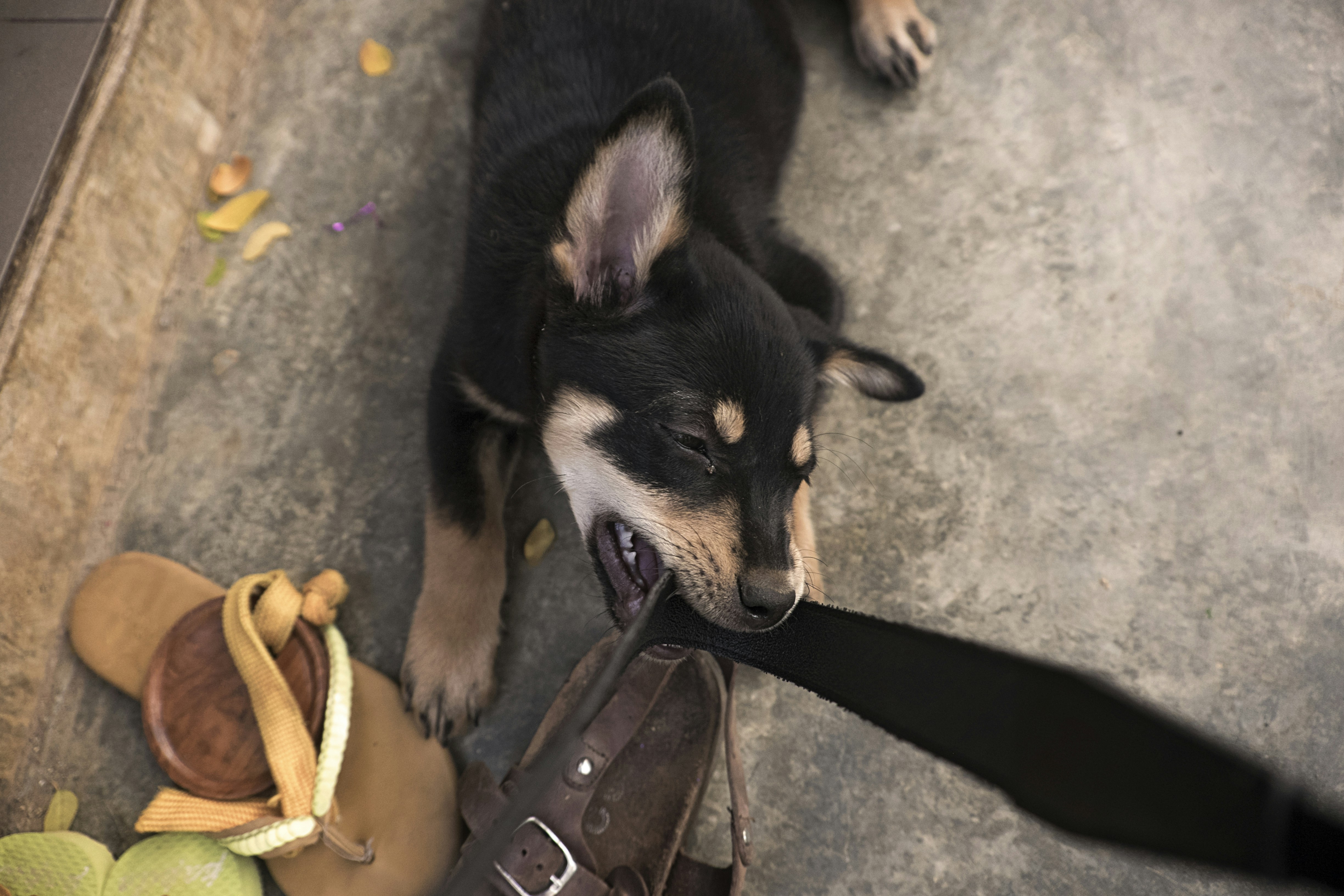
Boundaries get tested at home. Counter surfing, jumping up, stealing, and door barging come back after months of good manners.
Interest in the environment outcompetes you. Scent, other dogs, and in intact dogs the hormonal pull, all become more rewarding than anything in your pocket.
None of these mean the earlier training was wasted. Behavior learned before adolescence is not deleted. It is outbid.
Why recall collapses before anything else
Recall is the most expensive behavior you will ever ask for, because it always competes directly against the environment. Every other cue is asked for in a relatively quiet moment. Recall is asked for at the exact instant something more interesting is happening.
Through puppyhood, the environment is not yet that interesting and your food is. At eight months that ratio inverts. The cue has not degraded; the competition has improved.
Which leads to the single most damaging habit of this period: calling a dog you are going to lose. Every recall cue that goes unanswered is a repetition teaching your dog that the word is optional, and adolescent dogs are efficient learners of exactly that lesson. If you are not confident of the outcome, do not use the word. Go and get the dog instead, silently, and put the long line back on. Our guide to building a reliable recall covers the rebuild in detail.
The “second fear period”: what is solid and what is repeated
You will find a lot of confident writing about a second fear period between roughly 6 and 14 months. It is worth being honest about the evidence here, because the two claims are not equally supported.
The primary socialization window in early puppyhood is well established in the research literature, with a clear neurological basis and clear consequences for missing it. A discrete, universal second fear window in adolescence is a much weaker claim. It comes largely from clinical observation and is repeated as settled fact more often than the evidence justifies.
What is documented is that fears frequently emerge or intensify during the first two years, and that noise sensitivities in particular tend to generalize and worsen over time when left untreated. Whether that constitutes a discrete developmental window or simply the age at which underlying sensitivities surface is not resolved.
Practically, it makes no difference to what you should do. When something frightens an adolescent dog, do not flood him with it, do not drag him toward it, and do not laugh it off. Increase distance, pair the thing with food, and let him approach on his own terms. Our breakdown of the five types of dog anxiety is useful for working out whether what you are seeing is a passing wobble or something that needs a real plan.
The mistake that turns a phase into a problem
The instinct, when a dog that used to listen stops listening, is to get firmer. More insistent voice, a hand on the collar, a stronger correction, perhaps a piece of equipment that makes non-compliance uncomfortable. The reasoning is that the dog knows the cue and is choosing not to comply, so compliance must be enforced.
This is the worst possible moment for that approach, for two reasons.
The first is what confrontational handling does generally. A survey of owners at a veterinary behavior referral clinic found that confrontational techniques — hitting or kicking, alpha rolls, growling at the dog, staring it down, physically forcing objects out of its mouth — produced an aggressive response in a substantial proportion of the dogs they were used on. Non-confrontational methods rarely did.
The second is timing. The research above suggests adolescent conflict behavior is already directed at the primary caregiver. Escalating means adding conflict to a relationship that is, developmentally, already the flashpoint. You are making yourself less pleasant to be around at the precise age when the dog’s willingness to be around you is what you are trying to preserve.
This is not a fringe concern. A systematic review and meta-analysis of why dogs are surrendered to shelters found behavior problems among the most commonly reported reasons, and adolescence is the stage at which those problems typically surface — usually not because the dog was untrainable, but because a temporary phase was read as a permanent character flaw. If you want the evidence comparison in full, see our review of what the research actually shows about training methods.
What to do for the next six months
The goal in adolescence is not progress. It is preservation. You are trying to arrive at eighteen months with the cues, the relationship and the habits intact. Anything you gain on top of that is a bonus.
Put the long line back on, and leave it on
Not for two weeks. For three to six months. A fifteen-meter line on a harness gives your dog most of the freedom of off-lead time while removing your ability to lose a recall repetition. This one decision prevents more damage than everything else on this list combined.
Cut the number of cues you use
Pick four that matter — typically recall, a sit or down, a leave it, and a settle — and stop asking for anything else for a while. A small set of cues you can pay for and enforce beats a large set that are all quietly eroding. Our guide to leave it and drop it covers the two that matter most for safety.
Start paying again
Most owners phase out food by six months because the behavior looks finished. Then it stops working and they conclude the dog is being stubborn. Go back to paying for known behaviors, generously, with better food than you used at four months. You are not bribing a finished dog. You are outbidding a substantially more interesting environment.
Manage rather than test
If the counter is a problem, clear the counter. If the bin gets raided, move the bin. Adolescence is not the time to prove a point about what your dog should be able to resist. Every successful raid is a self-reinforcing repetition; you cannot out-train an environment that pays.
Shorten sessions and protect sleep
Adolescent dogs still need a great deal of sleep, and an overtired adolescent looks almost exactly like a badly behaved one: frantic, mouthy, unable to settle, unresponsive to cues that worked yesterday. Owners frequently respond to this by adding exercise, which makes it worse. Two five-minute training sessions beat one twenty-minute one, and a dog that is chewing furniture at seven in the evening usually needs a nap rather than another walk. See how to tire out a dog without walking more.
Puppy socialization is about positive exposure. Adolescent socialization is about neutrality. Your dog does not need to greet every dog he sees — and at this age, forced greetings are a common route into leash reactivity. Walk past at a distance he can cope with, pay him for noticing and disengaging, and let the interaction not happen. Our practical guide to socialization and reactivity goes further on distance work.
Does neutering fix it?
It is the most common suggestion an owner receives at this stage, and the evidence does not support it as a behavioral intervention.
A large analysis of C-BARQ data on male dogs found that those with minimal lifetime exposure to gonadal hormones scored higher on fear and aggression-related items, not lower. Neutering is reasonably associated with reductions in a narrow set of hormone-driven behaviors — roaming, some forms of intermale aggression, marking — and it is a legitimate decision for other reasons entirely. But an eight-month-old that ignores recall, pulls on the leash and barks at other dogs is not displaying a hormonal problem. He is displaying an adolescent one, and removing the hormones will not remove the adolescence.
Timing is also a separate veterinary conversation, particularly for large breeds where early neutering has been associated with orthopedic risk. Decide it on health grounds with your vet, not as a substitute for a training plan.
When it is not adolescence
Some things that appear at this age are not developmental and should not be trained through.
- Behavior that changed over days rather than weeks. Sudden change is a veterinary question first.
- Growling or snapping during handling, grooming, or when touched in one particular place. Pain is common, treatable and routinely missed.
- Guarding that is escalating rather than static. See why the common advice on resource guarding backfires.
- House-training regression with increased frequency or drinking. Check for a urinary tract infection before assuming it is behavioral.
- Fear that is worsening week on week despite sensible handling.
If you need outside help, note that dog training is an unregulated profession in most countries. Our guide to choosing a trainer covers what credentials actually mean.
Frequently asked questions
Why has my 7-month-old suddenly stopped listening?
Because he has entered adolescence. Responsiveness to familiar cues measurably declines around eight months, and the decline is strongest with the person the dog is most attached to. It is developmental, it is temporary, and it is not a sign that your earlier training failed.
How do I train an 8-month-old puppy?
Shorter sessions, higher-value food, a long line for anything involving recall, and a deliberately small list of cues. Aim to maintain what you have rather than add new skills. This is a holding period, and treating it as one takes the pressure off both of you.
Is a 9 or 10-month-old dog still a puppy?
Physically he is close to full height; behaviorally he is an adolescent, which is a distinct stage. Training a ten-month-old is not the same job as training a ten-week-old — the attention span is longer but the willingness to comply is lower. For the earlier stages, see our puppy training schedule from 8 weeks to 12 months.
At what age do dogs calm down?
Small breeds around 12 months, medium breeds 14–18 months, large and giant breeds 18–24 months and sometimes later. Energy level and settling are not the same thing: a two-year-old collie is socially mature and still needs a job.
How long does the adolescent phase last?
Typically six to ten months from onset. The most difficult stretch for most owners is 8 to 14 months.
Should I go back to basics?
Yes, and without treating it as a setback. Retraining a cue in a quiet room at nine months takes days, not weeks, because the dog already knows it. What needs rebuilding is the reinforcement history in difficult environments, and that is normal maintenance rather than starting over.
Do female dogs go through this too?
Yes. It is often less obvious in females, and in intact females behavior can shift noticeably in the weeks around a season, including temporary changes in appetite, clinginess and tolerance of other dogs.
Is my dog trying to dominate me?
No. Dominance-based explanations of adolescent behavior have no support in the current evidence, and the handling techniques that follow from them are the ones most likely to produce a defensive response. What you are seeing is a normal developmental stage in an animal whose brain has not finished maturing.
The short version
Your dog has not forgotten his training and has not decided you are beneath him. He is eight months old, his responsiveness to you specifically has dipped, and it will come back. Keep the long line on, pay well, manage the environment, protect his sleep, and stay pleasant to be around. In six months you will have the dog you were building, provided you do not damage the relationship trying to force him to be that dog today.
This article is general educational information, not a treatment plan for an individual dog. For aggression, self-injury, or any behavior that changed suddenly, speak to your veterinarian and ask for a referral to a veterinary behaviorist.
Sources
- Asher, England, Sommerville & Harvey, Teenage dogs? Evidence for adolescent-phase conflict behavior and an association between attachment to humans and pubertal timing in the domestic dog, Biology Letters 16 (2020)
- Herron, Shofer & Reisner, survey of the use and outcome of confrontational and non-confrontational training methods, Applied Animal Behaviour Science 117 (2009)
- McGreevy et al., behavioral risks in male dogs with minimal lifetime exposure to gonadal hormones may complicate population-control benefits of desexing, PLOS ONE 13 (2018)
- Lambert, Coe, Niel, Dewey & Sargeant, systematic review and meta-analysis of the proportion of dogs surrendered for dog-related and owner-related reasons, Preventive Veterinary Medicine 118 (2015)
- Blackwell, Bradshaw & Casey, fear responses to noises in domestic dogs
- AVSAB Position Statements on Humane Dog Training