Almost every guide on this subject makes the same mistake: it treats “my dog hates the car” as one problem.
It is at least three, they look nearly identical from the driver’s seat, and the treatment for one will make another worse. Feeding treats to a nauseous dog does not build a positive association — it builds a stronger association between your car and vomiting.
Working out which one you have is most of the job.
Short answer: find out first whether your dog feels sick or feels frightened, because the fixes are opposites. Sickness starts once the car is moving and is treated with your vet before any training. Fear shows up while the car is still parked and is treated by feeding near it, then in it, in eight small stages. If your dog will not take food, you have moved too fast. A dog that suddenly refuses a car it used to accept needs a vet appointment before a training plan.
The three problems, and how to tell them apart
1. Motion sickness
A physical problem. The vestibular system — the balance apparatus of the inner ear — is not fully mature in young dogs, which is why puppies are affected far more often than adults and why many simply grow out of it.
What it looks like: drooling, lip licking, repeated swallowing, yawning, then vomiting. It builds during the journey and it is worse on winding roads.
The tell: your dog is fine getting into the car. The trouble starts once you are moving.
2. Car anxiety
An emotional problem.
What it looks like: refusing to get in, trembling, whining, pacing, panting, sometimes barking at passing traffic. It is at its worst before and at the start of the journey, and often eases once you are underway.
The tell: your dog resists the car while it is stationary. Nausea does not do that.
3. Both, in sequence
The most common case in adult dogs, and the reason so many owners think their dog “got worse with age”.
A puppy is sick in the car a few times. It grows out of the motion sickness — but by then it has learned that the car predicts feeling terrible. The physical problem resolved; the learned association did not.
The tell: your dog was sick as a puppy, no longer vomits, but now refuses to get in.
4. Worth ruling out: pain
Jumping into a car is a demanding movement for a dog with sore hips, elbows or a spine. A dog that suddenly resists the car it used to love may be telling you the jump hurts, not that it is frightened.
There is a documented association between musculoskeletal pain and behavior problems, and around a third of dogs referred for behavior work have a painful condition. Any sudden change in an adult dog is a veterinary question before it is a training one.
Reading the signals
Owners usually describe the same handful of behaviors, and each one points somewhere specific.
| What you see | When | Most likely | What to do first |
|---|---|---|---|
| Heavy drooling, repeated swallowing | Once moving | Motion sickness | Vet appointment; no food games yet |
| Plants its feet, will not approach | Car parked | Fear, or pain on the jump | Rule out pain, then start at stage one |
| Trembling and panting that eases once underway | Start of the trip | Anxiety | Short below-threshold sessions |
| Barking or lunging at passing traffic | Mid-journey | Arousal or frustration | Block the side view; crate or cover |
| Silent, still, flat, will not eat | Whole trip | Shutdown, often mistaken for calm | Treat as severe fear; drop several stages |
| Fine on the way out, distressed on the way back | Return leg | Destination learning | Change what the trips predict |
| Hesitates only with the tailgate, fine at the side door | Loading | Height and joints | Use a ramp; ask your vet about pain |
The fifth row is the one most often misread. A dog that has gone quiet and stopped eating is not settling in; it has stopped coping. Refusing food is the single most useful measurement you have.
Why the distinction changes everything
| Motion sickness | Car anxiety | |
|---|---|---|
| Feed treats in the car? | No — makes it worse | Yes — central to the fix |
| Short practice trips? | Only after treatment | Yes, essential |
| Fix the vestibular side first? | Yes — with your vet | Not applicable |
| Usual timeline | Often resolves with age or medication | Weeks to months of work |
That first row is the one that matters. Pairing food with nausea is taste aversion — one of the most robust forms of learning there is, and it works in the opposite direction to everything you intended.
If it is motion sickness
Start with your vet. There are licensed anti-nausea medications for dogs, and this is one of the clearest cases where medication is the efficient first step rather than a last resort. Treating the nausea stops the negative association forming while you do the behavioral work.
Practical measures that genuinely help:
- Forward-facing. A dog facing sideways gets far more conflicting visual and vestibular input.
- Able to see the horizon. Same reason people are told to look at the horizon on a boat.
- Cool and ventilated. Heat makes nausea considerably worse.
- Empty stomach — skip the meal before traveling, but not water.
- Smooth driving. Gentle acceleration and early braking. It sounds trivial and it is not.
- Short and frequent rather than long and occasional.
Do not use food games until the nausea is controlled.
Free tool
Not sure whether your dog is nauseous or frightened? Tick the signals you can see — drooling, lip licking, freezing, weight shifted back — and get a weighted reading across six states.
Setting the car up before you start
Half the difficulty in this problem is environmental, and it is fixable in an afternoon.
- Give the dog a fixed spot. A crate or a harnessed position in the same place every trip. Sliding around a back seat makes both nausea and fear worse.
- Cut the side view, keep the forward view. A crate cover on the sides with the front open reduces the moving-scenery problem without leaving the dog in a box.
- Non-slip footing. A rubber mat or a bath mat under the bedding. Feeling the floor slide under you is unpleasant for any animal.
- Ventilation before air freshener. Strong scents in an enclosed space are a genuine irritant for a nose far better than yours.
- Get the temperature down before loading. Two minutes with the air conditioning running beats a dog panting in a hot car for the first five miles.
- A ramp for anything with height. Tailgates on modern cars are high, and repeated jumping is hard on joints even in a dog with no diagnosis.
If it is car anxiety
The protocol is the same one used for any conditioned fear: work below threshold, pair the trigger with something excellent, and increase difficulty only when the association has visibly shifted.
The mistake almost everyone makes is starting at step four.
The eight stages
Stage 1 — the car exists. Feed your dog its meal near the car. Engine off, doors shut. Several days, until the car is boring.
Stage 2 — doors open. Open the doors, feed nearby, do not ask your dog to approach. Let it choose.
Stage 3 — food in the car, dog outside. Scatter food on the sill and floor. Your dog eats with its feet on the ground. Do not lure it in.
Stage 4 — front feet in. Whenever your dog offers this itself, mark and pay. If it does not offer, you are moving too fast.
Stage 5 — in the car, doors open. Feed, then let your dog get out immediately. The exit staying available is what makes this work.
Stage 6 — doors closed, engine off. Ten seconds. Then twenty. Build slowly.
Stage 7 — engine on, not moving. Many dogs find the engine noise and vibration the hardest part. Feed, engine off, out.
Stage 8 — move, barely. To the end of the drive and back. Then round the block. Then somewhere good.
The rule that makes or breaks it
If your dog will not take food at any stage, you have gone too far. Drop back a stage. That test is more reliable than watching for trembling, because many anxious dogs go quiet and still rather than obviously distressed.
Puppies: the easiest version of this problem
Nearly every adult dog with a car problem started as a puppy whose first journeys went badly. Prevention costs a fraction of the effort of treatment.
Make the first trips short, frequent and pointless. Five minutes around the block, ending back at home, several times a week. A puppy whose first ten car journeys all ended somewhere neutral has no reason to build a prediction.
Feed meals in the stationary car during the first weeks, with the engine off, so the vehicle is a place where good things happen before it is a place that moves. If your puppy is being sick, stop the training side and speak to your vet, because a few sick journeys are exactly how the learned version of this problem gets built.
And spread the destinations early: the vet, a friend’s house, a field, the sidewalk outside a store. A puppy that only ever rides to the clinic learns exactly what the car means.
Break the destination pattern
This is the piece owners most often miss, and it is the same mechanism that ruins recall.
If the car reliably ends at the vet, the groomer or the kennels, your dog is not frightened of the car. It is frightened of what the car predicts — and it has learned that correctly.
The fix costs nothing. For every trip to somewhere your dog dislikes, make five that end somewhere good: a field, a friend’s house, or simply back home. Some trips should end at your own front door with nothing happening at all.
The same logic applies to your vet. Ask whether you can bring your dog in occasionally to be weighed and fed treats without an examination. Most practices are happy to, and it changes what the whole journey predicts.
Safety, which is not optional
An unrestrained dog is a projectile in a collision, and a hazard to the driver before that.
- A crash-tested crate or harness. Independent crash testing exists for pet restraints, and most products on sale have not passed any. Look for testing by a recognized body rather than a claim on the box.
- Never in the front seat where an airbag can deploy.
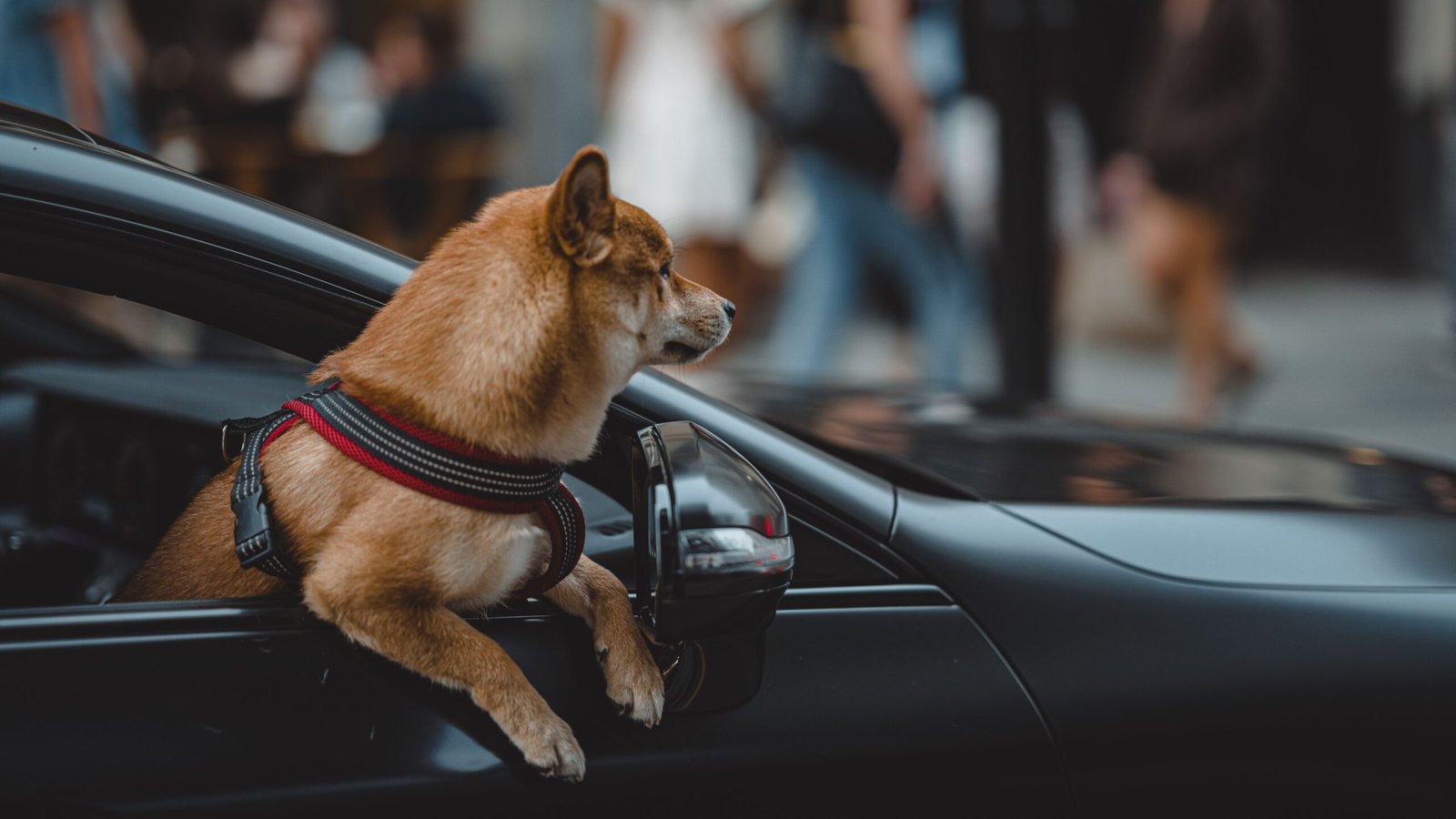
- Never with a head out of the window — eye injuries from debris are common and avoidable.
- Never left in a parked car in warm weather. Cars heat far faster than owners expect, and a window cracked open changes very little.
- Never restrained by the collar — a harness or crate spreads the load. A collar under crash forces does not.
A crate also helps the behavior side: a dog that cannot see moving scenery through side windows often travels better.
Planning a long journey
Most owners only think about this the night before a move or a vacation, which is the worst time to discover the dog cannot cope.
- Build up over weeks, not days. If the longest trip your dog has done is ten minutes, a four-hour drive is not a test, it is a setback waiting to happen.
- Stop every two to three hours for a toilet break, water and a short leg stretch on leash. Never open a door without a leash already attached.
- Skip the meal before departure but never the water. Offer small amounts at each stop rather than a bowl in the footwell.
- Pack the boring essentials within reach: paper towels, enzymatic cleaner, spare bedding, a leash, a bowl, and the dog’s own blanket.
- Carry ID and paperwork. A collar tag with your phone number and a microchip registered to a current address matter most on the one day something goes wrong.
- Never leave the dog in the parked car. Not for a coffee stop, not with a window cracked, not in mild weather. Plan stops where someone stays with the dog.
What makes it worse
- Forcing your dog in. Lifting a frightened dog into a car confirms that the car is something done to it.
- Long journeys before short ones. Do not test progress with a two-hour drive.
- Food games during nausea. As above — it builds the opposite association.
- Reassuring anxiously. Calm company helps; high-pitched fussing tells your dog something is wrong.
- Punishing barking at traffic. That is usually arousal or fear, and adding a correction to it makes both worse.
- Sedating without veterinary advice. Some sedatives immobilize a dog without reducing its fear, which is a welfare problem rather than a treatment. This is a conversation with your vet.
Realistic timelines
- Motion sickness alone: often manageable immediately with veterinary treatment, and many puppies outgrow it by around a year.
- Mild car anxiety: two to six weeks of short daily sessions.
- Established avoidance: two to six months. You are changing an emotion, not teaching a skill.
- Both together: treat the nausea first, then start the stages. Trying to do both at once is why people stall.
Troubleshooting
The dog gets in willingly but panics once the door shuts. The door is the trigger. Work on it alone: shut for one second with the dog eating, open again. Build in seconds.
It travels fine with one person and badly with another. Usually driving style rather than the person. Gentle acceleration, early braking and wider cornering change the experience more than anything else in this article.
Progress stalls at the engine-on stage. Common. Split it: keys in, then engine on for two seconds, then five. Some dogs need the engine started while they are still outside the car first.
It was improving and has gone backwards after one bad trip. One frightening journey can undo several weeks. Drop back three or four stages, rebuild quickly, and avoid real journeys during the rebuild.
The dog vomits only on the return leg. Often exhaustion and arousal after an outing rather than motion sickness. Give it twenty minutes to settle before loading, and offer water rather than food.
Nothing has changed after six weeks. Stop repeating the plan and get a professional assessment. Persistent panic that does not respond to careful desensitization is worth a conversation with your vet about combining behavior work with medication.
When to see a vet
- Any sudden reluctance in a dog that previously traveled fine
- Vomiting that continues on short journeys
- Difficulty jumping in, or stiffness afterwards
- Panic severe enough that your dog injures itself or cannot be settled
- Drooling or nausea with no travel involved
- Before using any sedative or anti-nausea product, including anything sold over the counter
Watch the training in action
PawMastery on YouTube — 149,000+ subscribers following along with real training sessions.
Frequently asked questions
How do I know if my dog has motion sickness or car anxiety?
Watch when the signs start. Motion sickness builds once you are moving, with drooling and swallowing. Anxiety shows before you set off — refusing to get in, trembling, whining while the car is still stationary.
Do dogs grow out of car sickness?
Many do. The inner ear balance system is not fully mature in puppies, which is why they are affected more often, and a large proportion improve with age. The learned fear that follows does not resolve on its own.
Should I feed my dog before a car journey?
Not immediately before, if there is any nausea. Skip the meal but leave water available. For pure anxiety with no sickness, food in the car is central to the treatment.
Why does my dog bark at cars through the window?
Usually arousal or frustration at movement it cannot reach. Blocking the view with a crate cover or traveling in a crate resolves most of it.
Is it safe to let my dog put its head out of the window?
No. Debris causes eye injuries, and an unrestrained dog near an open window is a serious risk in a sudden stop.
What is the safest way for a dog to travel in a car?
A crash-tested crate or harness, in the rear, never in the front seat where an airbag can deploy. Many products claim safety without independent testing, so look for a recognized testing body.
Can I sedate my dog for car journeys?
Only on veterinary advice. Some sedatives reduce movement without reducing fear, which leaves a frightened dog unable to express it. Modern anti-anxiety and anti-nausea options are a discussion with your vet.
How long does it take to fix car anxiety?
Two to six weeks for mild cases, two to six months where a dog has been refusing the car for a long time. Progress is not linear.
Should I use a crate or a harness?
Either, if it has been independently crash tested. A crate has the added advantage of limiting the side view, which helps both nausea and traffic barking. A collar is never a restraint.
Do calming sprays, collars or supplements work?
Evidence is mixed and none of them substitute for the training stages. If you try one, keep everything else the same for a couple of weeks so you can tell whether it changed anything.
My dog is fine on the way to the park and terrible on the way home. Why?
Because the return trip predicts the end of something good, and often follows a lot of physical excitement. Let the dog settle before loading and make some trips end at home with something pleasant waiting.
How short should the first moving trip be?
To the end of the driveway and back. If that sounds absurd, it is the right length. The first moving repetition should be so brief the dog barely registers it.
Can I train this on my own or do I need help?
Mild cases respond well to the stages at home. Get qualified help if your dog panics, injures itself, or if six weeks of careful work has produced nothing, and involve your vet whenever pain or nausea could be part of it.
Sudden reluctance to travel in a dog that previously coped, ongoing vomiting, or difficulty jumping into a car can all indicate pain or illness and need a veterinary appointment. Never give any sedative or anti-nausea product without veterinary advice.
Sources
- Mills et al., pain and problem behavior in cats and dogs, Animals
- AVMA: traveling with your pet
- ASPCA: travel safety tips
- Center for Pet Safety — independent crash testing of pet restraints
- Herron et al., confrontational and non-confrontational training methods
- AVSAB Position Statements on Humane Dog Training