The way most people introduce two dogs is the way most introductions go wrong: bring the new dog through the front door, let them sniff each other in the hallway, and hope.
That is the worst version of every variable at once — a confined space, a resident dog on its own territory, no room to retreat, and two animals meeting face to face while people hover anxiously above them.
Done properly, the first meeting happens somewhere neither dog owns, side by side rather than nose to nose, and it is deliberately boring.
Short answer: introduce the dogs on neutral ground with two handlers and loose leashes. Start with a parallel walk twenty to thirty yards apart rather than a face-to-face greeting, keep the first sniff to about three seconds, and go home together only after both dogs have walked calmly side by side. For the first two weeks, separate them behind a gate every time you leave the room, and feed them in different rooms permanently. Most pairs need four to eight weeks to settle.
Before the dogs meet at all
Be honest about your resident dog. A dog that already struggles with other dogs on the leash is unlikely to enjoy one living in its house. That is not a reason never to do it, but it changes the plan and usually means professional help. See our guide to leash reactivity.
Have a vet check both dogs. Pain lowers tolerance for everything, and a resident dog with an undiagnosed sore hip will not welcome a bouncy newcomer. Around a third of dogs referred for behavior work have a painful condition.
Set the house up first, not after. Two beds in separate rooms. Two water bowls. Baby gates already fitted. Feeding stations in different rooms with doors that close. If you improvise this in week one, you will improvise it badly.
Remove every high-value item before the new dog arrives. Chews, bones, favorite toys, anything the resident dog has ever guarded. They come back later, one at a time, in separate rooms.
The first meeting
1. Neutral ground. Not your garden, not outside your front door. A quiet park, a field, a parking lot — somewhere the resident dog has no history of defending.
2. Two handlers, two leashes, loose. Tension in the leash transfers straight to the dog, and a taut leash prevents the normal curving approach dogs use with each other.
3. Start with a parallel walk at distance. Twenty or thirty yards apart, walking in the same direction. No greeting at all. This is the step people skip and it is the one that does most of the work.
4. Close the gap gradually across the walk. Fifteen yards, then ten, then five. Watch the bodies rather than the distance.
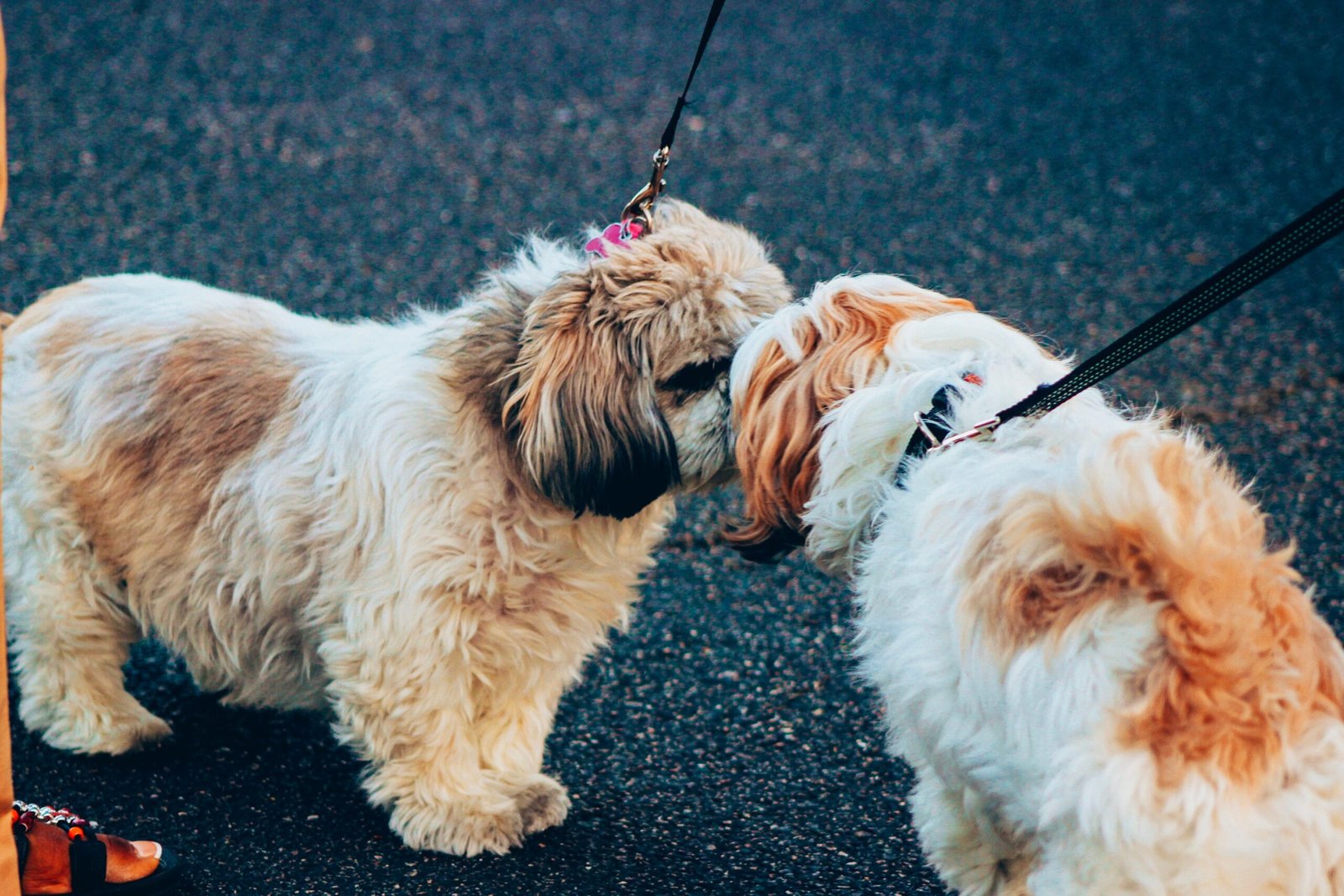
5. Allow a brief sniff, then move on. Three seconds, then both handlers walk on cheerfully. Ending the greeting early is what keeps it good — long face-to-face greetings are where things sour.
6. Repeat over several walks if you can. Two or three parallel walks before anyone goes home together is not excessive.
What good looks like
Loose, curved approaches. Sniffing then disengaging. Play bows. Bouncy, inefficient movement. One dog walking away and the other not following.
What to interrupt calmly
Stiff, still bodies. A hard stare. One dog standing over the other’s shoulders. Raised hackles combined with a frozen posture. One dog repeatedly trying to leave and being followed. Our guide to reading dog body language covers the signals in detail.
Interrupt by calling both dogs away cheerfully and walking on — not by grabbing collars, which is how handlers get bitten in a moment of tension.
Coming home
Walk in together after a long walk, both dogs tired, and let the new dog in first if your resident is territorial at the doorway.
Nothing valuable on the floor. No chews, no toys, no food bowls out.
Let them ignore each other. Dogs that are allowed to co-exist without interacting settle faster than dogs pushed to interact.
Separate the moment you leave the room. Gates and closed doors for the first two weeks, every single time. Most serious incidents between household dogs happen unsupervised.
Feeding, and the mistake that causes most fights
Feed in separate rooms with the doors closed, from day one, indefinitely. Not side by side, not at opposite ends of the kitchen.
This is the single most effective piece of prevention available, and it costs nothing. Resource guarding between household dogs is common, normal, and almost entirely avoidable through management. Our guide to resource guarding covers what the research shows.
The same applies to chews. Two dogs with two bones in one room is not sharing practice — it is an argument waiting for a trigger.
The first 48 hours at home
The meeting gets all the attention, but the two days that follow set the pattern.
- Leave a light leash trailing on the new dog indoors while you are watching. It gives you something to guide with instead of grabbing a collar, which is where handlers get bitten.
- Show the new dog the house without the resident dog present. Let it find the water bowl, the yard and the door on its own, then swap the dogs over.
- Sleep them separately. Different rooms, or crates in the same room with a barrier between. Two dogs loose together overnight in week one is the single most common way a good introduction goes wrong.
- Keep visitors away. A new dog, a resident dog and three excited guests is too many variables.
- Expect toileting accidents from both. The resident dog may mark indoors; that is stress and novelty, not defiance, and it settles.
- Do not test them. Owners often drop a toy between the dogs on day two to see what happens. You already know what might happen, and you gain nothing by finding out.
The first two weeks
- Walk them separately as well as together. The new dog needs to bond with you, not only with the other dog.
- Give the resident dog time alone with you. Same walks, same training sessions, same sofa time. A resident dog whose routine collapses overnight has good reason to resent the newcomer.
- Do not force sharing. Separate beds, separate crates, separate spaces. They can choose to share later.
- Expect the honeymoon to end. Many pairs are perfect for a week and start testing boundaries in weeks two to four. That is normal, and it is when management matters most.
- Keep training separate at first. Two dogs learning a new cue in the same room is competition, not training.
A realistic four-week plan
Introductions fail more often from rushing week two than from getting day one wrong. This is the shape of a normal, uneventful month.
| Stage | What the dogs do | What you manage | Sign you have moved too fast |
|---|---|---|---|
| Day 1 | Parallel walk, brief sniff, then home together after exercise | Nothing on the floor, leashes stay on indoors, gates already fitted | Either dog freezes or refuses to move |
| Days 2–3 | Share space calmly while ignoring each other | Separate feeding and sleeping, supervised time only, short sessions | One dog shadows the other constantly |
| Week 1 | First voluntary interactions, short play | End play before it peaks; separate whenever you leave the room | Play that stops being mutual, or one dog trying to leave |
| Week 2 | Boundary testing. Often looks worse than week one | Hold every rule. This is not the week to relax management | Stiff standoffs near doorways, beds or you |
| Weeks 3–4 | A routine forms; each dog picks its own spots | Begin longer unsupervised windows only if week two was quiet | Any incident at all resets the clock |
Note the shape: things usually get slightly harder before they get easier. Owners who read week two as failure often either give up or push the dogs together to force a friendship, and both reactions make it worse.
Puppy meets adult dog
A different situation and the risks run the other way.
The adult needs protecting from the puppy, not the reverse. Puppies are relentless, and an adult dog that has been pestered for hours with no escape eventually snaps — which teaches the puppy to fear other dogs and teaches the adult that you will not intervene.
Give the adult a puppy-free zone it can access at any time, and enforce it.
Interrupt before the adult has to. If the puppy is being ignored and keeps escalating, that is your cue, not the adult’s.
A growl from the adult is appropriate communication, not aggression. Do not punish it. An adult that is punished for growling at a pestering puppy will skip the growl next time. Our guide to puppy biting covers the wider picture.
If your resident dog is elderly, read senior dog behavior changes first — a relentless puppy and an arthritic senior is a common source of conflict.
Common problems in the first month
The new dog follows the resident dog everywhere. Common, and usually temporary, but walk and train them separately so the new dog attaches to you rather than depending entirely on the other dog.
The resident dog has gone quiet and stopped eating. Take this seriously. A withdrawn resident dog is a stressed dog, not a gracious one. Increase its separate time with you, tighten the management, and speak to your vet if appetite has not returned within a couple of days.
One dog mounts the other. Often arousal or stress rather than anything sexual, and it frequently triggers a fight because the dog underneath objects. Interrupt calmly, separate for ten minutes, and lower the excitement level of whatever preceded it.
One dog takes every toy. Do not referee it and do not force sharing. Pick the toys up. Toys come out during separated time until the pair is stable.
They are fine outdoors, tense indoors. Normal, and it tells you space is the variable. Add gates, widen doorways with furniture changes if you can, and do more of the relationship-building on walks.
One dog guards you. Stiffening when the other approaches your lap or the sofa is an early warning worth acting on immediately. Stop lap and sofa access for both dogs for now, and get professional help before it escalates.
Choosing a second dog
Worth thinking about before you commit rather than after.
Opposite sexes are generally an easier pairing than two of the same, particularly two females, though individual temperament matters more than any rule.
Match energy, not breed. A calm senior and a working-line adolescent is a harder combination than two dogs of different breeds with similar needs.
Consider an adult rather than a puppy. An adult from a good rescue has a known temperament and a known history with other dogs, which removes most of the guesswork.
Do not get a second dog to fix the first one. A second dog does not cure separation-related distress — those dogs are usually attached to a person rather than lonely in general, and you risk ending up with two dogs with the problem. See our guide to separation anxiety.
Rotation: running the house when they cannot be loose together
If the dogs are tense, or one is recovering from surgery, or you simply cannot supervise for a few days, the honest answer is not to hope. It is to rotate.
Rotation means the dogs are never loose in the same space unsupervised. One is behind a gate or in a crate while the other has the run of the room, and they swap every hour or two. Both get walks, training and time with you; neither gets an unsupervised opportunity to rehearse a conflict.
- Swap which dog gets which space, so neither builds ownership of one room.
- Feed, chew and rest during the separated periods. The highest-risk resources then never appear in shared space at all.
- Use the shared time for calm, structured activity such as a walk or a sniffing session in the yard, not for free play.
- Give it a review date. Two weeks, then reassess honestly rather than drifting.
Rotation carries a bad reputation because people treat it as an admission that the household failed. It is closer to the opposite: it is what keeps a fixable situation from becoming a bite history, and plenty of multi-dog homes run a permanent version of it without drama.
When it is not working
Get professional help — a veterinary behaviorist, not a general trainer — if:
- There has been a fight that drew blood
- One dog is consistently avoiding the other, hiding, or has stopped eating
- Tension is building rather than easing after four to six weeks
- Fights happen without warning signals you can see
- One dog guards you specifically from the other
- Anyone in the household is afraid to leave them together
Do not break up a fight by reaching between them. Use a loud noise, a barrier, or something to block the line of sight. Hands between two aroused dogs is how serious human injuries happen.
Realistic expectations
Most pairs take four to eight weeks to settle into a stable routine, and some take months. A minority never become friends and instead learn to co-exist politely — separate beds, separate feeding, calm co-existence.
That is a legitimate and common outcome. Two dogs that ignore each other peacefully is a success, not a failure. The expectation that they will play together daily is where a lot of disappointment comes from.
Watch the training in action
PawMastery on YouTube — 149,000+ subscribers following along with real training sessions.
Frequently asked questions
How do I introduce a new dog to my current dog?
On neutral ground, with two handlers and loose leads, starting with a parallel walk at distance rather than a face-to-face greeting. Keep the first sniff to a few seconds and then walk on.
Should they meet at home first?
No. Your home is territory your resident dog already owns, and hallways and doorways are the worst possible spaces for a first meeting.
How long until two dogs get along?
Usually four to eight weeks to a stable routine. Expect the first week to look better than weeks two and three, when boundaries get tested.
Should I feed my dogs together?
No. Separate rooms with the doors closed, indefinitely. It is the cheapest and most effective prevention available.
Is it better to get a dog of the opposite sex?
Opposite-sex pairings are generally reported as easier, but individual temperament and energy level matter more.
My older dog growls at the new puppy. Is that bad?
No — it is appropriate communication, and it should not be punished. Your job is to intervene before the adult has to, and to give it a puppy-free space.
Will a second dog help with separation anxiety?
Usually not. Dogs with separation-related problems are typically attached to a specific person rather than lonely, and you may end up with two affected dogs.
What do I do if they fight?
Never reach between them. Use noise, a barrier, or block their line of sight. A fight that draws blood needs a veterinary behaviorist, not more supervision.
Can I leave two dogs alone together?
Not for the first two weeks, and not until several quiet weeks have passed with no standoffs. Most serious incidents between household dogs happen with nobody in the room. Build up in short windows rather than all at once.
Do I need two crates?
If you crate at all, yes, one each, and never a shared one. Crates also give you a clean way to separate at feeding time and overnight without shutting doors all over the house.
Should the new dog sleep in the same room as my resident dog?
Not at first. Separate rooms, or the same room with both dogs crated and a barrier between them. You can relax it once the pair has been settled for several weeks.
My dogs play very roughly. Is that a fight?
Play is loose, bouncy, inefficient and it pauses. Both dogs take turns and both come back for more. If one dog is always on top, if the pauses disappear, or if one is trying to leave, stop the session and give them both a break.
How much attention should the resident dog get?
At least as much as before, and ideally more one-to-one time in the first month. Most resentment between household dogs traces back to a routine that collapsed the day the second dog arrived.
Fights that cause injury, one dog consistently hiding or refusing food, or escalating tension after several weeks need a veterinary behaviorist rather than an article. Sudden intolerance in a previously sociable dog can have a medical cause and warrants a veterinary examination.