A muzzle is the most misunderstood piece of equipment in dog ownership. People read it as a label — that dog is dangerous — when what it usually means is the opposite: someone made a considered decision about safety before anything went wrong.
The dogs that end up in serious trouble are rarely the muzzled ones. They are the ones whose owners could not face what the muzzle would imply.
Short answer: buy a basket muzzle your dog can fully open its mouth in, then spend two or three minutes a day for two to three weeks teaching it to push its own nose in for food. Never strap it on and hope. Most muzzled dogs are scavengers, vet patients or travelers, not biters, and the muzzle is a management tool that buys safety while the actual training happens.
The reasons that have nothing to do with aggression
Most muzzled dogs have never bitten anyone.
Scavenging. The most common reason of all. A dog that eats things on walks — discarded food, cooked bones, dropped medication, animal feces — is at real risk of intestinal obstruction or poisoning. A basket muzzle solves this immediately while you train leave it and drop it, which takes months.
Veterinary visits. A dog in pain may snap at the person handling the painful part, and that is normal rather than a character flaw. A dog already comfortable in a muzzle gets examined properly, sedated less often, and treated faster.
Grooming and nail trims. Same logic, and it lets the groomer work rather than rush.
Legal requirements. Public transport, some countries, some breeds, some ferry and airline rules. Discovering this at the port is a poor time to introduce one.
Emergencies. An injured dog will bite the person trying to help it. Almost any dog will.
Recovery from surgery where licking a wound is the risk.
Notice that four of these have nothing to do with temperament at all. Which is the argument for teaching it to every dog, not only the ones with a history.
Basket only — and this part is not a preference
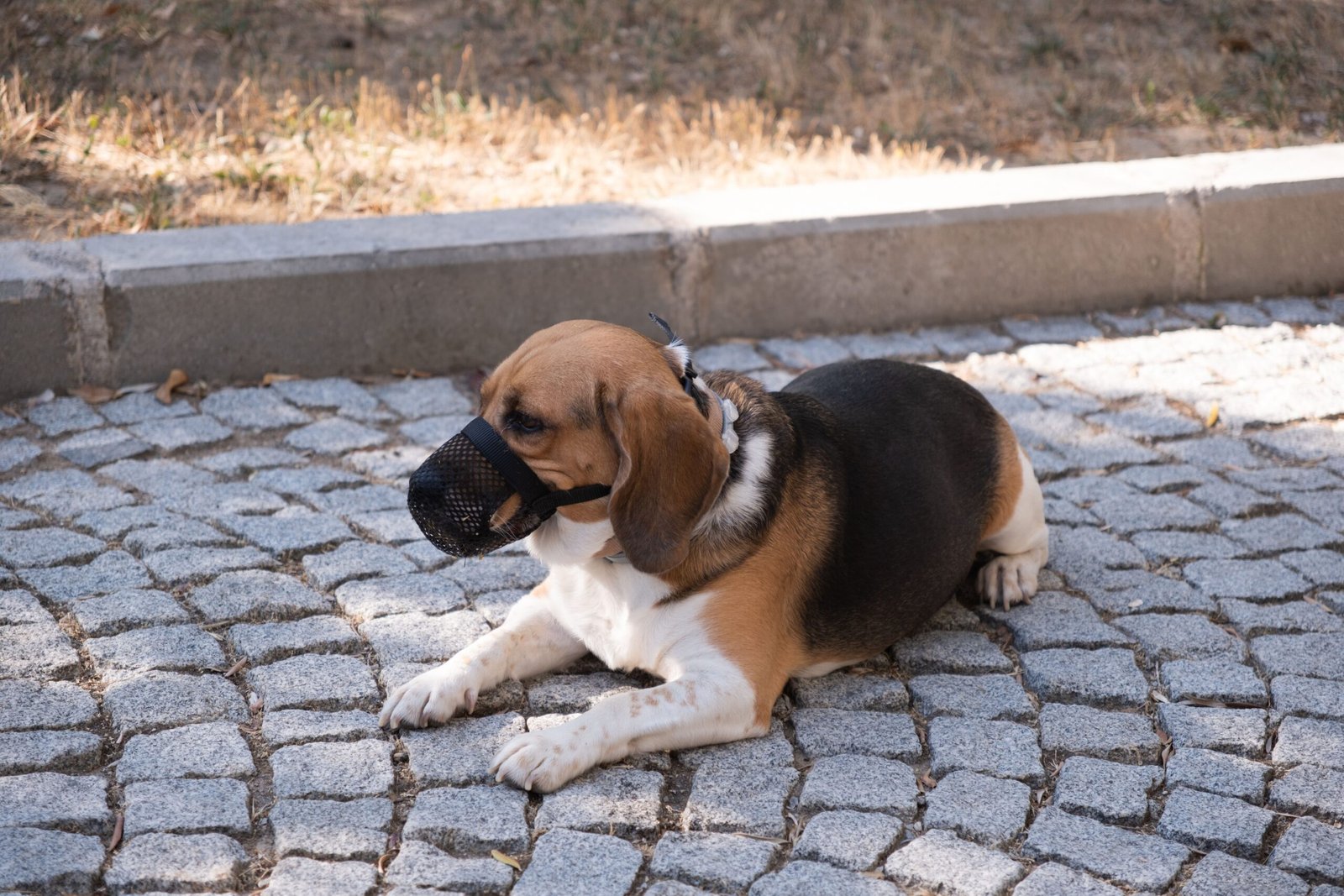
A basket muzzle is an open cage of rubber, biothane or wire. The dog can open its mouth fully, pant, drink and take treats through it. Dogs cool themselves almost entirely by panting.
A fabric or “sleeve” muzzle holds the jaw closed. The dog cannot pant, cannot drink, and cannot take food. These are designed for a few minutes of veterinary restraint and nothing else. A dog left in one on a warm day, or on a walk, is at genuine risk of overheating.
If you take one thing from this article: if your dog cannot pant in it, it is the wrong muzzle. The fabric ones are cheaper and sold everywhere, which is exactly why this needs saying.
Muzzle types compared
The label on the packet is not a reliable guide, so judge every muzzle by one question: can the dog open its mouth wide, pant and eat a treat through it?
| Type | Can pant fully | Can take treats | Best for | Watch out for |
|---|---|---|---|---|
| Rubber or silicone basket | Yes | Yes | Walks, everyday use, training | Sizing runs small; measure first |
| Biothane or leather basket | Yes | Yes | Long wear, comfort, hot weather | Costs more; often made to order |
| Wire basket | Yes | Yes | Durability, large or strong dogs | Reads as aggressive to strangers; can bruise a person it bumps |
| Plastic vented basket | Partly | Sometimes | Short vet or grooming use | Vents are often too narrow for real panting |
| Fabric sleeve muzzle | No | No | A few minutes of vet restraint only | Overheating risk; never for walks or hot days |
| Improvised (bandage, leash wrap) | No | No | Genuine emergencies only | Slips easily; a stopgap, never a plan |
The pattern is straightforward. Anything that holds the jaw closed is a restraint device for a short procedure. Anything the dog can eat through is a piece of equipment it can learn to live in.
Fitting
- Length: roughly half an inch of clearance past the end of the nose — the dog must be able to open its mouth wide, not just part it.
- Width: room to pant without the sides pressing the muzzle.
- Straps: snug enough that two fingers fit under the neck strap, and an overhead strap so it cannot be pushed off with a paw.
- Flat-faced breeds need a shape designed for them; standard baskets do not fit and restrict breathing.
- Measure before buying. Length from the eye line to the nose tip, and circumference at the widest point with the mouth open.
Measuring your dog in three minutes
More muzzles fail on fit than on training. Two numbers decide it, and both are easier to take with a piece of string and a ruler than with a tape measure.
- Length. From just below the eye line to the tip of the nose. Add roughly half an inch of clearance, because the dog needs to open its mouth inside the basket, not merely part its lips.
- Circumference. Around the widest part of the muzzle, taken with the mouth open, not closed. A measurement taken on a closed mouth is the classic reason a new muzzle presses the sides.
- Check the strap line. Two fingers should slide under the neck strap. An overhead strap that runs between the ears stops the dog levering it off with a front paw.
- Watch it move. A well-fitted muzzle stays put when the dog shakes, sniffs the ground and drinks. If it swings or rotates, the strap arrangement is wrong rather than the size.
Flat-faced breeds are the exception to all of this and need a shape built for a short nose. A standard basket sits against the face and restricts breathing on a dog that already has less airway to work with.
Conditioning: fourteen sessions, not one afternoon
The failure mode is universal and predictable: buy the muzzle, put it on the dog, dog paws at its face and freezes, owner concludes their dog hates muzzles. What the dog actually learned in that thirty seconds is that this object traps its face.
Undoing that takes far longer than doing it properly. Two or three minutes a day, and most dogs are wearing one happily inside two or three weeks.
Stage 1 — the muzzle is a food bowl. Hold it, put a treat inside, let the dog take it out. Do not touch the head. Ten repetitions. Repeat for two or three days until your dog moves toward the muzzle when it appears.
Stage 2 — nose in voluntarily. Smear something sticky inside the end — pate, cream cheese, wet food. Hold it still and let the dog put its own nose in and lick. Never push it onto the face. The dog choosing to put its nose in is the entire mechanism.
Stage 3 — duration, still no straps. Build from one second to ten. Feed through the front the whole time, which is what the basket design is for.
Stage 4 — straps touched, not fastened. Bring them up behind the ears, release, treat. Repeat until it is boring.
Stage 5 — clip and unclip immediately. Fasten, feed, unfasten within two seconds. Build to ten.
Stage 6 — movement. Fastened, then walk two steps and feed. A dog standing still in a muzzle and a dog moving in one are different experiences.
Stage 7 — generalize. The yard, then a quiet street, then the environments you actually need it for.
Three rules that decide whether this works
Always end before the dog wants to stop. If it is enjoying it, that is the moment to finish.
Pawing means back up a stage. Not push through. Pawing is the signal you are ahead of the dog.
Never make the muzzle predict something bad. If it only ever appears before the vet, it becomes a reliable warning that the vet is coming. Put it on for ordinary walks, dinner, and doing nothing at all.
Free tool
If your dog has already made contact, this grades the incident objectively and tells you how urgently to act — including when muzzle conditioning is the right interim step.
The first real walks
Conditioning in the kitchen and wearing it in public are separate skills, and the second one has its own small failures.
- Put it on before you leave, not at the door. A muzzle that only ever appears in the doorway becomes part of the excitement, and an aroused dog is a poor candidate for a new piece of equipment.
- Keep the first outings short and dull. Five minutes on a quiet street beats thirty minutes at the park.
- Carry food that fits through the basket. Squeeze tubes and soft paste work through the front; large biscuits do not, and a dog that cannot be paid while wearing it starts to dislike wearing it.
- Let it sniff and drink. Confirm early that your dog can actually reach water through the muzzle. If it cannot, that is a fit problem to fix now, not on a hot day.
- Take it off at random moments, not only at the front door on the way home, so removal is not the reward the whole walk points toward.
What a muzzle does not do
This is where owners get into trouble.
It does not treat anything. A muzzled reactive dog is still frightened. A muzzled dog with a bite history still has one. It buys safety while the behavior work happens — it is not the behavior work. See our guides to leash reactivity and fear of strangers.
It does not make a dog safe to leave with children. Basket muzzles can be dislodged, and a dog can still knock someone down.
It is not a license to push the dog further. The most common misuse is treating it as permission to take a fearful dog into situations it cannot cope with. The muzzle protects other people; it does nothing for the dog’s experience, and over-threshold exposure still makes the fear worse.
It is not a substitute for a leash, a gate, or supervision. Management is layered. Removing one layer because another exists is how incidents happen.
Troubleshooting
The dog freezes and will not move. Shutdown, not acceptance. Take it off, and rebuild from the stage where the dog was still eating happily. A still dog in a muzzle is often the most worried dog in the room.
The dog paws at its face. You went a stage too far. Shorten the duration until pawing stops, then build again more slowly. Never hold the paws down.
The dog rubs its face along the ground or the sofa. Usually the fit. Check the length first: a basket that touches the end of the nose is the most common culprit.
The muzzle spins sideways. The neck strap is too loose or there is no overhead strap. Fix the strapping rather than tightening the whole thing, which just makes it uncomfortable.
The dog will not take food through it. Either the treats are the wrong shape or the dog is too stressed to eat. Switch to paste in a tube and, if it still refuses, go back several stages.
The dog uses the muzzle to shove people and other dogs. Common in bouncy dogs and it hurts more than a nose does. Manage the distance and work on greeting manners separately.
People will assume the worst. Some will cross the road. Occasionally someone will say something.
What actually helps:
- A brightly colored muzzle rather than a black wire one reads as equipment rather than restraint.
- A one-line answer prepared in advance: “He eats everything off the ground.” True for most muzzled dogs, and it ends the conversation.
- Behave normally. Apologetic body language is what makes strangers nervous.
- Remember the trade. The alternative to a muzzled dog on a walk is usually a dog that does not get walked.
There is a wider version of this worth naming. Bite-related fatality research found a set of preventable circumstances recurring across cases — no able-bodied person present to intervene in 87.1%, and the victim unfamiliar with the dog in 85.2%. Those are management failures rather than breed facts, and management is exactly what a muzzle is.
Using it at the vet
This is the situation muzzle training pays for most often, and the one owners leave until the appointment itself.
Tell the clinic in advance that your dog is muzzle trained. It changes how the visit is planned: staff can allow more time, work in a quieter room, and skip the wrestle that otherwise starts the appointment. A dog that arrives already comfortable in a basket muzzle is examined more thoroughly, needs sedation less often, and leaves with a less frightening memory of the place.
Practice at home in the position the vet will need. Muzzle on, then handle ears, paws and mouth for a few seconds at a time, paying through the front of the basket. Then practice in the parking lot outside the clinic, without going in. Two or three of those rehearsals do more than anything that happens on the day.
One thing not to do: putting a muzzle on for the first time in the waiting room. The dog then has a new object, a frightening building and a stranger in gloves in the same memory.
When a muzzle is the wrong answer
- As a permanent solution instead of treatment. If the plan is a muzzle and nothing else, the underlying problem is being stored rather than solved.
- On a dog left alone. Never. Basket muzzles catch on things.
- In hot weather for extended periods, even a basket. Panting is less efficient through one.
- To stop barking. It does not, and a fabric one that does is a welfare problem.
- Instead of a veterinary appointment. A dog that has started snapping needs examining. Around a third of dogs referred for behavior work have a painful condition, and pain lowers tolerance for everything.
When to get professional help
Speak to your veterinarian and ask about a referral to a veterinary behaviorist if your dog has bitten or attempted to bite, if the behavior appeared suddenly in an adult dog, if you are muzzling to manage aggression rather than scavenging, or if you cannot condition the muzzle without the dog panicking.
That last one matters. A dog that panics at a muzzle after weeks of careful work is telling you something about its general anxiety level, and that is worth investigating.
Watch the training in action
PawMastery on YouTube — 149,000+ subscribers following along with real training sessions.
Frequently asked questions
Is muzzling a dog cruel?
A properly fitted basket muzzle allows panting, drinking and eating. Used correctly it gives an anxious or scavenging dog more freedom, because it makes outings possible. A fabric muzzle that holds the jaw shut is a different object and is only appropriate for brief veterinary restraint.
Which muzzle should I buy?
A basket design in rubber, biothane or wire, sized so your dog can open its mouth fully and pant. Measure length and circumference first. Flat-faced breeds need a shape made for them.
How long does muzzle training take?
Two or three minutes a day for two to three weeks for most dogs. Rushing it is what creates a dog that hates muzzles.
Can my dog wear a muzzle all day?
No. Use it for specific situations. Never leave a muzzled dog unsupervised or alone, and limit use in hot weather.
Does a muzzle stop aggression?
No. It prevents a bite. The dog is still frightened or aroused, and the underlying behavior still needs work with a qualified professional.
My dog paws at the muzzle. What am I doing wrong?
Moving too fast. Go back two stages and rebuild. Pawing is information, not defiance.
Should I muzzle train a dog with no problems?
Yes, and it is the best time to do it. Emergencies, injuries and veterinary procedures happen to friendly dogs too, and conditioning is far easier before it is needed.
Will people judge me?
Some will. A brightly colored muzzle and a prepared one-line explanation handle most of it, and the alternative is often a dog that stops being walked.
How do I measure my dog for a muzzle?
Take the length from just below the eye line to the nose tip and add about half an inch, then measure the circumference of the muzzle with the mouth open. Buying on breed or weight alone is the usual reason a muzzle does not fit.
Can a dog drink with a basket muzzle on?
A well-fitted one, yes, and you should confirm it before you rely on it. If your dog cannot reach water through the basket, the fit or the design is wrong.
Can my dog wear a muzzle in hot weather?
A basket muzzle for short periods, with water available and shade. Panting is slightly less efficient through any muzzle, so shorten the outing rather than assuming it makes no difference. A fabric muzzle in warm weather is a genuine welfare risk.
My dog stands completely still when muzzled. Is that good?
No. Stillness is usually shutdown rather than calm acceptance. A comfortable dog moves, sniffs and looks for food. Take the muzzle off and rebuild more slowly.
What should I tell people who stare?
One prepared line and a normal tone. “He eats everything off the ground” is true for most muzzled dogs and it ends the conversation before it starts.
A dog that has bitten, or that has begun snapping suddenly, needs veterinary assessment and a qualified behaviorist — a muzzle manages risk while that happens, it does not replace it. Never leave a muzzled dog unattended.
Sources
- Mills et al., pain and problem behavior in cats and dogs, Animals
- Patronek et al., co-occurrence of preventable factors in dog bite-related fatalities
- RSPCA: dog behavior guidance
- ASPCA: aggression in dogs
- AVMA: why breed-specific legislation is not the answer
- AVSAB Position Statements on Humane Dog Training