Potty training comes down to three things: taking the puppy out often enough that it rarely gets the chance to go indoors, paying it well the instant it goes outside, and supervising closely enough that accidents do not happen unnoticed. Most puppies are largely reliable by four to six months.
The single most useful number to know: a puppy can hold its bladder for roughly its age in months, plus one hour. A two-month-old puppy manages around three hours. A four-month-old, around five.
Treat that as a ceiling, not a target. It describes what a puppy can do with effort and a full bladder, not what is comfortable.
How long can a puppy hold it?
| Age | Rough maximum | Realistic daytime interval when awake |
|---|---|---|
| 8 weeks | about 3 hours | Every 1 to 2 hours |
| 12 weeks | about 4 hours | Every 2 hours |
| 16 weeks | about 5 hours | Every 3 hours |
| 6 months | about 7 hours | Every 4 hours |
Two adjustments to make.
Small breeds need more frequent trips than the rule suggests. Smaller bladder, faster metabolism. A Chihuahua puppy is genuinely harder to house train than a Labrador puppy, and it has nothing to do with intelligence.
Awake and active is different from asleep. A sleeping puppy can hold on considerably longer than a puppy that has just woken up and started running around. The interval that matters is awake time.
Free tool
Puppy Potty Training Planner
Enter your puppy’s age and your wake-up time and it builds the whole day — every toilet trip, every enforced nap, meals and the night trips — with the reasoning for each one. Printable.
House training runs alongside everything else in the first year. See our puppy training schedule by age.
The schedule that does most of the work
Take the puppy out at all of these moments, every time:
- Immediately on waking, including from short naps. This one is non-negotiable and it is the most frequently missed.
- Five to thirty minutes after every meal. The younger the puppy, the shorter the gap.
- After drinking water. Treat it like a meal.
- After every play session. Activity moves things along.
- Before and after crate time.
- Last thing before bed.
- Plus at the interval from the table above.
That is eight to twelve trips a day for an eight-week-old puppy. It is exhausting, it lasts a few weeks, and it is the entire reason some puppies are trained in three weeks and others take four months.
Control the input to predict the output
Free-feeding, meaning leaving a bowl down all day, makes house training considerably harder, because you have no idea when the puppy will need to go.
Feed at fixed times, three or four meals a day for a young puppy, and pick the bowl up after fifteen minutes. Predictable meals produce predictable output. Stop food roughly two to three hours before bedtime and lift the water bowl about an hour before, taking the puppy out one last time right before you settle for the night.
Outside: the two-minute protocol
Where most people lose weeks is not the schedule. It is what happens in the garden.
Go to the same spot every time. The residual smell prompts the puppy to go. Carry a young puppy there rather than walking it, so it does not stop and squat on the way.
Stand still and be boring. No talking, no playing, no wandering around. You are a lamppost. A puppy that gets a game the moment it steps outside will spend ten minutes playing and then pee the moment it comes back in.
Add your cue word once the puppy is already going. Say go potty quietly while it is mid-stream, not before. Said too early it becomes background noise; said during, it becomes a label the puppy eventually connects. After a few weeks you will be able to prompt it.
Reward within three seconds. This is the detail that matters most and is almost universally skipped. Praise and a treat outside, immediately, while the puppy is still standing on the spot. Waiting until you are back indoors rewards coming inside, not eliminating outside.
Then play. Going out becomes the thing that starts the fun rather than the thing that ends it. Puppies who learn that peeing means going straight back inside start holding on to extend the trip.
If nothing happens in five minutes, bring the puppy in, crate it or keep it on a lead beside you for ten minutes, and try again. Do not let it roam the house unsupervised with a full bladder.
Using a crate properly
Crates work because most puppies will not soil where they sleep. That instinct is the entire mechanism, and it is easy to break.
Size it correctly. The puppy should be able to stand, turn, and lie down, and no more. A crate big enough for the adult dog gives a puppy a bathroom at one end and a bed at the other, which teaches exactly the wrong thing. Buy the adult size with a divider panel and move it out as the puppy grows. That is the practical solution nobody mentions.
Build a positive association first. Meals in the crate, treats tossed in, door open, short sessions. A puppy that fears the crate will hold on until it is let out and then go on the floor.
Never crate a puppy that is showing it needs to go. If it is circling, sniffing, or restless after a meal, take it outside. Putting a restless puppy in the crate forces it to soil its bed, and once it has done that a few times the instinct that made the crate work is gone.
Respect the time limits. Use the age-plus-one rule as your maximum, and less during the day. A puppy left crated past its capacity has no choice, and you have taught it that soiling its bed is survivable.
Crates are the mechanism behind most of this, and how long a dog spends in one matters as much as how it is introduced. See our guide to crate training and where the limits are.
If the nights are the hardest part right now, our guide to puppy crying at night covers settling, timing and when to go to a crying puppy.
Night-time
Most puppies cannot manage a full night at eight weeks. Plan for it rather than being surprised.
- Put the crate beside your bed for the first weeks. You will hear the puppy stir before it is desperate, and the proximity reduces distress.
- Set one alarm, roughly four to five hours after bedtime for an eight-week-old.
- Night trips are silent and businesslike. No lights on, no talking, no play. Out, potty, quiet praise, straight back to the crate. Any excitement teaches the puppy that 3am is social hour.
- Push the alarm later by fifteen to thirty minutes each week as the puppy grows.
Most puppies sleep through by around four months, some sooner.
Accidents
If you catch the puppy mid-accident
Make one soft, neutral sound to interrupt, a quiet ah or a clap. Enough to pause it, not enough to frighten it. Then pick it up or hurry it outside, let it finish, and reward it there.
Do not shout. A puppy that learns eliminating in front of you is dangerous will start hiding to go, behind the sofa or in another room, and a puppy that will not go while you are watching is far harder to train than one that has accidents in the open.
If you find it afterwards
Clean it up and say nothing. The puppy cannot connect a telling-off to something it did twenty minutes ago. The old advice about rubbing a dog’s nose in it teaches fear and nothing else.
An accident you did not see is a supervision failure, not a puppy failure. Tighten the schedule or the supervision.
Cleaning: one thing you must get right
Use an enzymatic cleaner made for pet messes. Ordinary detergents remove what you can smell; enzymatic cleaners break down the compounds the dog can smell. Anything left behind is a signpost saying this is the toilet.
Never use an ammonia-based cleaner. Urine contains ammonia, so to a dog an ammonia-cleaned patch smells like a spot that has already been used. You will actively draw the puppy back to it.
Blot first, do not rub, then soak the area properly and let it air dry. Skip air fresheners over the top, because they cover the smell for you, not for the dog.
Puppy pads: the honest answer
Pads teach a puppy that peeing indoors, on a soft absorbent surface, is acceptable. Then you ask it to unlearn that. Meanwhile bath mats, rugs, and folded laundry are all soft absorbent surfaces.
Skip pads if you can. If you have any access to outdoors and someone home during the day, going straight to outdoor training is faster and avoids a second training phase.
Use them if you must, for example an apartment on the tenth floor, a puppy not yet fully vaccinated, or a work schedule that makes hourly trips impossible. If you do:
- Put pads in one fixed location only, ideally in a pen, never scattered around
- Move the pad progressively toward the door over weeks, then just outside it, then remove it
- Expect the transition to take longer than starting outdoors would have
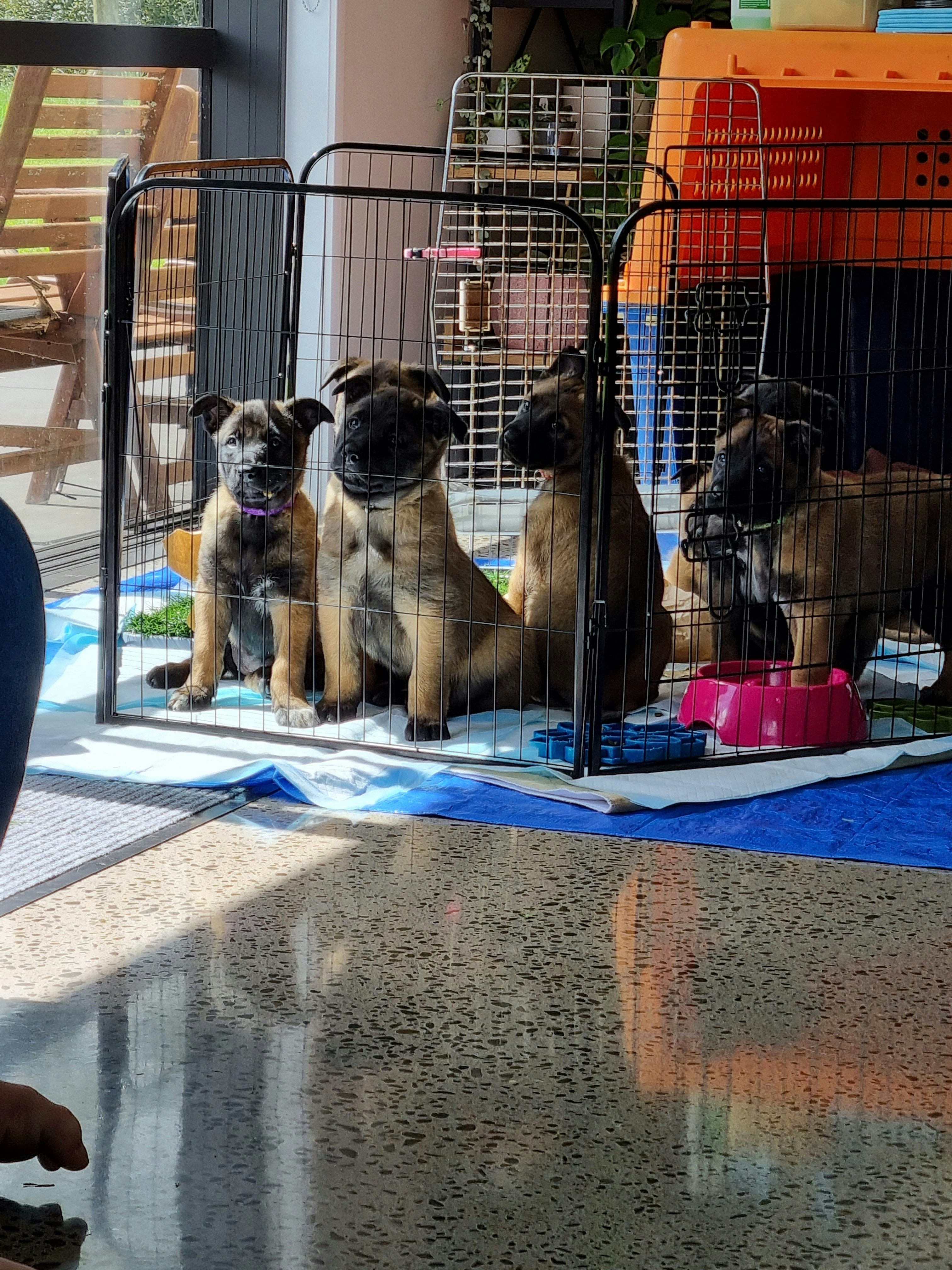
A useful middle option: a pen with a real-turf tray rather than a pad. The substrate is closer to what you eventually want, so the transition is smaller.
One feeding habit is worth avoiding from the start: reaching into the bowl while your puppy eats. Our guide to resource guarding explains why adding food beats taking it.
Common mistakes
- Assuming a quiet puppy is an empty puppy. Young puppies do not reliably signal. Go by the clock, not by their behavior, for the first month.
- Too much freedom too early. A puppy loose in the house is a puppy having unsupervised accidents. Use a pen, a lead attached to your belt, or closed doors. Expand the territory as reliability grows.
- Punishing accidents. Produces a puppy that hides to eliminate.
- Rewarding indoors instead of outdoors. Timing beats everything.
- Inconsistent household rules. If one person skips the after-nap trip, the schedule has a hole in it.
- Declaring victory too early. Two clean weeks is not trained. Keep the schedule going for another month.
Regression, and when it is medical
Almost every puppy regresses. Common triggers: a growth spurt, moving house, a new person or pet, adolescence around six to nine months, or a schedule that got relaxed too soon.
The fix is usually to go back a step, with tighter supervision and more frequent trips, for a week or two.
But check with a vet first if any of these apply. A break in house training is a recognized red flag for a bladder problem, and urinary tract infections in puppies are common:
- Straining, or seeming to be in pain while urinating
- Frequent small amounts rather than a normal volume
- Blood in the urine, or urine that is cloudy or unusually strong-smelling
- Dripping or leaking, or frequent licking of the genitals
- Increased thirst
- Sudden accidents in a puppy that had been reliable
UTIs need veterinary diagnosis and antibiotics. They do not clear on their own, and an untreated infection can spread to the kidneys. Punishing a puppy that has a painful bladder infection is the worst outcome in this whole article, and it happens regularly because owners assume every accident is a training issue.
A third possibility is worth ruling out: if the accidents happen only in your absence and come with barking or damage, that points toward a separation-related problem rather than a house training gap.
Excitement and submissive urination
Different problem, different solution, and the article that treats it as a house-training failure makes it worse.
A puppy that dribbles when greeting you, when someone leans over it, or when it is told off is not failing to hold its bladder. It is an involuntary response, common in young puppies and usually outgrown by around a year.
What helps: greet the puppy outside or in a low-key way, crouch sideways rather than looming over it, keep hellos calm and brief, and ignore the puddle entirely.
What makes it worse: any correction at all. Telling a puppy off for submissive urination reliably increases it.
Realistic timeline
- 8 to 12 weeks: frequent accidents, no bladder awareness yet. Purely on you and the clock.
- 12 to 16 weeks: accidents dropping, puppy starting to head toward the door.
- 4 to 6 months: mostly reliable, occasional accidents, sleeping through the night.
- 6 to 12 months: reliable, with possible adolescent regression.
Small breeds often take longer. A puppy from a background where it had to soil its sleeping area, as happens in some pet-shop or poor-breeder situations, can take considerably longer, because the natural instinct the whole method relies on was overridden early.
Three weeks of consistency beats three months of inconsistency. The owners who finish fastest are not the ones with the smartest puppies. They are the ones who did not skip the after-nap trip. For the wider first-month picture, see our guide to training an 8-week-old puppy.
Watch the training in action
PawMastery on YouTube — 149,000+ subscribers following along with real training sessions.
Frequently asked questions
How long does potty training take?
Most puppies are largely reliable by four to six months, with the bulk of progress in the first four to six weeks of consistent work. Small breeds often take longer.
How often should I take my 8-week-old puppy out?
Every one to two hours while awake, plus after every meal, nap, drink, and play session. Eight to twelve trips a day is normal.
Should I use puppy pads?
Only if outdoor access is genuinely limited. They add a training phase, because you will later have to teach the puppy that indoor elimination is not acceptable after all.
My puppy pees the moment we come back inside. Why?
It has not finished, or it learned that going outside means the trip ends. Stay outside longer, and play after it goes rather than heading straight back in.
Should I punish my puppy for accidents?
No. It teaches the puppy to hide when it eliminates, which makes training harder and can look like a sudden regression.
My puppy was trained and has started having accidents again. What happened?
Check with a vet first, because a break in house training can signal a urinary tract infection. If the puppy is healthy, it is usually adolescence or a schedule that got relaxed, and tightening supervision for a couple of weeks resolves it.
Can I potty train an older dog?
Yes. The method is identical. An adult dog has better bladder control, so the schedule is easier, but it may have years of practice at the wrong habit.
Accidents that appear suddenly in a previously reliable puppy, or that come with straining, blood in the urine, increased thirst, or signs of pain, need a veterinary exam rather than more training. Urinary tract infections and other bladder conditions are common in puppies and are easily mistaken for a training problem.