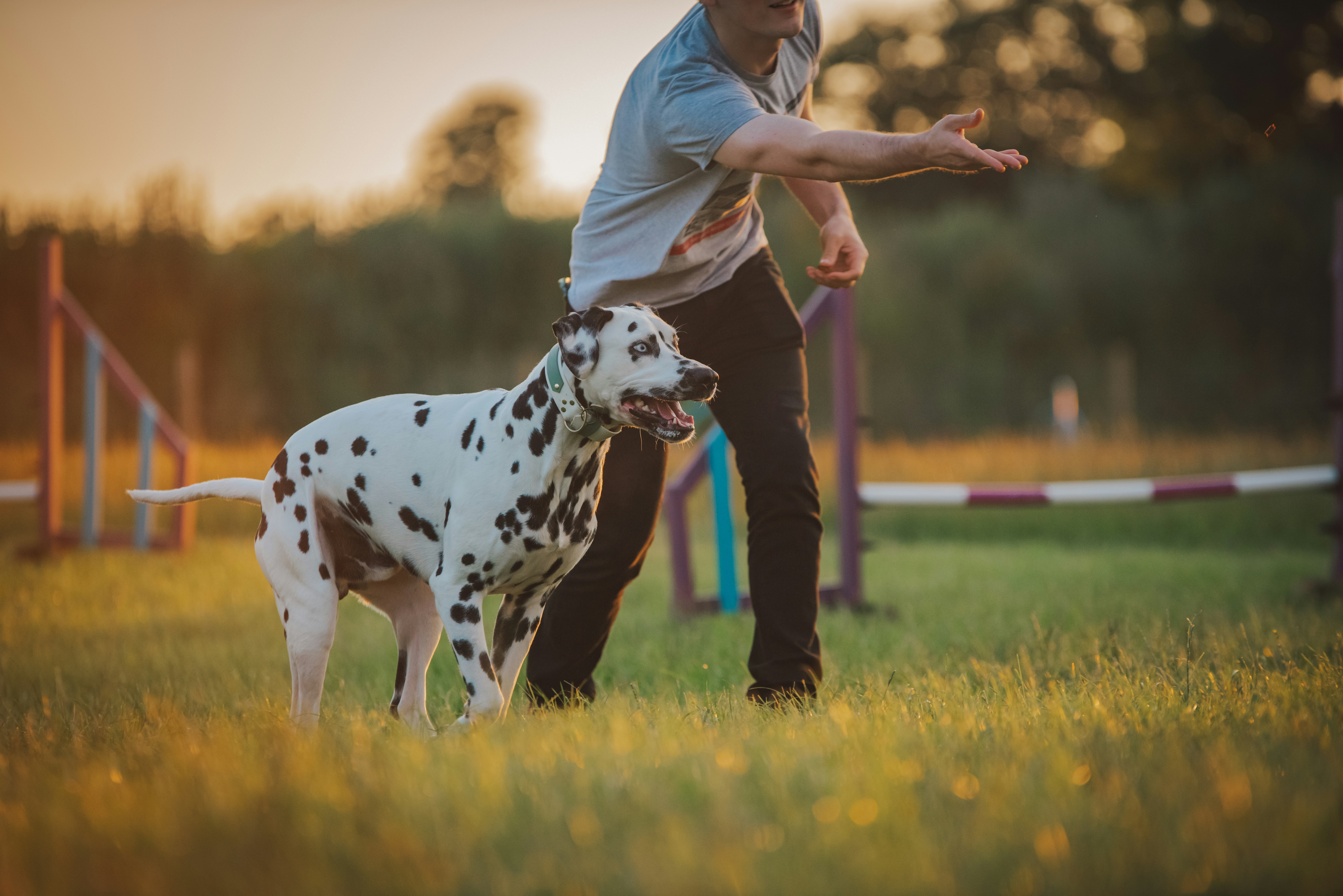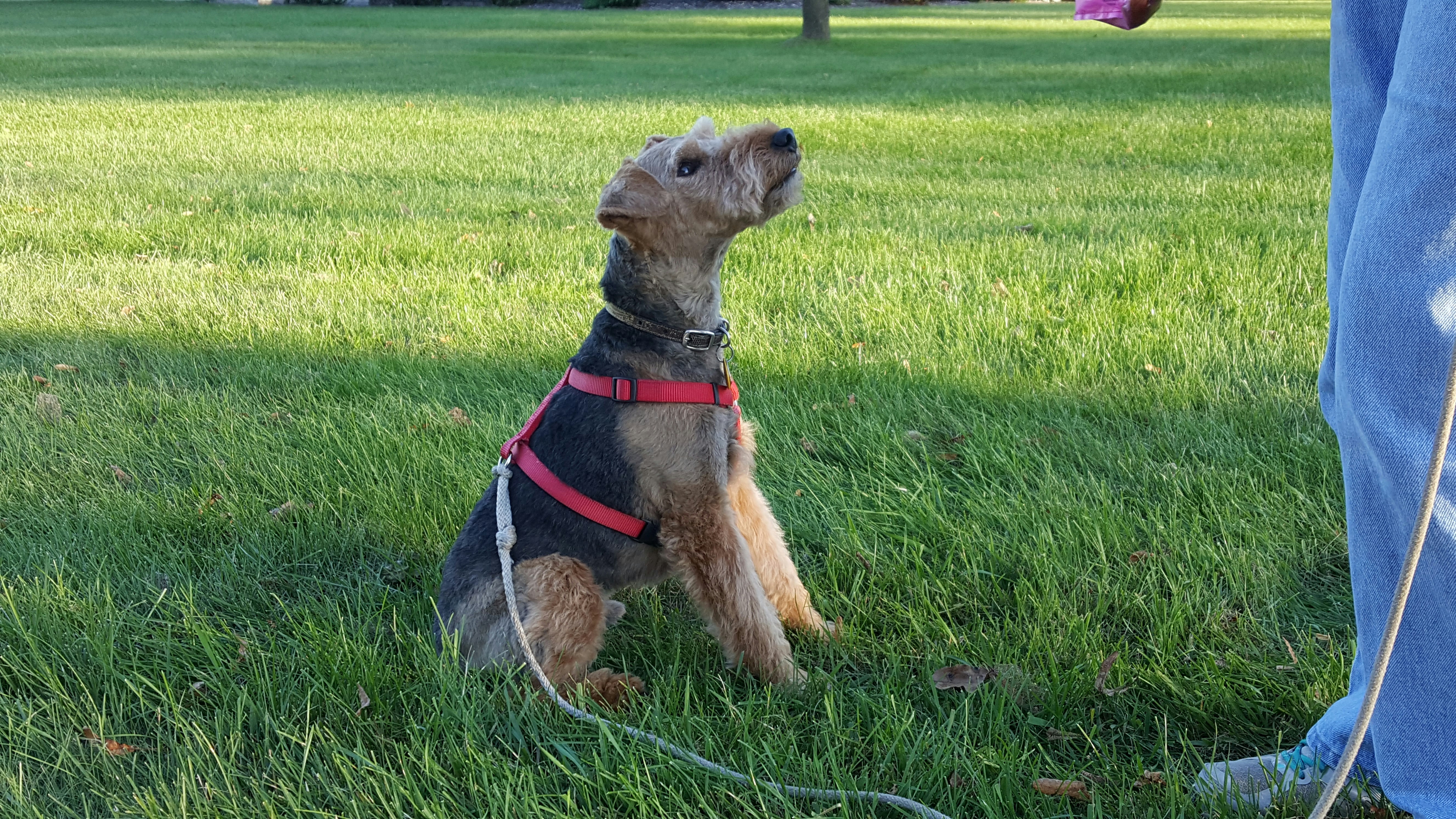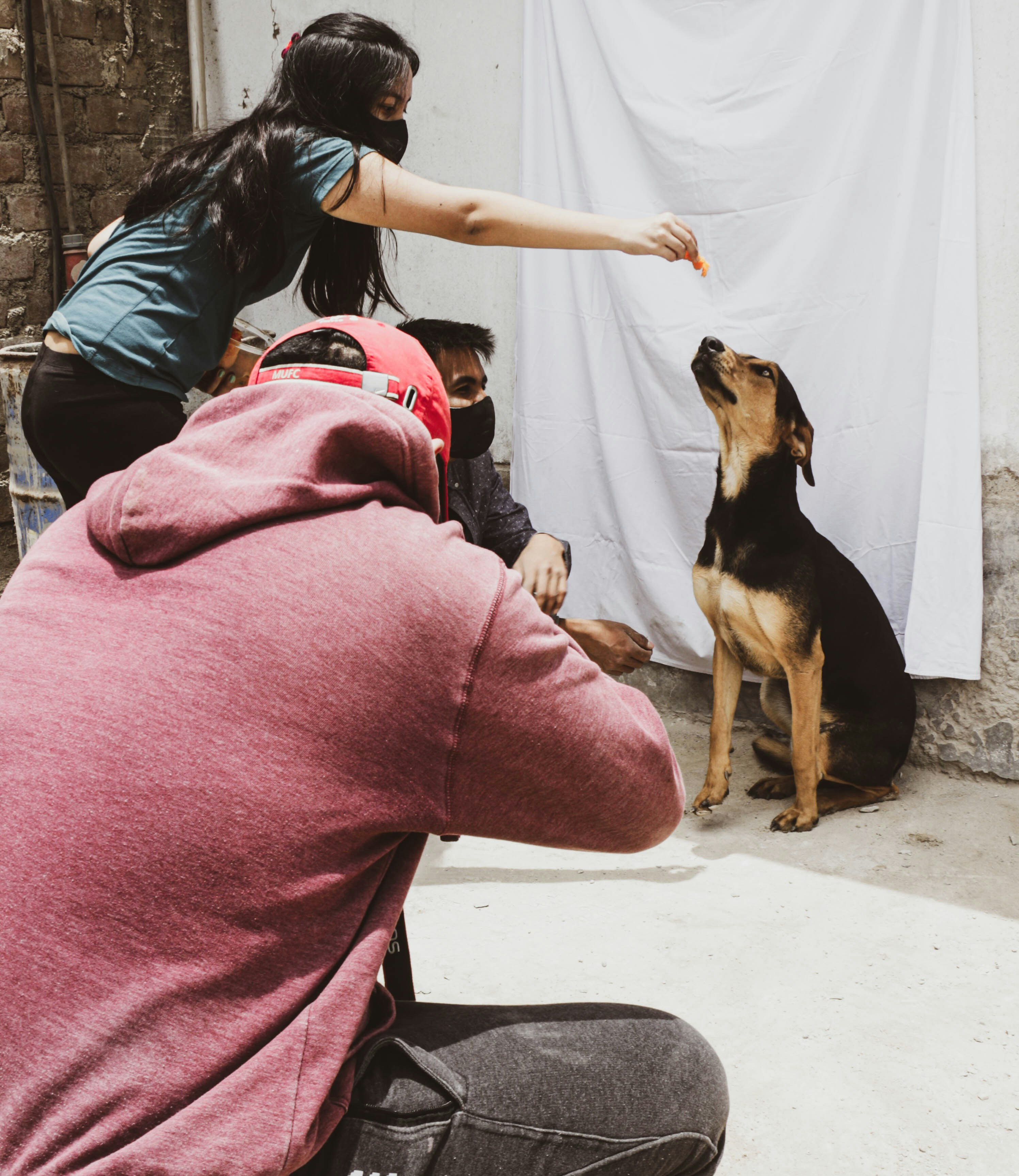
Most dogs learn to sit in a single session. What takes longer is getting the treat out of your hand, and that is where the majority of owners get permanently stuck, ending up with a dog that sits beautifully when it sees food and ignores you when it does not.
The whole technique comes down to one hand movement, and it is the movement most guides describe wrongly.
Short answer: hold a treat at your dog’s nose and move your hand up and back over its head, so the weight shifts onto the hindquarters and the rear drops. Mark the moment it touches the floor and pay. Take the food out of your luring hand by about the sixth repetition, shrink the gesture into a small hand signal, and only then add the word. Most dogs learn the movement in one session; the word alone takes a week or two.
The hand movement (this is the part that matters)
Hold a treat between your thumb and fingertips, right at your dog’s nose. Then move your hand up and back, over the head, toward the tail.
Not straight up. Straight up makes most dogs back away or jump for it. The backwards angle shifts the dog’s weight onto its hindquarters, and the rear drops because that is the easiest thing for the body to do.
If your dog is jumping or reversing, your hand is going too high and not far enough back. Lower it and angle it further over the shoulders.
Step by step
1. Quiet room, no distractions, five minutes. Have six or eight small soft treats ready.
2. Lure the movement, no word yet. Treat at the nose, hand up and back, and the moment the rear touches the floor, mark it with yes (or a click) and give the treat.
Say nothing else. You are not teaching a word yet. You are teaching a body movement.
3. Repeat five times. Most dogs have it by the third rep.
4. Take the food out of your luring hand. Same movement, empty hand, treat hidden in the other hand or a pouch. When the dog sits, mark and reward from the other hand.
This is the single most important step on this page. Do it at rep six, not week three.
5. Shrink the hand movement. Over the next ten or fifteen reps, make the gesture smaller each time, so a full arm sweep becomes a small upward flick of the hand. That flick is now your hand signal.
6. Add the word. Only once the dog reliably sits to the hand signal.
Say sit, pause half a second, then give the hand signal. Word, then signal, then behavior, then mark, then reward.
After twenty or thirty repetitions in that order, try the word alone. Most dogs anticipate and sit before the signal arrives. That is the moment the word actually means something.
Say it once. If you find yourself saying sit, sit, SIT, the dog is not ready at this difficulty and the word is being worn out.
7. Add a release cue. Pick a word such as okay, free, or break, and use it to end every sit. Without one, the dog decides when to get up, and you will spend months wondering why it never holds the position.
Free tool
See where sit sits on the proofing ladder against your other cues, and which one to work on next.
What session one actually looks like
Written out repetition by repetition, the first five minutes are more specific than most guides admit.
| Reps | What you do | What you say | Move on when |
|---|---|---|---|
| 1–5 | Lure with food in the hand, up and back | Marker only, no cue word | The rear drops without hesitation |
| 6–10 | Same movement, empty hand, pay from the other hand | Marker only | The dog follows the empty hand |
| 11–20 | Shrink the gesture a little each rep | Marker only | A small flick produces the sit |
| 21–40 | Word, half-second pause, then the signal | “Sit” once, then signal | The dog starts sitting before the signal |
| 41+ | Word alone, signal only if needed | “Sit” once | Nine out of ten on the word alone |
Those repetitions are spread across several short sessions, not forced into one. Two minutes, twice a day, gets a typical dog through the whole table inside a week.
Fading the lure vs thinning the rewards
These are two completely different things, and confusing them is why so many dogs only work for visible food.
Fading the lure means removing the treat from your luring hand. This happens in the first session, around rep six. The dog still gets paid every time. The food just comes from somewhere else.
Thinning the rewards means paying less often. This happens weeks later, once the behavior is fluent, and you move to rewarding roughly every second or third time, unpredictably.
If you never fade the lure, you have a dog that follows food. If you thin the rewards too early, you have a dog that stops bothering.
And do not try to replace food entirely with praise. Praise works as a bonus alongside food for most dogs; as a sole payment it is thin, and behaviors that stop paying eventually stop happening. Keep paying occasionally, forever, especially for the hard ones.
Timing: the half-second that decides everything
The marker is not a formality. It tells the dog precisely which instant earned the food, and a marker half a second late marks something else entirely.
- Mark the contact, not the settling. The word or click happens the moment the rear touches the floor, not once the dog has arranged itself comfortably.
- Marker first, hand second. If you reach for the pouch before you mark, the dog is watching your hand and learns to sit when the hand moves.
- One marker, one reward. Every mark gets paid, even the ones you got wrong. Breaking that promise is how a marker stops working.
- Deliver the food where you want the dog. Fed at chest height in position, the dog stays sitting. Fed away from your body, it stands up, which is useful when you want a reset.
- A marker word is enough. “Yes” works if it is short, said the same way every time, and never used in conversation during a session.
If you are late by a second consistently, the dog is learning to sit-then-stand, because standing is what got marked. Practice the timing on a bouncing ball for two minutes if you want to feel the difference.
If your dog will not follow the lure
Some dogs, often the very food-focused ones, get so fixated on the hand that they jump at it instead of thinking. Others are not interested in the food at all.
Try capturing instead. Stand near your dog with treats and simply wait. Sooner or later it will sit on its own. The instant it does, mark and reward. Then take a step away so the dog stands up, and wait again.
Capturing is slower to start but often produces a more solid behavior, because the dog worked it out rather than being steered. It is particularly good for puppies, who sit constantly anyway.
Never push your dog’s bottom down. It is the first instinct most people have and it is counterproductive: dogs push back against physical pressure rather than yielding to it, so you get resistance instead of a sit. In an older or arthritic dog you can also cause real pain, and you teach the dog that hands coming toward its rear end are unpleasant.
Two reasons your dog will not sit that are not about training
If your dog sits fine sometimes and refuses at others, check these before you assume a training problem.
The surface
Dogs are reluctant to sit on cold, wet, hot, gritty, or slippery ground. Slick floors like tile and hardwood make a proper sit physically harder, because there is not enough grip to keep the back legs in position.
This is by far the most common explanation for my dog sits at home but not outside. Test it: ask for a sit on grass, then on wet sidewalk, then on a mat. If the mat works and the pavement does not, it was never a training problem.
Pain
This is the one worth taking seriously.
A dog that is reluctant to sit when asked, sits crooked with one leg kicked out to the side, or flops down without using its back legs may have an orthopedic problem. Hip dysplasia, arthritis, a cruciate ligament injury, or back pain can all make a square sit uncomfortable. Even something as ordinary as impacted anal glands will make a dog avoid sitting squarely on its bottom.
Puppies sit sloppily and usually grow out of it. An adult dog that consistently sits crooked, or a dog whose sitting changes suddenly, should be seen by a vet rather than trained harder.
Signs worth a veterinary appointment:
- Reluctance to sit at all when asked, in any location
- Consistently sitting with one hip rolled and a leg out
- Slow or laboured rising from a sit
- Bunny-hopping with both back legs together when running
- Stiffness after rest, or reluctance on stairs
Filming your dog sitting and rising and showing your vet the clip is more useful than describing it.
What changes with age
Puppies learn this fastest and hold it worst. Sessions of two or three minutes, several times a day, and expect the cue to fall apart in any new room. Capturing works especially well because puppies sit constantly anyway.
Adolescents between six and eighteen months often stop responding to a cue that looked finished. This is developmental rather than defiance. Lower the difficulty, raise the payment, and wait it out.
Adult dogs concentrate better and usually learn the whole sequence in a few days. The obstacle is any history of the cue being repeated or ignored, which takes a fresh word to fix.
Senior dogs can learn it perfectly well, but a sit is physically demanding on stiff joints. Ask for fewer repetitions, allow a sloppy sit, and consider teaching a stand or a down as the default position instead if sitting is uncomfortable.
Making sit actually useful
Sit on cue is worth much less than sit as a default.
Teach your dog that sitting is what makes good things happen, and it will start offering a sit instead of jumping, barking, or shoving. Nothing to un-train. You just pay the behavior you want in the situations where the unwanted one usually appears.
Ask for a sit, or wait for one, before:
- Putting the food bowl down
- Clipping the leash on
- Opening the front door
- Greeting a visitor
- Getting out of the car
- Being let off the leash
Within a couple of weeks most dogs start sitting automatically at doors and bowls without being asked. That is when the cue starts earning its keep.
This is what turns sit from a party trick into something useful. Our guide to house manners and jumping up covers how to use it at doors and greetings.
Practicing in new places
A dog that sits in your kitchen has learned sit in the kitchen. Dogs generalize poorly, and a new room genuinely looks like a new problem to them.
Rebuild it in each new place, starting easy: hall, yard, front step, quiet street, park. Go back to the hand signal if the word alone stops working, because that is normal at a new location, not a sign of stubbornness.
Expect this to take a few reps in each setting, not a full retrain.
Free tool
Dog Training Session Builder
Get an actual session script for sit — reps, success criterion, and when to stop.
The proofing ladder
Once the word works in a quiet room, you have finished about a third of the job. This is the rest, in order.
- New room, same house. Then a different floor surface. Both easier than they sound and both necessary.
- Your body position changes. Sitting on a chair, standing sideways, facing away, crouching. Dogs treat each as a new picture.
- Distance. One step away, then three, then across the room. Not before the word is solid up close.
- Yard, then front step, then a quiet sidewalk. Pay generously each time the picture changes.
- Mild distraction. A person walking past at a distance, a toy on the floor, a bird in the yard.
- Real life. Doorways, the vet waiting room, outside a store.
Raise one rung at a time and lower the others when you do. Two changes at once is the single most common reason a cue “stops working,” and the fix is always to make it easier rather than louder.
Common mistakes
- Luring straight up instead of up and back, so the dog jumps or reverses.
- Never fading the lure, producing a dog that only works for visible food.
- Adding the word too early, while the dog is busy following your hand, so the word attaches to nothing.
- Repeating the cue.
- Pushing the dog’s bottom down.
- Dropping food rewards entirely once the dog knows it.
- Training in a chaotic environment and concluding the dog is stubborn.
- No release cue, so the dog decides when the sit is over.
Troubleshooting
The dog jumps at your hand. The hand is too high. Keep it in contact with the nose and travel back over the head rather than up.
The dog backs up instead of sitting. Same cause, or the dog feels crowded. Try it with the dog’s rear near a wall or a sofa so backing up is not an option.
It sits, then immediately stands. No release cue, and probably a late marker. Mark faster and add the release word before the dog decides for itself.
It only sits when you have the pouch on. The pouch has become the cue. Keep food in a pocket, on a shelf, in another room, and vary where the payment comes from.
It sits perfectly for you and ignores everyone else. Normal. Have each person run through the table above from rep one. It goes much faster the second time.
The word worked last week and does not now. Either the environment changed or the word has been repeated too often without meaning. Go back to the hand signal for a few sessions and rebuild.
How long it takes
- Session one: the body movement, via lure. Most dogs get this in under ten reps.
- Days 2 to 4: hand signal alone, no food in the luring hand.
- Week 1: verbal cue working in a quiet room.
- Weeks 2 to 3: working in the yard, hallway, front step.
- Month 2: reliable with moderate distractions, sitting automatically at doors and bowls.
Five minutes, twice a day, beats a single long session, because dogs consolidate short, frequent practice much better.
For duration, distance, and holding the position, sit is only the starting point. See how to train a dog to stay. The mechanics behind all of this, including markers, cue timing, and reward schedules, are covered in our obedience training guide.
Watch the training in action
PawMastery on YouTube — 149,000+ subscribers following along with real training sessions.
Frequently asked questions
How long does it take to teach a dog to sit?
Most dogs learn the movement in one short session. Responding reliably to the word alone takes a week or two; responding in distracting places takes a month or more.
Why does my dog only sit when I have a treat?
You never faded the lure. Repeat the same hand movement with an empty hand and reward from your other hand or a pouch afterwards.
Should I push my dog’s bottom down?
No. Dogs push back against physical pressure, so it produces resistance rather than a sit, and it can hurt an older or arthritic dog.
My dog sits indoors but not outside. Why?
Usually the surface, meaning cold, wet, or slippery ground, or the distraction level. Test on a mat outdoors to rule the surface out, then rebuild the cue from easy to hard.
At what age can a puppy learn to sit?
From eight weeks. Keep sessions to two or three minutes and expect a shorter attention span rather than slower learning. See our 8-week puppy guide.
My dog sits crooked with one leg out. Is that a problem?
In a puppy, usually not. In an adult dog that does it consistently, or if it is a new change, it can indicate hip, knee, or back pain and is worth a veterinary check.
Do I need a clicker?
No. A marker word like yes works the same way. A clicker is more precise, which some people find helpful, but plenty of dogs are trained without one.
Should I use a hand signal or a word?
Both, and teach the signal first. Dogs read body language far more fluently than speech, which is why the signal usually works when the word fails in a noisy place.
How many times a day should I practice?
Two or three sessions of two to five minutes. Long sessions produce a bored dog and a worse behavior than short ones do.
What treats work best?
Small, soft and quick to eat, so the session keeps moving. Save the highest-value food for the harder environments rather than using it in the kitchen where kibble would do.
My dog knows sit but ignores it when excited. Is that disobedience?
No. Arousal makes a known behavior much harder to produce. Train at a distance from whatever is exciting and move closer over weeks, rather than repeating the word louder.
Can I stop rewarding once my dog knows it?
Thin the rewards, do not remove them. Paying unpredictably every second or third time keeps the behavior strong; paying never lets it fade.
If your dog is reluctant to sit, sits abnormally, or its sitting posture changes suddenly, see your veterinarian rather than increasing training. Orthopedic pain, injury, and anal gland problems all present this way and are commonly mistaken for stubbornness.
Sources
- China, Mills & Cooper, first-command responsiveness by training method, Frontiers in Veterinary Science
- Herron et al., confrontational and non-confrontational training methods, Applied Animal Behaviour Science
- Kis et al., the interrelated effect of sleep and learning in dogs, Scientific Reports
- Mills et al., pain and problem behavior in cats and dogs, Animals
- Asher et al., adolescent-phase behavior and reduced trainability in dogs
- ASPCA: general dog care
- AVSAB Position Statements on Humane Dog Training