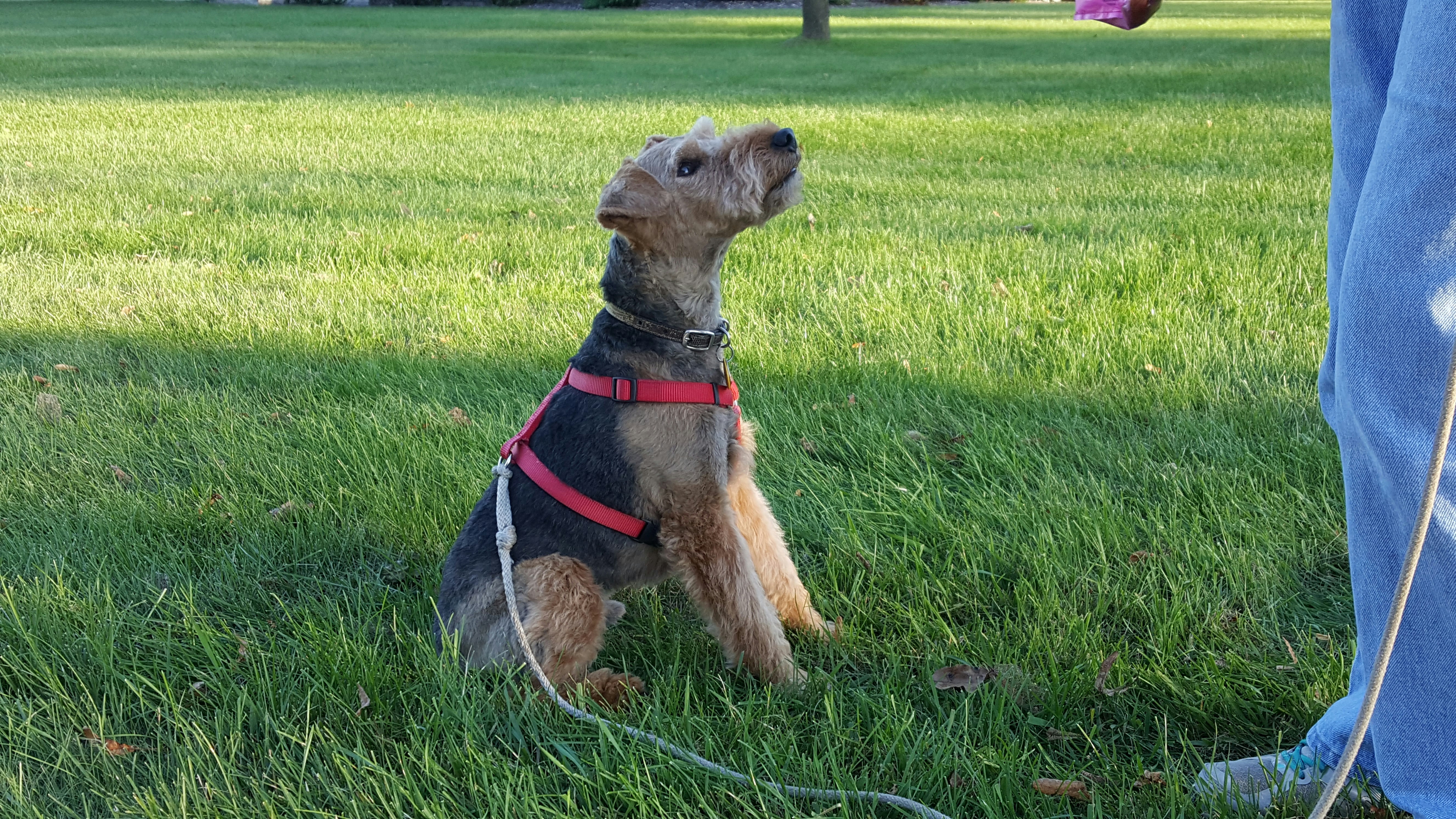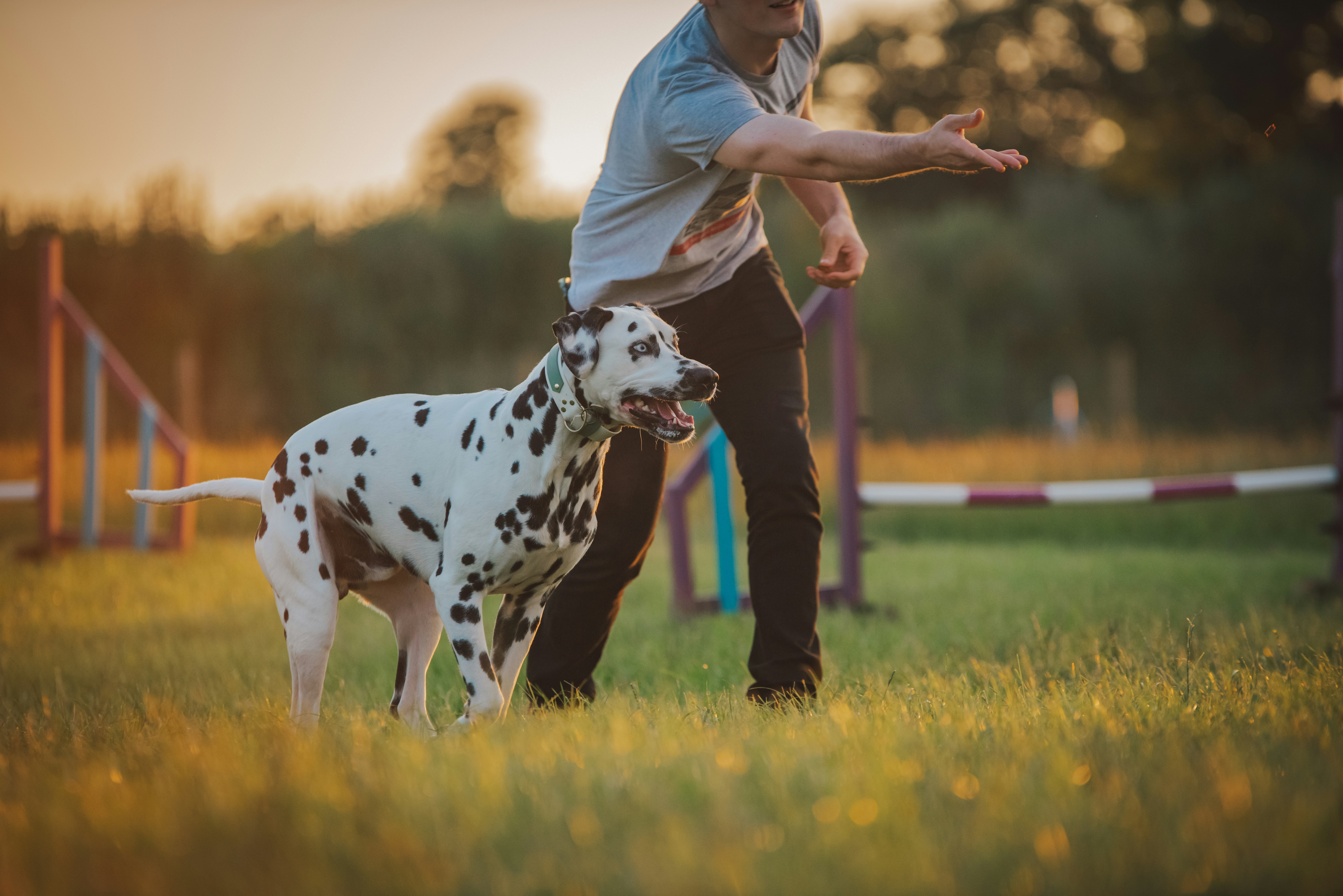
Most stay training fails for one reason: the dog was never taught when the stay ends.
If your dog does not know how the behavior finishes, it will decide for itself, and that looks like a dog that breaks the stay. It is not disobedience. It is a missing instruction.
So we teach the ending first, then the stay itself, then build the three variables that make it hold up in real life: duration, distance, and distraction. Never two at once.
Short answer: teach the release word first, so the dog knows how the position ends. Then build three variables one at a time and never together: duration beside the dog, then distance with the duration reset to three seconds, then distraction with both reset again. Reward in position, walk back to the dog before releasing, and say the cue once. A minute of duration takes two to three weeks; reliability in busy places takes months.
Start with the release cue
Pick a word: okay, free, or break. Anything you do not say often in normal conversation. Okay is popular but you probably say it fifty times a day, so free or break is cleaner.
Teach it on its own, before you teach stay:
- Ask your dog to sit.
- Wait one second.
- Say your release word in a bright, upward tone and take a small step backwards.
- The dog gets up and comes to you. Mark and reward.
Repeat ten or fifteen times over a couple of sessions. You are building one association: that word means the position is over.
From this point, the dog never ends a position on its own. You release it, every time, for the rest of its life. That single rule does more for stay than any amount of duration work.
Before you start
Your dog should already know sit or down reliably in a quiet room. Stay is not a first cue. It is a duration added to a position the dog already has.
Have small, soft treats ready in a pouch, work somewhere quiet, and keep sessions to about five minutes.
The marker, and where the food goes
Two mechanics decide whether a stay holds, and both are about timing rather than duration.
Use a marker word. A short yes the instant the behavior is right. It tells your dog precisely which moment earned the reward and buys you the seconds it takes to get food out of a pouch. Without it you are rewarding whatever your dog happened to be doing when the treat arrived — which, with a stay, is often the act of getting up.
Always pay at the dog. Walk back and deliver the food where your dog is sitting. Never call it to you for the reward. Calling your dog out of a stay to be paid teaches it that the fastest route to food is to break position, and it is the single most common reason stays fall apart at distance.
Step 1: the first stay is three seconds
Ask for a sit. Hold your open palm toward the dog and say stay once.
Count three seconds. Then, while the dog is still sitting, deliver a treat directly to its mouth, low, in position. Then say your release word.
That order matters more than anything else on this page:
Position, then wait, then reward in place, then release.
The reward pays the sitting. The release ends it. If you release first and reward second, you have paid the getting up.
Say the cue once. If you find yourself repeating stay, stay, stay, the dog is not ready at this level and the word is being worn out.
Free tool
Dog Training Session Builder
Generates a stay session sized to your dog’s attention span, with the criterion to hit before you make it harder.
Step 2: duration, without a pattern
Build the time in seconds, not in leaps: three, five, three, eight, four, ten.
Vary it deliberately. If you go 5, 10, 15, 20 in a predictable ramp, the dog learns to anticipate release at the point it expects. Random durations mean the dog holds until you say otherwise, which is the whole point.
Reward during the stay, not only at the end. For a twenty-second stay, feed at five seconds, at twelve, at twenty. Every treat delivered in position tells the dog that staying pays continuously.
Stand right next to your dog for this entire step. No distance yet.
Aim for a comfortable thirty seconds beside your dog before moving on.
Step 3: distance, and drop the duration
The moment you add distance, take the duration back to three seconds. This feels like undoing your work. It is not. You have changed the picture, so the difficulty resets.
- Say stay, take half a step back, step straight back in, reward in place, release.
- Then one step. Then two.
- Build distance the same way you built duration: irregularly. One step, three steps, one step, five.
Always return to your dog before releasing. Do not call the dog out of a stay from across the room in the early stages, because that teaches it to watch you for the moment it can leave. Walk back, reward in place, then release.
Break eye contact deliberately. Look away. Turn side-on. Turn your back for a second. A stay that only works while you are staring at your dog is no use when you are carrying groceries through a door.
Once you are at ten or twelve feet, start combining some distance and some duration, but reduce whichever one you are not currently pushing.
Step 4: distraction, back to basics again
Third reset. Stand next to your dog, three seconds, and add one mild distraction:
- Drop a treat on the floor three feet away
- Have someone walk past at a distance
- Bounce a ball once
- Open the front door
Then build distance and duration back up again at that distraction level.
Work up in order of difficulty: a family member walking past, then someone knocking, then food on the floor, then a dog visible at a distance, then a dog nearby. Each step is its own project.
If your dog fails twice in a row, the jump was too big. Go back to the last version it managed, get three easy successes, and end the session there.
Free tool
Stay carries the second-highest weight in our assessment. See how yours scores against five other cues.
The three variables, with actual targets
Every stay problem traces back to raising two of these at once. Working through them in order, with a target for each, removes most of the guesswork.
| Stage | Duration | Distance | Distraction | Move on when |
|---|---|---|---|---|
| 1 | 3–30 seconds | None, beside the dog | None | 30 seconds is comfortable |
| 2 | Back to 3 seconds | Half a step to 3 steps | None | 3 steps away, returning each time |
| 3 | 10–30 seconds | Up to 10 feet | None | Both hold together at that level |
| 4 | Back to 3 seconds | Beside the dog again | One mild distraction | Dog ignores it three times running |
| 5 | Rebuild to 30 seconds | Rebuild to 10 feet | Same distraction | Nine successes out of ten |
| 6 | 1–2 minutes | Across a room, out of sight briefly | Real-life distractions | This is a working stay |
Note what happens at stages 2 and 4: the numbers go backwards on purpose. Resetting is not lost progress, it is the mechanism.
Sit-stay or down-stay?
Use the right position for the job.
Sit-stay is for short holds, from a few seconds to a minute. Sitting is an active position and dogs get uncomfortable holding it.
Down-stay is for anything longer. A dog can hold a down for twenty minutes in a way it cannot hold a sit. If you want your dog to settle while you eat, train a down-stay.
Asking for a long sit-stay and then getting frustrated when the dog shifts is asking for the wrong thing.
From stay to settle: the long down
What most owners actually want is not a two-minute stay but a dog that lies quietly while they eat, work or talk to a visitor. That is a settle, and it is trained differently.
- Give it a place. A bed or mat that means this behavior. The mat becomes the cue, which is far easier for a dog to read than a word repeated across a room.
- Pay for stillness, not for the down. Deliver food quietly onto the mat while the dog is already relaxed. A dog fed for lying flat with its hip rolled learns something different from a dog fed for holding a tense sphinx position.
- Start with two minutes of your own boring activity. Read, chop vegetables, answer email. Build to twenty minutes over weeks.
- Give a chew for the long versions. A settle at dinner is far easier to keep if the dog has something to work on.
- Release deliberately, every time. Same word, same rule. A settle that ends whenever the dog gets bored is not a settle.
A settle is the single most useful household behavior on this site, and it takes months rather than weeks. Train it in parallel with stay rather than instead of it.
Stay and wait are different jobs
Worth separating, because it removes a lot of confusion.
Stay means do not move until I release you. Position is fixed, duration is open.
Wait means pause here, something is about to change. Used at doors, at curbs, at the trunk of the car. The dog pauses and is then given permission to move through.
Some trainers use only one word. That is fine too. The important thing is that you know which one you are asking for, because a dog asked to wait at a door and then expected to hold a twenty-minute settle is being set up to fail.
When your dog breaks the stay
First, work out why. There are only three real answers.
You raised two variables at once. The most common cause by far. Check what changed since the last successful rep.
The step was too big. Halve it. Two steps instead of four, five seconds instead of fifteen.
The dog does not know the release cue. Go back to the release cue exercise for a couple of sessions.
What to do in the moment: calmly reset the dog into position and make the next repetition easier. Do not repeat the identical rep it just failed, because that is practicing failure.
What not to do: do not tell the dog off. Punishing a broken stay makes the position itself feel risky, and you end up with a dog that is reluctant to settle at all. Reward-based methods are what veterinary behavior organizations recommend, and for a duration behavior like this one, punishment is particularly counterproductive, because you are trying to build relaxation and anxiety is the opposite of that.
Doorways deserve their own training, because that is where the consequences are real. See door manners and how to stop a dog jumping up.
Proofing the front door
Doorways are where a stay stops being a party trick, and they need their own progression because everything about them is exciting.
- Hand on the handle, nothing else. Ask for the position, touch the handle, reward in place, release. Repeat until dull.
- Handle turns, door stays shut. Same again.
- Door opens an inch, then closes. If the dog moves, you opened it too far. Half an inch is a legitimate step.
- Door opens fully, you stay inside. Reward in position several times before closing it.
- You step outside and come straight back in. Two seconds, then five.
- Finally, release the dog through the door on your word, on leash, so that going through is something you grant rather than something it takes.
Run the same six steps at the car door and the yard gate. The dog that treats an opening door as an invitation is the one this training exists for.
Where you will actually use it
Train these specifically, because they are the situations that matter:
- Doorways. Dog stays while you open the front door. This is the one that prevents a dog bolting into a road.
- Food bowl. Stay while the bowl goes down, released to eat.
- Car doors. Stay until released, so the dog does not leap out into traffic.
- Greeting visitors. A down-stay on a bed is more achievable than do not jump.
- Vet and grooming. A dog that holds a stand-stay makes examinations far easier.
Each of these needs its own training. A dog with a perfect stay in the living room has not been taught to stay at the front door.
Troubleshooting
The dog creeps forward a few inches at a time. The food is arriving from in front. Deliver it straight down to the mouth in position, and return to the dog rather than calling it.
It holds a stay perfectly until you turn your back. Your face was part of the cue. Add turning away as its own variable, one second at a time, at close range.
It breaks the moment you reach for the treat pouch. Mark first, then reach. The reach is currently predicting the end of the exercise.
It stays for thirty seconds indoors and three seconds in the yard. Expected. Every new location resets the difficulty, and rebuilding takes a handful of repetitions rather than a full retrain.
It lies down during a sit-stay. Either the sit is uncomfortable or the duration is too long for that position. Switch to a down-stay for anything over a minute.
A dog that could hold a down suddenly cannot. Comfort first, training second. Joint pain, a full bladder and a slippery floor all look like disobedience from a distance.
Common mistakes
- No release cue. Everything else follows from this.
- Raising two variables at once.
- Rewarding after the release rather than in position.
- Predictable duration, so the dog learns to anticipate.
- Repeating the cue.
- Only ever staring at the dog, producing a stay that collapses the moment you look away.
- Calling the dog out of the stay every time, instead of returning to it.
- Asking for long sit-stays when a down-stay is the right tool.
Realistic timeline
- Days 1 to 3: release cue, plus three to ten seconds beside the dog.
- Week 1: thirty seconds at your side, a step or two of distance.
- Weeks 2 to 3: a minute of duration, ten to fifteen feet of distance, mild distractions.
- Month 2: holding through moderate distractions, useful at doorways and the food bowl.
- Month 3 onwards: reliable in busy environments.
Adolescent dogs, roughly six to eighteen months, will lose ground. Reduce your criteria and rebuild rather than pushing harder. The mechanics behind all cue training are covered in our obedience training guide.
Watch the training in action
PawMastery on YouTube — 149,000+ subscribers following along with real training sessions.
Frequently asked questions
How long should a dog be able to stay?
A minute or two is plenty for most everyday situations. A down-stay for twenty or thirty minutes is achievable but is a settle behavior, trained separately over months.
Do I really need a release word?
Yes. Without one, the dog decides when the behavior ends, and that decision is what people call breaking the stay.
Why does my dog stay at home but not outside?
Dogs generalize poorly. Outside is a new picture, so the behavior needs rebuilding from short and close, not repeating at full difficulty.
Should I say stay or use a hand signal?
Both, together. Many dogs read the hand signal more reliably than the word, and having both is useful when your dog is too far away to hear you.
My dog stays but creeps forward. What is wrong?
The reward is probably coming from in front, drawing the dog toward you. Deliver treats directly to the dog’s mouth in position, and return to the dog rather than calling it.
Can I teach stay to an older dog?
Yes. Adult dogs often learn duration behaviors faster than puppies because they settle more easily.
How long should training sessions be?
About five minutes, two or three times a day. Stay is mentally tiring, so short and frequent works far better than long.
Can I use stay to stop my dog running out of the door?
It helps, but a physical layer matters more. Train the door stay properly and still use a gate, a leash or a closed inner door while the training is young. Management and training work together rather than as alternatives.
Should I ask for a stay when my dog is already excited?
Not while you are building it. A known behavior gets much harder under arousal, so train it calm and add excitement gradually as its own variable.
How do I add the out-of-sight version?
One second behind a door frame, then back. Build from there. Out of sight is a big jump for most dogs and it belongs near the end, not in week two.
My puppy cannot hold a stay at all. Is that normal?
Yes. Duration is hard for a young puppy, and three to five seconds is a genuine achievement at twelve weeks. Build seconds, not minutes, and expect it to come apart during adolescence.
Is it fair to ask a dog to hold a long stay?
A settle on a comfortable bed, yes, for as long as the dog is relaxed. A rigid sit-stay for twenty minutes, no. Choose the position to fit the length, and let the dog shift and get comfortable during long settles.
A dog that suddenly struggles to hold a position it knew, sits or lies crookedly, or is slow to rise may be in pain rather than being disobedient. Speak to your veterinarian before increasing the training.
Sources
- China, Mills & Cooper, first-command responsiveness by training method, Frontiers in Veterinary Science
- Herron et al., confrontational and non-confrontational training methods, Applied Animal Behaviour Science
- Kis et al., the interrelated effect of sleep and learning in dogs, Scientific Reports
- Mills et al., pain and problem behavior in cats and dogs, Animals
- Asher et al., adolescent-phase behavior and reduced trainability in dogs
- ASPCA: general dog care
- AVSAB Position Statements on Humane Dog Training