Puppy biting is normal, it peaks somewhere between eight and sixteen weeks, and it ends. What determines how fast it ends is not how firmly you correct it. It is whether your puppy is getting enough sleep, whether your reaction is accidentally making the game more fun, and whether you are teaching a replacement behavior instead of just suppressing the biting.
If your puppy is biting hardest in the evening, skip ahead to the section on overtiredness. That is the answer for most people, and almost nobody mentions it.
Why puppies bite
Four reasons, roughly in order of how often they are the actual cause.
They are overtired. By a wide margin the most common cause of the biting that makes owners desperate. Covered in detail below.
Mouths are how puppies investigate. A puppy has no hands. Everything new gets tested with teeth: your fingers, the rug, your shoelaces, the cat.
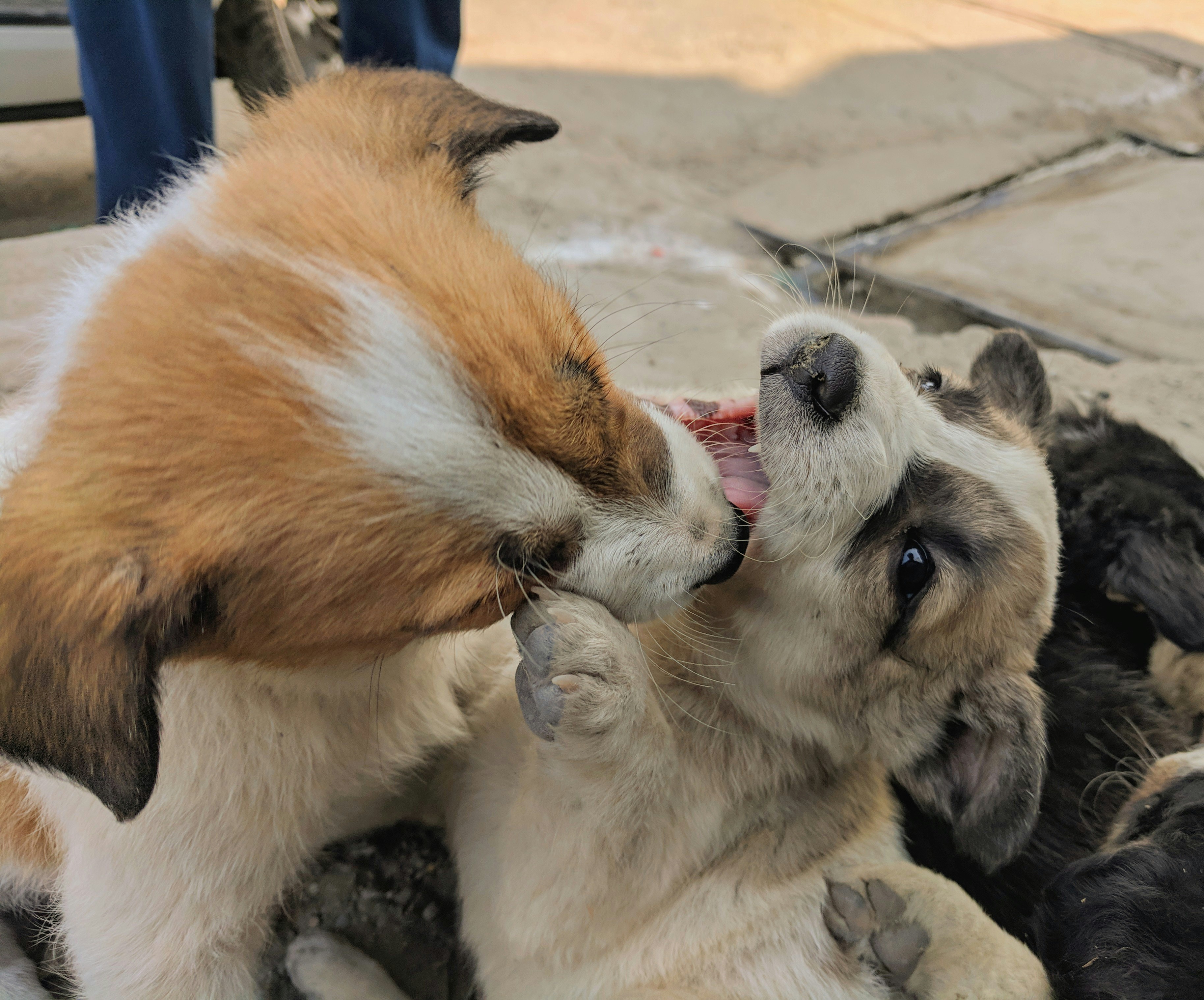
Play. Littermates wrestle and bite. That is normal dog play, and when the litter is gone, you inherit the role. Your puppy is not being aggressive; it is playing the only way it knows.
Teething discomfort. Real, but smaller than most owners assume, and it arrives later than the peak biting period.
Notice what is not on this list: dominance. A puppy biting your ankle is not competing with you for rank. The American Veterinary Society of Animal Behavior has been explicit that dominance theory is an outdated framework for pet behavior, and that most undesirable behavior comes from accidental reinforcement rather than status-seeking. This matters practically: an owner who believes the puppy is challenging them tends to respond with force, and force is what turns ordinary mouthing into a real problem.
Night sleep and daytime naps are one system. See our guide to puppy sleep and crying at night.
Free tool
Puppy Potty Training Planner
Builds the nap and toilet rhythm for your puppy’s exact age — overtiredness is the most common cause of the biting owners find unmanageable.
The overtired puppy: the piece most guides leave out
Young puppies need roughly 16 to 18 hours of sleep a day. Some need more. When they do not get it, they do not get sleepy. They get frantic, uncoordinated, and bitey, exactly like an overtired toddler.
The pattern is recognisable once you know it:
- Biting is dramatically worse in the late afternoon and evening
- The puppy will not disengage, and normal redirection stops working
- The body is tight and fast rather than loose and bouncy
- It gets worse the longer play continues, not better
The instinct here is to play harder and tire them out. That reliably makes it worse: you are adding stimulation to a brain already running on stress hormones.
What to do instead: put the puppy in a crate or pen, dim the lights, and leave it alone. If it settles within ten or fifteen minutes, it needed sleep. If it is still alert and calm after fifteen minutes, it genuinely needed activity, and you can let it out.
Prevent it rather than fixing it. Most young puppies can handle roughly one to two hours awake before they need a nap. Track your puppy’s awake windows for a single day and you will usually find the evening explosion lines up precisely with a missed nap four hours earlier.
Bite inhibition, meaning control of jaw pressure, requires impulse control, and impulse control requires a rested brain. An exhausted puppy physically cannot moderate its bite. Training a puppy in that state is wasted effort.
Enforced naps usually mean a crate or pen, and how you introduce it decides whether the puppy settles or panics. See crate training done properly.
What to do the moment teeth touch skin
The goal is to make biting boring and everything else interesting. Here is the sequence.
1. Freeze. Stop moving your hand. Jerking away triggers chase and grab, and a moving hand is a far better toy than a still one. Go completely still and quiet.
2. Disengage. Stand up, fold your arms, turn away, and stop all interaction. No talking, no eye contact, no pushing the puppy off. Any of those is attention, and attention is the reward.
3. Use a reverse time-out. If the puppy keeps going, you leave. Step over a baby gate or out of the room for ten to thirty seconds. This works better than carrying the puppy to a crate, which is slower, more physical, and risks turning the crate into a punishment.
Ten to thirty seconds is enough. Longer breaks do not teach more; the puppy stops connecting the break to the bite, and long isolation can create anxiety around being alone.
4. Come back and restart calmly. With a toy in your hand this time.
5. Reward the mouth doing something else. This is the step most people skip. When your puppy chews a toy on its own, quietly praise it. When it licks your hand instead of biting, praise that too. Suppressing a behavior without building a replacement leaves the puppy with nothing to do with its mouth.
One timing detail that matters
If your puppy bites you and you immediately produce a toy, you have just taught it that biting you is how you start a game.
Break the sequence. Bite, then interaction stops, then a short pause, and then the toy appears. Better still, have a toy in your hand before play starts, so hands are never the target in the first place.
If you have an adult dog at home, it needs protecting from the puppy rather than the reverse. See introducing a second dog.
Teaching bite inhibition
Bite inhibition is the ability to control jaw pressure. It matters more than stopping mouthing entirely, because a dog that has learned to be gentle with its mouth is far less likely to cause injury in a startled moment years later.
The training is gradual and works on a sliding scale.
Stage one: stop the hardest bites. Any bite that genuinely hurts ends the interaction immediately.
Stage two: raise the standard. Once the hard bites are gone, respond the same way to medium-pressure bites.
Stage three: raise it again. Now even light pressure ends the game.
Stage four: mouth on skin at all is what ends play. Most puppies reach this around five or six months.
Do not skip to stage four in week one. A puppy that has never learned the difference between hard and soft pressure has no scale to work from. Teaching pressure control first, and no-teeth-at-all second, is the order that produces a dog with a soft mouth.
Structured socialization and puppy classes help a great deal here, because supervised play with other puppies of similar size and age gives your puppy feedback you cannot replicate.
Note the word supervised. Deliberately letting an unfamiliar adult dog correct your puppy is a bad idea. A single frightening correction from a large adult dog can produce a puppy that is fearful of dogs for life. That is a trade nobody should make.
What does not work
Yelping. Widely recommended, and it does work for some puppies. But for a substantial minority, and for any puppy that is already tired or overexcited, a high-pitched noise escalates arousal rather than dampening it. If you have tried yelping and your puppy got more excited, that is a known outcome, not a failure on your part. Switch to freezing and disengaging.
Physical correction. Muzzle grabs, nose taps, holding the mouth shut, alpha rolls, pinning. These damage trust, and veterinary behaviorists have documented that confrontational handling can produce a defensive, escalating response rather than a calmer dog. There is also no version of these techniques that a child can safely use, which alone rules them out in a family home.
Punishing growls. A growling puppy is communicating discomfort. Punish the growl and you do not remove the discomfort; you remove the warning. That produces a dog that bites without signalling first.
Rough hand play. Wrestling with your hands, letting the puppy chase your fingers, tug played with your sleeve. All of it teaches that hands are toys, then you spend months untraining it.
Bitter sprays as a primary strategy. Occasionally useful on furniture. Useless for social biting, because the behavior is about interaction, not taste.
Object chewing is a separate problem from mouthing people, and it has its own causes and safety rules. See our guide to destructive chewing and what is safe to chew.
Biting is one stage of a longer developmental arc. See the full puppy training schedule by age.
Teething: the real timeline
Teething gets blamed for more biting than it causes, partly because owners are given the wrong dates.
Puppies start getting their baby teeth at around three weeks, and all 28 are usually in by six weeks, long before you bring the puppy home. The adult teeth begin pushing through at around twelve weeks, and most puppies have their full set of 42 permanent teeth by six months, with some finishing closer to seven or eight months.
So a nine-week-old puppy shredding your hands is not teething. It is investigating and playing. Actual teething discomfort lands later, roughly from three to six months, and it drives chewing on objects more than biting people.
For genuine teething relief: a frozen wet washcloth twisted into a rope, chilled rubber toys, and a stuffable rubber toy filled with wet food and frozen solid. All cheap, all effective.
What to avoid: veterinary dentists generally advise against anything genuinely hard, including antlers, bones, and hard nylon, because they fracture teeth. A useful rule is not to let a dog chew anything that will not flex under your thumbnail.
If you find a baby tooth still in place next to an erupting adult tooth, mention it to your vet. Retained baby teeth can push adult teeth out of alignment and usually need removing.
Puppies and children
Children get bitten more than adults, for reasons that have nothing to do with the child’s behavior: they are at face height, they move fast, they squeal, and they wave their hands. Every one of those is a play trigger.
- Keep a leash on the puppy indoors during child and puppy time, so you can end an interaction without grabbing at the puppy
- Teach children to stand still and fold their arms rather than run, because running turns them into prey in the puppy’s mind
- No games where the child’s hands, feet, or clothing are the toy
- Give the puppy a pen or crate that children are not allowed to enter, and enforce it
- Supervise directly, in the room, not from the kitchen
Children cannot reliably perform the freeze-and-disengage routine, so an adult should be the one managing it.
When does it stop?
Most puppies show clear improvement between four and five months, and mouthing is largely gone by six to eight months as adult teeth finish coming in and impulse control develops.
Progress is not linear. Expect a good week followed by a bad one, particularly around teething and adolescence. That is normal and not a sign the training has failed.
If there has been no improvement at all after four to six weeks of consistent handling, something else is going on: usually a management problem, where the puppy is being accidentally rewarded somewhere, or a sleep problem. Or it is genuinely not play biting.
Telling these apart comes down to reading the body rather than the teeth. See our guide to dog body language for the signals most owners miss.
Play biting vs fear vs aggression
Most puppy biting is play. A small amount is not, and telling them apart changes what you should do.
Play biting looks like: a loose, wiggly body, a wagging tail with a full-body sway, play bows, bouncing, and pauses where the puppy comes back for more. Pressure varies. There is no fixed stare.
Fear-based biting looks like: a lowered body, tucked tail, ears back, weight shifted backwards, the puppy trying to retreat first and biting only when cornered. Often the puppy freezes before it bites.
Warning signs worth taking seriously: a hard, still stare; a stiff body that stops moving entirely; a low growl with the body frozen; guarding food, toys, or a sleeping spot; biting that consistently breaks skin rather than occasionally scratching; biting directed specifically at one family member.
Fear-based biting is not fixed with time-outs. It needs the frightening thing removed and a gradual, positive reintroduction, and usually professional guidance.
If the biting happens specifically around food, chews, or a resting place, that is a different problem with a different solution. See our guide to resource guarding.
When to get professional help
Contact a certified trainer or a veterinary behaviorist if:
- Bites regularly break skin rather than occasionally scraping
- Your puppy freezes, stares, or growls with a rigid body before biting
- There is resource guarding around food, toys, or resting places
- The biting targets a specific person, especially a child or an elderly family member
- There is no improvement after four to six weeks of consistent work
- Anyone in the household is now afraid of the puppy
That last one is enough on its own. A household walking on eggshells around a fourteen-week-old puppy needs help now, while the problem is small and the dog is still small.
Look for someone who uses reward-based methods. AVSAB’s current position is that only reward-based training methods should be used for dog training, including for behavior problems. If a trainer proposes alpha rolls, pinning, or shock, find a different trainer.
Watch the training in action
PawMastery on YouTube — 149,000+ subscribers following along with real training sessions.
Frequently asked questions
Why does my puppy bite me and not my partner?
Usually because of how each of you moves and reacts. Faster movement, higher-pitched reactions, and more hand play all invite biting. It can also be who plays with the puppy when it is overtired.
Is it normal for a puppy to growl while play biting?
Yes. Play growling is common and comes with a loose, bouncy body. A growl paired with a stiff body and a hard stare is a different signal and should not be punished, because it is a warning worth listening to.
Should I let my puppy bite my hands gently?
Early on, yes. That is how bite inhibition gets taught. By five or six months, raise the standard so no teeth on skin ends the game.
Does neutering stop puppy biting?
No. Play biting is developmental, not hormonal, and it resolves with age and training regardless.
My puppy bites more when I say no. Why?
Because no is attention, and attention is what the puppy wants. Silence and disengagement work better than any word.
Can I use a spray bottle or bitter spray?
Bitter spray has some use on furniture. Neither works for social biting, and spraying a puppy in the face risks creating fear of your hands.
How long should a time-out be?
Ten to thirty seconds. Longer does not teach more and can cause distress. Frequency of repetition matters more than duration.
This article covers normal puppy behavior. If your puppy shows sudden changes in temperament, bites that seem disproportionate to the situation, or any biting accompanied by signs of pain, consult your veterinarian, because behavior changes sometimes have medical causes. For persistent aggression or fear, work with a veterinary behaviorist.