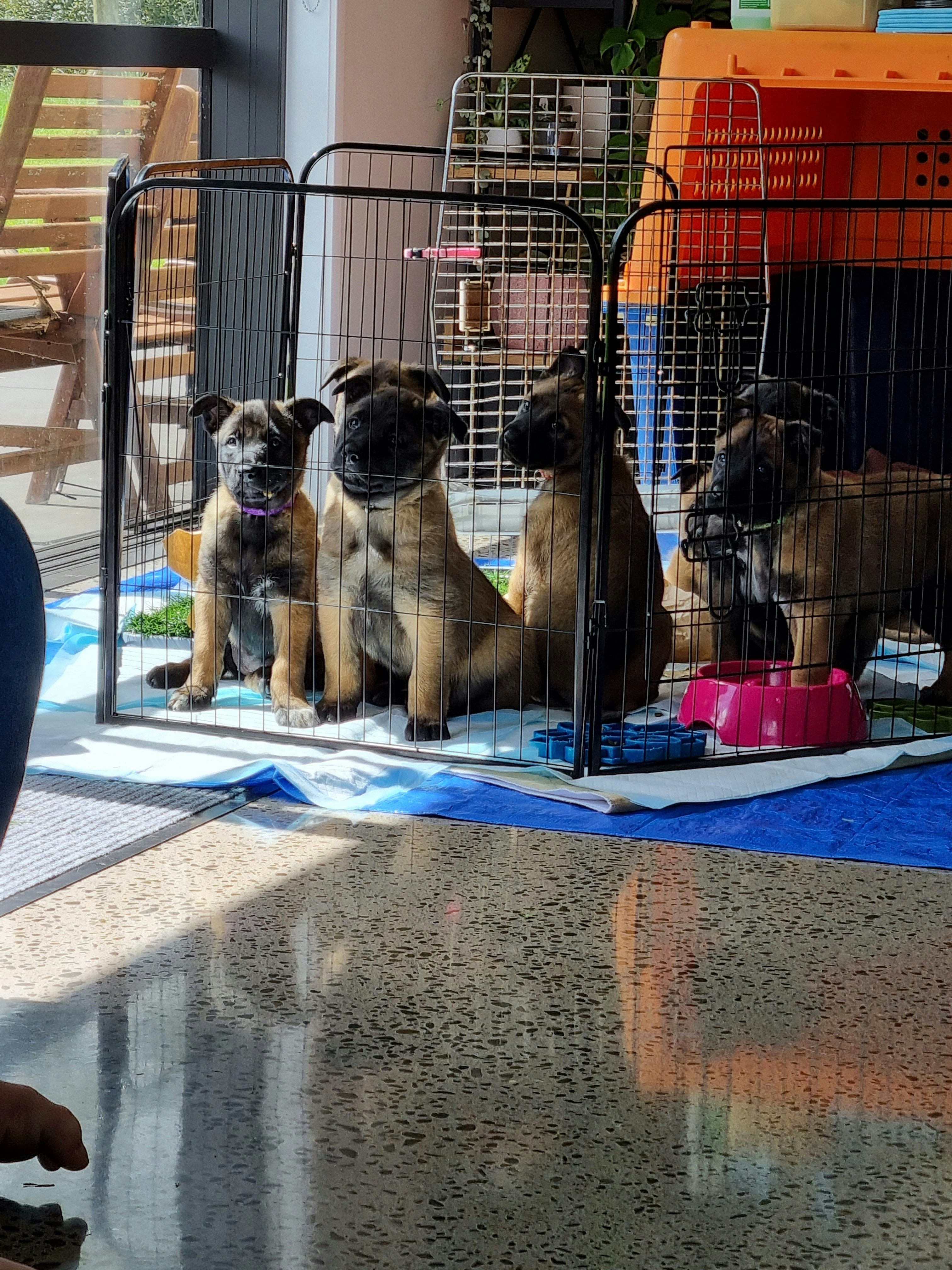
It is 2am on your puppy’s second night. It has been crying for forty minutes. You have read that going to it teaches it to cry, and you have also read that leaving it is cruel, and neither piece of advice is helping you right now.
Here is the part that resolves most of it: a puppy crying at night is almost always saying one of two things — I need to go out, or I have never been alone in my life and I am frightened. Both have answers. Neither is manipulation, and a puppy this age is not capable of it.
Short answer: put the crate beside your bed, empty the puppy right before lights out, set one alarm four to five hours later, and go to the puppy during a pause in the crying rather than at its peak. Keep night trips silent and boring. An eight-week-old will usually wake once or twice; most puppies sleep through by around four months. Crying on the first three nights is normal and is not manipulation.
Why this matters more than getting through the night
Sleep is not downtime for a young dog. It is when learning gets fixed.
A study published in Scientific Reports taught dogs new commands in a foreign language and then measured their sleep. Sleep structure changed after the learning session, activity in specific frequency bands correlated with how much performance improved, and dogs that slept after training performed better afterwards. Sleep spindle density has also been linked to learning performance in dogs, in the same way it is in humans.
The practical translation: a puppy that does not sleep enough does not consolidate what you taught it, and it is also more frantic, more bitey, and less able to control itself the following day. Fixing the nights is not just about your rest.
Free tool
Puppy Potty Training Planner
Get an exact schedule for your puppy’s age, including how many night trips to expect and when to set the alarm.
The nights are one part of a longer arc. See our puppy training schedule by age.
What is normal
Young puppies need roughly 16 to 18 hours of sleep in 24, and they do not take it voluntarily in a busy household.
On bladder capacity, the working rule is age in months plus one, in hours — so an eight-week-old manages about three hours at a stretch, and less when awake and active. Expect one or two night trips at eight weeks, one by twelve weeks, and most puppies sleeping through somewhere around four months.
The first three nights are usually the hardest. Your puppy has just lost its mother and every littermate it has ever slept against, traveled in a car for the first time, and arrived somewhere with unfamiliar smells. Crying is a reasonable response to that.
What to expect at each age
Almost every “my puppy will not sleep” problem is a puppy being asked for more than its bladder and its brain can currently manage.
| Age | Longest realistic stretch | Night wake-ups | What is normal |
|---|---|---|---|
| 8 weeks | About 3 hours | 1–2 | Real crying on nights one to three; needs to be beside you |
| 10 weeks | 3–4 hours | 1–2 | Settles faster, still wakes early in the morning |
| 12 weeks | 4–5 hours | 1 | Crate can start moving away from the bed |
| 16 weeks | 5–7 hours | 0–1 | Most puppies now sleep through most nights |
| 5–6 months | Through the night | 0 | Occasional regressions during adolescence |
Small breeds sit a step behind this table, because bladder capacity is genuinely smaller rather than because the puppy is being difficult.
The single change that fixes most cases
Put the crate or bed beside your bed. Not the kitchen, not the utility room, not downstairs.
This one decision does more than everything else combined:
- The puppy is not alone, so the fear that drives most of the crying is gone
- You hear it stir before it becomes desperate, which means you catch potty needs early instead of cleaning up at 4am
- You can drop a hand down to the crate without getting up, which settles many puppies instantly
- You are building a positive association with the crate while you sleep, at no extra effort
Owners are often told this will create a dependency. In practice the opposite happens: puppies that start close and are moved gradually settle faster than puppies left to panic alone and then moved closer in desperation two weeks later.
Move the crate a foot further away every few nights once the puppy is sleeping soundly, and most reach their final spot within a few weeks. Our guide to crate training and where the limits are covers the introduction in detail.
Setting the sleeping space up properly
The setup does a surprising amount of the work, and it is easier to get right before night one than to fix at 3am.
- Size the crate for now, not for the adult dog. The puppy should be able to stand, turn and lie stretched out, and no more. A crate big enough to have a bathroom corner will get one. Use a divider and move it out as the puppy grows.
- Bedding it cannot shred and swallow. A flat vet bed is safer overnight than a thick fluffy one, especially with a chewer.
- Cover three sides. A light cover makes the crate feel like a den and cuts the visual noise of an unfamiliar room. Leave one side open for airflow.
- Keep it dark and dull. No night light bright enough to make the room interesting, and no television in the background.
- Something that smells right. A cloth carrying the smell of the litter, or an unwashed t-shirt of yours, helps more than any gadget.
- Have the cleanup kit ready by the door. Enzymatic cleaner, paper towels, a spare bed. Accidents at 3am are much less stressful when you are not hunting for supplies.
The night routine
Wind down properly. No boisterous play in the last hour. An overstimulated puppy cannot switch off any more than an overtired toddler can.
Stop food two to three hours before bed, and lift the water bowl about an hour before, with a final potty trip right at bedtime.
Empty the puppy properly last thing. Outside, same spot, boring, wait for the result. A puppy put to bed with a full bladder will wake you.
Give something to settle with — a frozen stuffed rubber toy, or a soft toy. Licking is calming in a way that nothing else is.
Set one alarm roughly four to five hours after bedtime for an eight-week-old. Waking the puppy on your schedule is easier than being woken on its schedule, and it prevents the puppy learning that crying is what produces a potty trip.
Night potty trips: silent and boring
This is where people accidentally create a problem.
No lights on if you can avoid it. No talking. No play. No cuddles. Out, potty, quiet praise, straight back to the crate.
If 3am becomes social hour, your puppy will book it every night. Make the trip so dull that the only thing worth waking for is the actual potty need.
The five mistakes that make night one worse
1. Starting the puppy downstairs. Almost every household that begins in the kitchen ends up moving the crate upstairs within a week, after both parties have had a miserable time. Start close and fade out later.
2. A big exciting evening. Visitors, new toys and boisterous play in the last hour produce an overstimulated puppy that physically cannot switch off.
3. Going at the loudest moment. Timing is the whole thing. Arriving at the peak of the crying teaches the puppy which volume works. Arriving in a pause teaches it that quiet works.
4. Turning the night trip into a social event. Lights, chat and a cuddle make 3am worth booking again tomorrow.
5. Changing the plan every night. Kitchen on Monday, bedroom on Tuesday, bed on Wednesday, back to the kitchen on Thursday. Puppies settle on predictability, and four different arrangements in four nights is the one thing that reliably prevents it.
Should you go to a crying puppy?
The honest answer is that it depends on when you go, not whether.
The problem with never going: a puppy that needs to go out and is ignored soils its bed. Once that happens a few times, the instinct not to soil where it sleeps — the whole mechanism house training depends on — is broken, and it does not come back easily. Prolonged distress also is not neutral for a young animal.
The problem with always going the moment it cries: the puppy learns that crying produces you.
What actually works: go, but go during a pause rather than at the peak. Puppies cry in bursts. Wait for a gap of a few seconds, then go quietly. Take it out if it might need to go out, and return it to the crate without fuss.
What you are rewarding is the quiet moment, not the crying. That distinction is the whole answer, and it is far more practical than either extreme.
And if the crying is escalating rather than settling — frantic, sustained, drooling, with attempts to escape the crate — stop treating it as a routine problem. That is panic, and confinement will make it worse. Use a pen or let the puppy sleep beside you on the floor for now.
Moving the crate away, without going backwards
Sleeping beside you is a starting position, not a permanent arrangement, and the fade-out is straightforward once the puppy is settling within a few minutes.
- Wait for three quiet nights in a row before you move anything.
- Move about a foot every two or three nights. Slow enough that the puppy does not notice a change.
- The doorway is the hard step. Going from inside the room to just outside it is a bigger jump than the whole distance across the floor. Do that one with the door open first.
- If a move produces crying, go back one position for a few nights, then try again. That is information, not failure.
- Some households simply keep the dog in the bedroom. That is a legitimate choice and it does not cause behavior problems, whatever you have been told.
Building alone-time separately
Night-time is the wrong place to teach a puppy to be alone, because you are asleep and the sessions last eight hours.
Do it in daylight, in seconds. Puppy in the pen with a chew, you visible. Step out of sight for five seconds and return before it notices. Then thirty seconds, two minutes, five.
Always return while the puppy is calm, never in response to crying.
This matters more than most owners realize. Research on separation-related problems identifies regular short absences during puppyhood as a protective factor. A puppy that is never left alone has not been spared anything — it simply has not learned the skill. See our guide to separation anxiety and what the research shows.
Daytime naps decide night-time sleep
Counter-intuitive and consistently true: an overtired puppy sleeps worse, not better.
The pattern most owners miss is that puppies cannot self-regulate. Left in a busy household, they stay awake until they are frantic, and a frantic puppy neither settles at bedtime nor stops biting.
Work in cycles: roughly one to two hours awake, then an enforced nap in a crate or pen with the lights dimmed. If the puppy settles within ten or fifteen minutes, it needed sleep. If it is still alert and calm after fifteen, it genuinely needed activity.
Track the awake windows for a single day and you will usually find the evening meltdown lines up exactly with a nap that got missed four hours earlier. Our guide to the first month covers the full daily rhythm.
Troubleshooting the specific patterns
The puppy settles at bedtime but screams at 5am. Usually a full bladder plus daylight. Bring your alarm earlier than the wake-up for a week so you are choosing the time rather than the puppy, then push it later by fifteen minutes a week.
It sleeps fine in the living room but not in the crate. The crate association needs work in daylight, separately, with food. Nights are the wrong place to teach it.
It only settles when touching you. Common at eight weeks. Let a hand rest against the crate at first, then a fingertip, then nothing. Fade it over a week rather than removing it in one night.
It cries the moment the crate door closes, at any hour. Work on the door itself during the day: closed for one second, fed, opened. Build up in seconds. Use a pen overnight until that is solid.
It was sleeping through and has started waking again at six months. Adolescence, or something changed in the house. Rule out a medical cause if it persists more than a few nights, then treat it like week one for a short period.
You are exhausted and losing patience. Take the sofa in shifts with someone else if you can, and remember the shape of the timeline: the hardest part is measured in nights, not months.
When it is not a settling problem
A few patterns mean something else:
- Crying that gets worse over weeks rather than better. Normal settling improves; this does not.
- Soiling the crate repeatedly despite appropriate sizing and timely trips — check with a vet, because urinary infections are common in puppies and easily mistaken for a training failure.
- Frantic escape attempts, drooling, damaged nails or teeth. Stop crating and speak to your vet.
- Distress the moment you leave the room, at any time of day. That is a separation-related problem, not a night-time one.
- A previously settled puppy that starts crying again. Worth a veterinary check, especially if there are other changes.
Realistic timeline
- Nights 1–3: disrupted, significant crying, one or two potty trips. This is normal and not a sign anything is wrong.
- Week 1: settling faster, still waking once or twice.
- Weeks 2–4: one wake-up, settling within minutes.
- By 12–16 weeks: most puppies sleep through, and the alarm can be pushed later by fifteen to thirty minutes each week.
Small breeds often take longer, because bladder capacity is genuinely smaller.
Watch the training in action
PawMastery on YouTube — 149,000+ subscribers following along with real training sessions.
Frequently asked questions
Should I ignore my puppy crying at night?
Not entirely. Go during a pause in the crying rather than at its peak, take the puppy out if it may need to go out, and return it quietly. Ignoring a puppy that needs to eliminate risks breaking the instinct house training depends on.
Where should my puppy sleep the first night?
Beside your bed, in a crate or pen. It reduces distress, lets you hear early potty signals, and is the single most effective change for most households.
How long can an 8-week-old puppy sleep at night?
Around three hours at a stretch, so expect one or two night trips. Most puppies sleep through by around four months.
Will letting my puppy sleep near me create bad habits?
No. Puppies that start close and are moved gradually usually settle faster than those left alone from night one.
Why is my puppy worse in the evening?
Overtiredness. Puppies need 16 to 18 hours of sleep a day and will not take it voluntarily. The evening meltdown usually traces back to a missed nap earlier.
How much sleep does a puppy actually need?
Roughly 16 to 18 hours in 24. Sleep is also when learning is consolidated, so a sleep-deprived puppy trains poorly the next day.
Should I use a crate or a pen at night?
Either, provided the puppy is comfortable in it. If your puppy panics when the door closes, use a pen and work on the crate separately in daylight.
My puppy soils the crate every night. What am I doing wrong?
Usually the crate is too large, the trips are too infrequent, or the puppy cannot hold on that long yet. If those are addressed and it continues, see your vet.
Can I let my puppy sleep on my bed?
Once house training is reliable, it is a personal choice rather than a training error. Before that, a puppy on the bed cannot signal that it needs to go out and cannot be contained, so a crate or pen beside the bed is more practical.
Should I use a heartbeat toy or a ticking clock?
They help some puppies and do nothing for others, and neither replaces being in the room. Try one if you like, but do not swap a working setup for a gadget.
How do I know if it is the bladder or the loneliness?
Take the puppy straight out with no interaction. If it goes, it was the bladder. If it stands there looking at you and cries again once returned, it was company, and the answer is proximity plus a duller routine.
What if I work early and cannot do a 2am alarm?
Set the alarm for whatever time you can manage and accept the occasional accident until the puppy can hold on longer. A pen with an absorbent area outside the sleeping space is a reasonable compromise for those weeks.
My puppy sleeps through but cries when I leave the room in the daytime. Is that the same problem?
No, and it needs a different plan. That is about being alone rather than about night-time, and it is built in seconds during the day rather than in eight-hour blocks overnight.
Persistent night-time soiling, escalating distress, or a previously settled puppy that starts waking again can have medical causes, including urinary tract infections. Speak to your veterinarian rather than intensifying the routine.