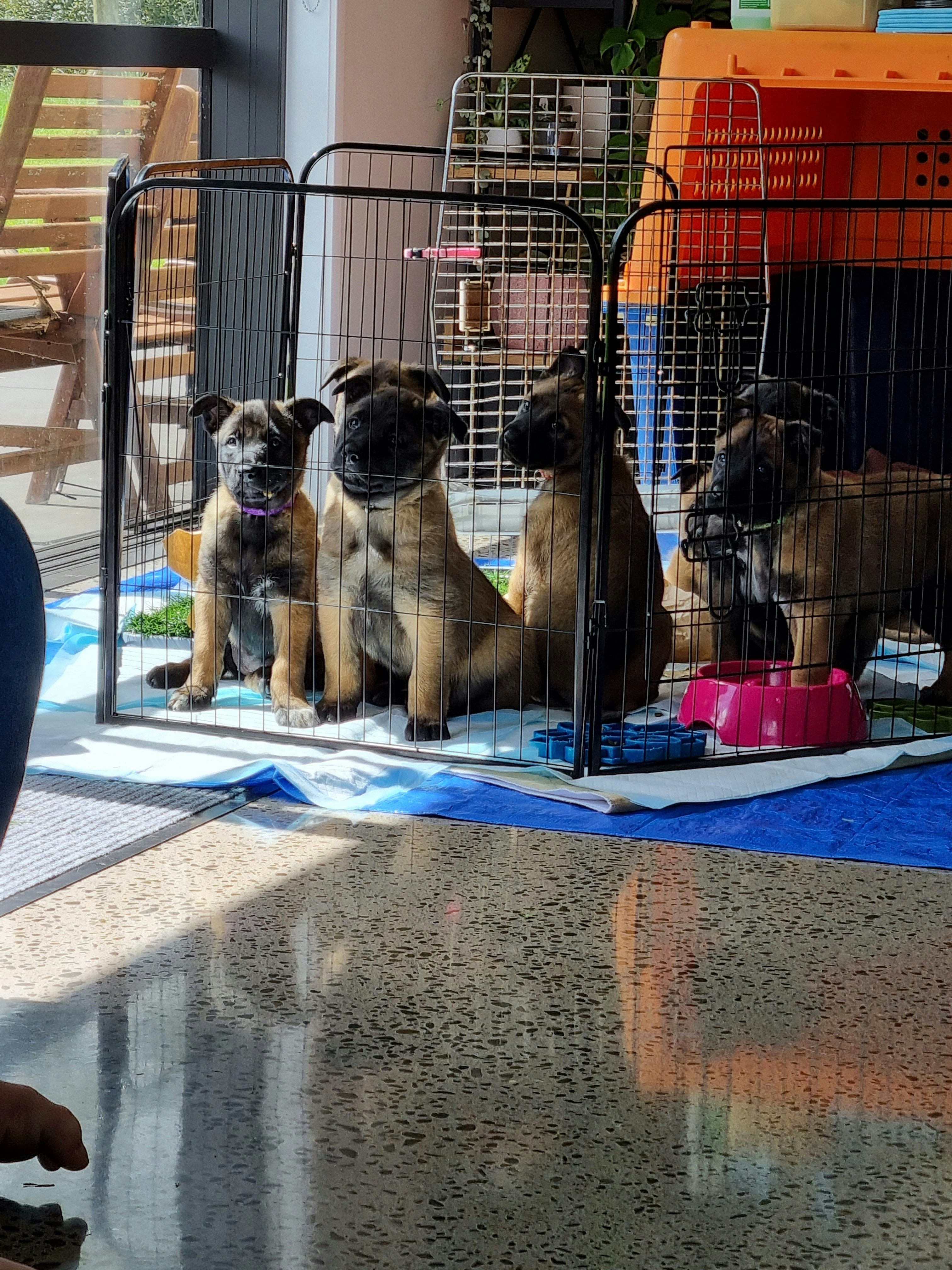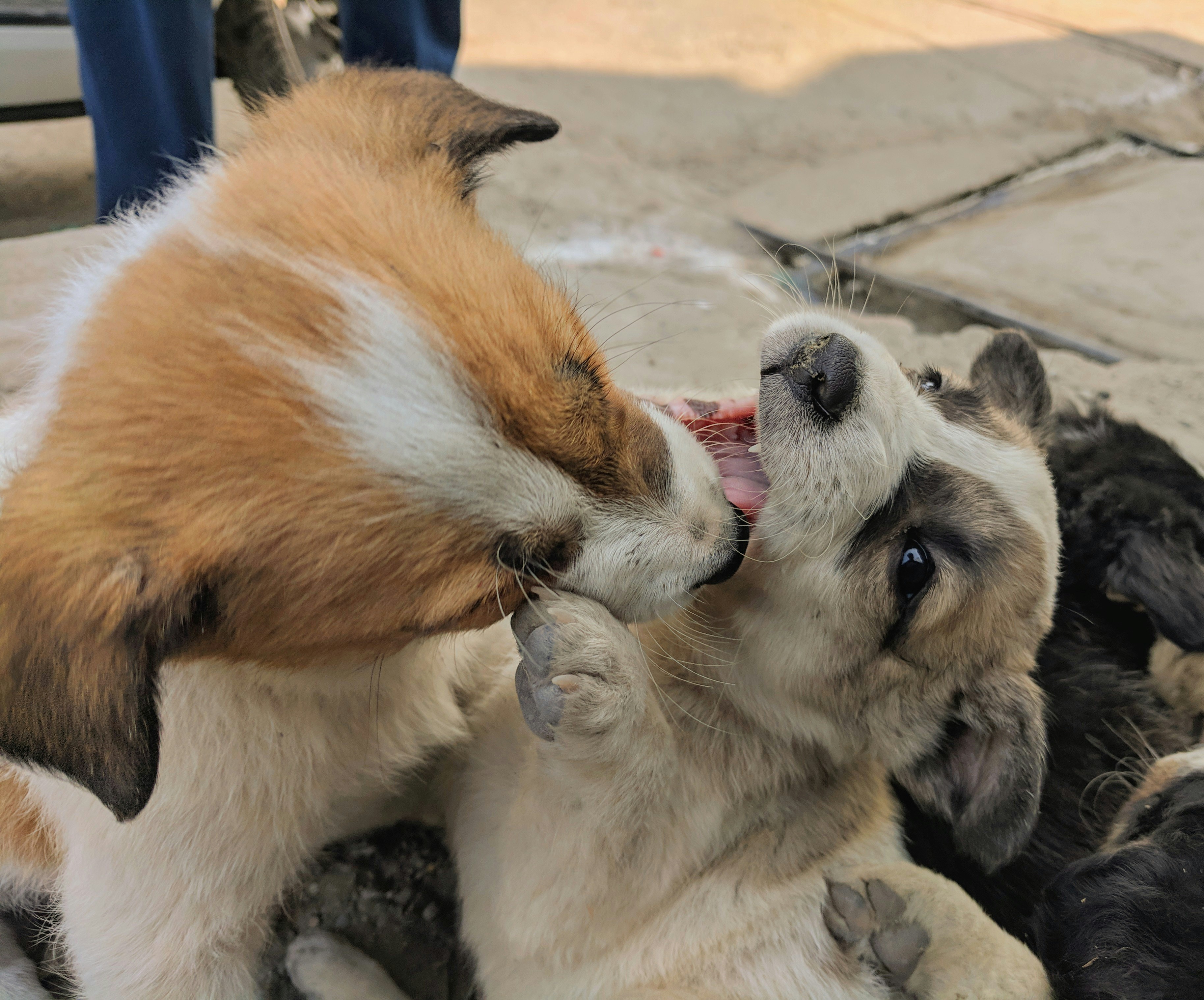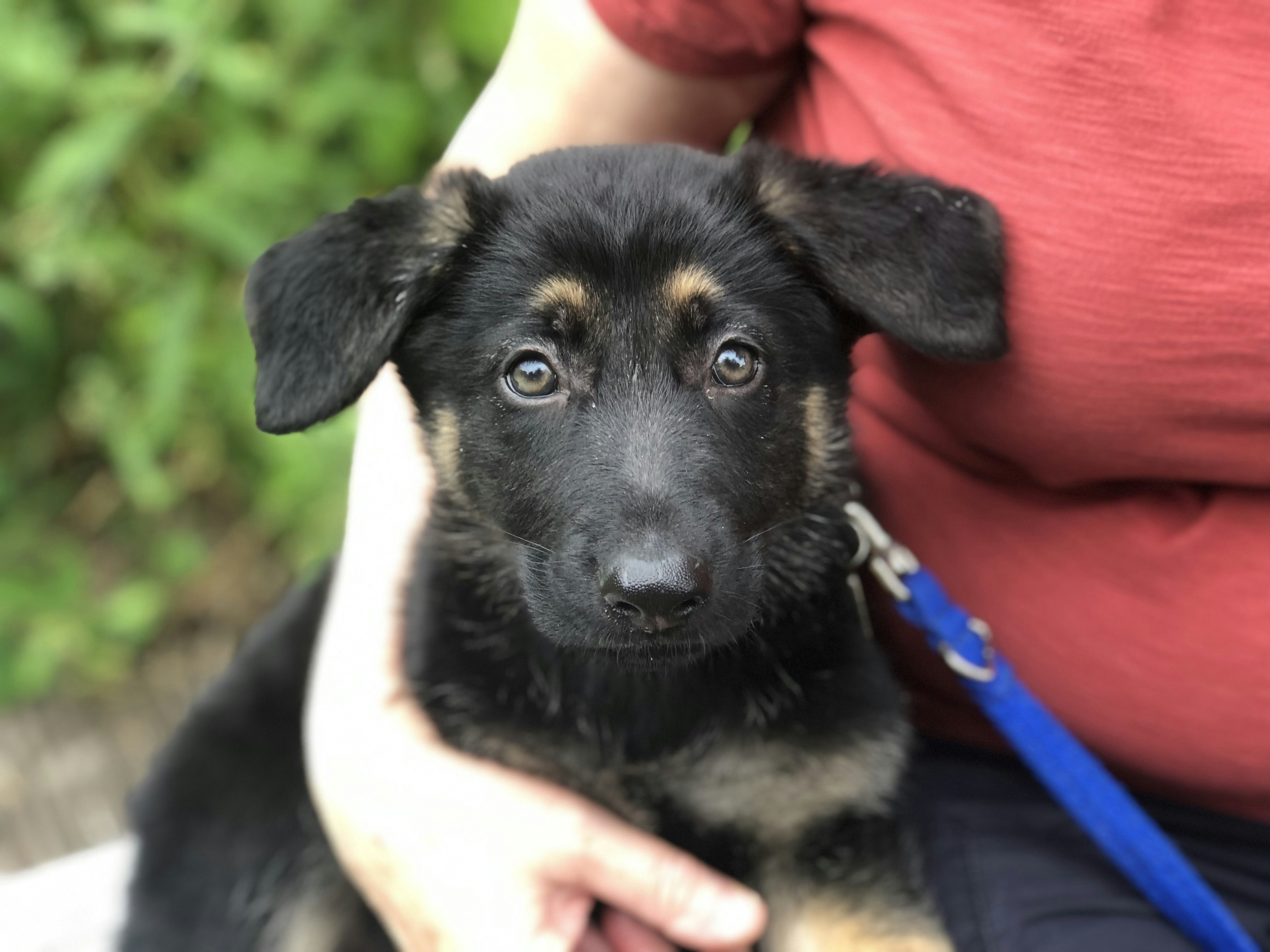
At eight weeks your puppy can learn, but not for long and not much at a time. What you do in this first month matters less for obedience than for temperament: the confident, unbothered adult dog you want in two years is largely built now, and the window does not reopen.
The practical priorities, in order: sleep, socialization, handling, house training, and only then commands.
Short answer: in the first month, sleep, socialization and handling matter more than cues. An eight-week-old needs somewhere around eighteen hours of sleep a day and will not take it without help, and an overtired puppy is the one that bites hardest. Do two or three two-minute training sessions a day, carry the puppy to see the world before it can walk on public ground, and start alone-time in seconds rather than hours.
The statistic that should reorder your priorities
Most new owners worry about parvovirus and keep the puppy indoors until vaccinations are complete. That instinct is understandable and it is backwards.
The American Veterinary Society of Animal Behavior states that behavioral issues, not infectious diseases, are the number one cause of death for dogs under three years of age, and that behavioral problems are the leading cause of relinquishment to shelters.
AVSAB’s position is that the first three months are the primary and most important window for socialization, and that it should be the standard of care for puppies to be socialized before they are fully vaccinated. Their guidance is that puppies can begin classes as early as seven to eight weeks, having had a minimum of one set of vaccines at least seven days beforehand, showing no signs of illness, and in a clean environment.
This is not an argument for ignoring disease risk. It is an argument for weighing two real risks against each other rather than one.
Socialization is not what most people think
It does not mean meeting as many dogs as possible. It means positive, controlled exposure to the ordinary world, at a level the puppy can handle.
What to expose your puppy to: different floor surfaces, stairs, the car, umbrellas, hats, beards, walking sticks, wheelchairs, bicycles, children’s voices, the vacuum, the washing machine, traffic noise at a distance, men with deep voices, people in high-vis jackets, being handled by a stranger.
How to do it safely before full vaccination: carry the puppy on outings, sit in the car with the window down at a supermarket car park, invite healthy vaccinated dogs to your garden, take it to a friend’s clean house, and attend a properly run puppy class.
What to avoid: dog parks, pavements outside vet clinics, and anywhere large numbers of unknown dogs toilet.
The rule that governs all of it: the puppy should be curious, not overwhelmed. A puppy that freezes, tucks its tail, tries to retreat, or refuses food is too close to whatever it is. Increase the distance. A frightening experience during this window does more damage than no experience at all.
Our guide to socialization covers the process in detail.
The 8 to 11 week fear period
Your puppy arrives in the middle of a period when it is unusually sensitive to frightening experiences.
Practically, this means: no forcing. If the puppy is worried by the vacuum, do not carry it toward the vacuum to show it there is nothing to fear. Turn the vacuum off, feed the puppy at a distance where it is comfortable, and close the gap over days.
Keep the first vet visit deliberately positive: treats on the scales, treats on the table, ideally a visit where nothing happens at all.
The nights are the part most owners are unprepared for. See our guide to puppy crying at night and how to get through the first weeks.
Free tool
Puppy Potty Training Planner
Builds the awake-and-nap rhythm for your puppy’s exact age, so you are not guessing when the next nap is due.
Sleep: the most underrated priority
Puppies this age need roughly 16 to 18 hours of sleep a day, and they will not take it voluntarily if the household is interesting.
An overtired puppy does not slow down. It gets frantic, uncoordinated, and bites hard. The evening explosion that owners describe as the witching hour is almost always a missed nap four hours earlier.
Work in cycles: roughly one to two hours awake, then a nap in a crate or pen with the lights dimmed. Enforce it. A puppy that will not settle after fifteen minutes genuinely needed activity; one that drops off within ten needed sleep.
Nothing else in this article works on a puppy that is not sleeping enough. Impulse control needs a rested brain.
Handling: an hour now saves years of struggle
The most valuable training at eight weeks is not sit. It is teaching your puppy that human hands doing odd things predicts food.
Every day, briefly and calmly:
- Touch each paw, then a treat. Later, hold a paw for two seconds, then a treat
- Touch a nail with the clippers without cutting, then a treat. Then one nail, then a treat
- Lift an ear flap and look inside, then a treat
- Lift a lip to see the teeth, then a treat
- Run a hand along the body, the tail, the belly
- Have the puppy stand on a towel or mat while being handled, as a vet-table rehearsal
- Add food near the bowl while the puppy eats, so a hand approaching food predicts more food rather than less
Thirty seconds a day. Adult dogs that need sedation for nail trims are usually dogs that never had this month.
Another habit worth building this month costs nothing: walk past your puppy while it eats and drop something better into the bowl. See preventing resource guarding.
Most of this happens in a crate or pen, so it is worth getting the introduction right. See our guide to crate training a dog.
Teaching your puppy to be alone
Rarely mentioned, and it prevents a problem that is very hard to fix later.
Your puppy has just left a litter and has never been alone in its life. If you spend a week with the puppy attached to you at all times and then go back to work, the contrast is severe.
Start from day two, in seconds:
- Puppy in the pen with something to chew, you visible in the room
- You step out of sight for five seconds and return before it notices
- Build to thirty seconds, two minutes, five, twenty
- Return while the puppy is still calm, never in response to crying
Coming back only when the puppy screams teaches screaming. Coming back during the quiet teaches that quiet works and that you always return.
One habit is worth starting now because it is far easier than undoing it later: see preventing jumping up.
What a day actually looks like
Owners plan the training and improvise the rest, which is backwards. The schedule is the training at this age.
| Time | What happens | Why |
|---|---|---|
| On waking | Straight outside, then breakfast from your hand or a scatter | Bladder first, and the meal doubles as training |
| Morning, 30–45 min awake | Play, handling practice, one 2-minute session | This is a realistic awake window at eight weeks |
| Nap, 1–2 hours | Crate or pen, curtains drawn | Enforced rest. The puppy will not do this alone |
| Midday | Outside, short carried outing, another nap | Novelty at a distance rather than walking |
| Afternoon | Chew on a mat, alone-time practice in seconds | Building settling and independence early |
| Early evening | The daily peak of biting and zoomies | Expected. Redirect to a chew, then nap |
| Before bed | Last meal early, final trip out, lights low | Shortens the night wake-ups |
| Overnight | Crate beside your bed, one alarm 4–5 hours in | You choose the wake time rather than the puppy |
Count the awake windows rather than the training minutes. A puppy that has been up for more than an hour is usually overdue for a nap, whatever it is doing.
What you can actually train at eight weeks
Sessions of two or three minutes. Two or three a day. That is the limit at this age, and pushing past it produces a frustrated puppy.
Its name. Say it once, and the instant the puppy looks at you, mark with yes and pay. Nothing else. Never use the name as a telling-off.
A marker word. Say yes, give a treat, twenty times. This is the foundation for everything else.
Sit. Lure the nose up and back. See how to teach a dog to sit.
Recall, as a game. Two people, opposite ends of a hallway, calling the puppy back and forth with food. Start now and it is far easier later.
Settling on a mat. Reward the puppy any time it lies down calmly on a particular mat. You are building a default off switch.
Do not expect stay, loose-leash walking, or any reliability outdoors. Those come later.
House training
An eight-week-old puppy can hold its bladder about three hours at most, and considerably less when awake and active. Expect eight to twelve trips outside a day, including immediately after every nap, meal, drink, and play session.
The full schedule, night-time routine, and what to do about accidents are in our potty training guide.
Biting
Your puppy will bite your hands constantly. This is normal, it is not aggression, and it peaks between eight and sixteen weeks.
Freeze rather than jerking your hand away, disengage completely for ten to thirty seconds, then restart with a toy in your hand. And check whether the puppy is overtired, because that is the most common cause of the biting that feels unmanageable. Full detail in how to stop puppy biting.
What to have ready before the puppy arrives
- A crate or pen you can put beside your bed. Moving it downstairs later is easy. Starting downstairs and moving up is not.
- Enzymatic cleaner, more than you think. Ordinary cleaners leave scent markers that invite a repeat.
- Baby gates for two doorways. Shrinking the space does more for house training than any schedule.
- Several rubber toys you can stuff and freeze. Fill four at once so one is always ready.
- Soft treats you can tear into pea-sized pieces. Most of the first month is paid in food.
- A flat collar with an ID tag and a lightweight leash. Fitted before the first outing, not on the day.
- The vet booked. A first appointment in the opening days sets the vaccination and parasite schedule and gives you a baseline weight.
Skip the puppy pads if you have outdoor access. Teaching a puppy to go indoors and then unteaching it adds weeks to house training.
The first 48 hours
Keep it quiet. No welcome party. The puppy has just lost its mother and littermates and traveled in a car for the first time. Meet the family, explore two rooms, sleep.
Set up before it arrives: a crate sized so the puppy can stand, turn, and lie down and no more, ideally an adult-size crate with a divider you move as it grows. A pen. Baby gates. An enzymatic cleaner.
The first night will be disrupted. Put the crate beside your bed. The proximity reduces distress and you will hear the puppy stir before it is desperate. Set one alarm four or five hours after bedtime for a silent, businesslike potty trip: no lights, no talking, no play.
Agree the household rules now. Sofa or no sofa, who feeds, what words you use. Changing your mind in a month is harder than deciding today.
If you are still choosing a breed, or you have taken on a large one, our breed guides cover what different types demand: Rottweilers and high-energy working breeds.
One more skill belongs in this month and is easy to postpone: teaching the puppy to be alone. Regular short absences during puppyhood are associated with a lower risk of problems later. See our guide to separation anxiety in dogs for why this window matters.
One preventive habit costs nothing and pays for years: pair every startling sound with something good. See preventing noise fear.
This month is one stage of a longer arc. See our puppy training schedule by age for the full first year, including what closes and when.
Common mistakes in the first month
- Keeping the puppy inside until fully vaccinated. The behavioral cost of a missed socialization window outweighs the disease risk when reasonable precautions are taken.
- Too much stimulation, too little sleep.
- Forcing exposure during the fear period. Distance and food, never coercion.
- Never leaving the puppy alone in the first weeks, then leaving it for hours.
- Long training sessions. Three minutes, not twenty.
- Using the name as a reprimand, which teaches the puppy to ignore it.
- Free-feeding, which makes house training much harder to predict.
- Waiting until six months to start training. That advice is decades out of date.
What the first month realistically looks like
Week 1: settling in, disturbed nights, frequent accidents, name recognition beginning, handling exercises started.
Week 2: a nap rhythm emerging, sit coming along, first carried outings, brief alone-time practice.
Week 3: puppy class if available, fewer accidents, longer stretches at night, recall games indoors.
Week 4: a routine that feels manageable, sit reliable indoors, socialization checklist steadily filling.
Almost every owner finds weeks one and two considerably harder than expected. That is normal and it does improve.
Affiliate recommendation
Brain Training for Dogs
If you want a structured program to work through, this is the one we point people to. It was built by Adrienne Farricelli, a CPDT-KA certified trainer, and it is force-free throughout — no dominance, no prong or shock collars. The focus is mental stimulation and impulse control, which is the foundation most training problems come back to.
One honest caveat: the sales page talks about eliminating problems quickly. Ignore that part. Real behavior change takes weeks to months, as every guide on this site says.
See the program · We earn a commission at no extra cost to you. See our affiliate disclosure.
Watch the training in action
PawMastery on YouTube — 149,000+ subscribers following along with real training sessions.
Frequently asked questions
Can you train an 8-week-old puppy?
Yes. Two to three minute sessions, two or three times a day. Name, marker word, sit, and recall games are all achievable. The old advice to wait until six months is outdated.
Can my puppy go outside before it is fully vaccinated?
With precautions. AVSAB recommends socialization before full vaccination, with a minimum of one set of vaccines at least seven days prior, no signs of illness, and clean environments. Avoid dog parks and areas where unknown dogs toilet. Confirm the plan with your own vet.
How much should an 8-week-old puppy sleep?
Roughly 16 to 18 hours a day. Most need enforced naps, because they will not stop on their own.
How long can an 8-week-old puppy hold its bladder?
About three hours as a ceiling, and much less while awake and active. Plan for eight to twelve trips outside a day.
Should the crate be in my bedroom?
For the first weeks, yes. It reduces night-time distress and lets you hear when the puppy needs to go out. You can move it gradually later.
My puppy cries when left alone. What do I do?
Build alone time in seconds rather than hours, and return while the puppy is quiet rather than in response to crying. Returning to a screaming puppy teaches screaming.
When should I start puppy classes?
AVSAB suggests as early as seven to eight weeks, provided the puppy has had one set of vaccines at least seven days before and the class is run hygienically.
Vaccination and socialization decisions should be made with your own veterinarian, who knows the disease risk in your area. If your puppy shows persistent fear, refuses food in ordinary situations, or does not recover from startling events, speak to your vet early rather than waiting.