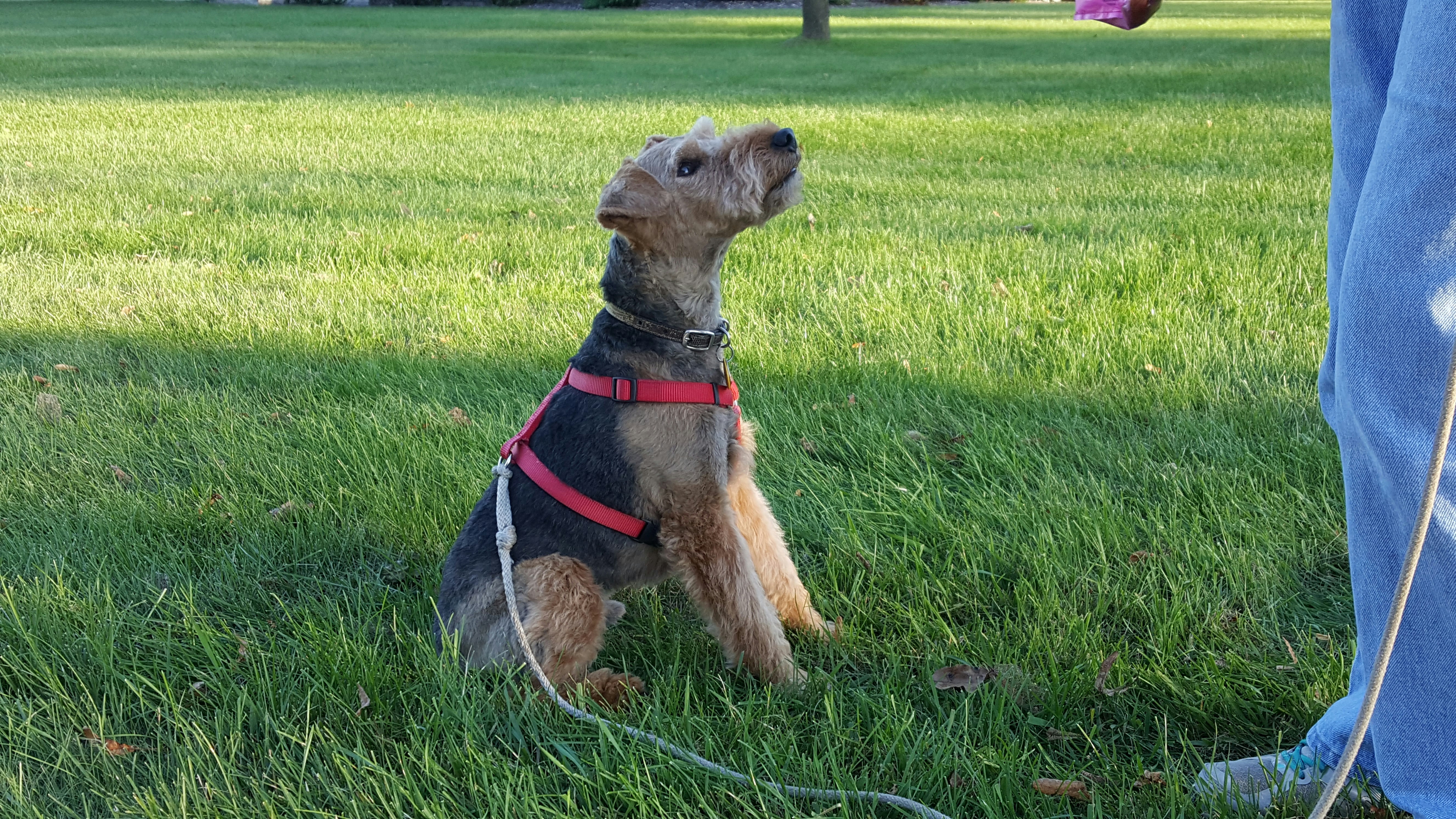
Every trainer will tell you their method works. Most of them are right, because dogs learn from almost anything applied consistently. The real question is not whether a method produces results, but what it costs the dog to get there, and whether something else would have worked as well or better.
On that question the research is clearer than the internet arguments suggest.
Short answer: the research comparing methods points one way. Reward-based training performs as well or better on obedience measures, and aversive methods carry documented welfare and aggression costs. Balanced is a label, not a method, so ask what happens when the dog gets it wrong rather than which camp a trainer belongs to. Dominance theory rests on a wolf model its own author later withdrew.
First, a distinction the industry blurs
Two different things get bundled together as methods, and separating them clears up most of the confusion.
How learning is arranged, meaning whether the dog works to earn something good or to avoid something unpleasant. This is the actual methodological divide.
How training is delivered, meaning a group class, private lessons, a residential program, or an online course. These are formats. You can deliver reward-based or aversive training in any of them.
A clicker is not a method. It is a marker, a tool inside reward-based training. An obedience class is not a method either. Confusing tools and formats with methods is how people end up combining approaches without knowing what they have combined.
The four quadrants, briefly
Learning theory gives four ways to change behavior:
- Positive reinforcement: add something the dog wants, behavior increases. A treat for sitting.
- Negative reinforcement: remove something unpleasant, behavior increases. Leash pressure stops when the dog complies.
- Positive punishment: add something unpleasant, behavior decreases. A collar correction for pulling.
- Negative punishment: remove something the dog wants, behavior decreases. Play stops when the puppy bites.
Positive and negative mean added and subtracted, not good and bad.
Reward-based training works mainly in the first and fourth quadrants. Aversive training uses the second and third. Every real approach sits somewhere on this map, whatever it calls itself.
What the research shows
The most useful evidence comes from studies that put methods head to head on the same problem.
A UK field study assigned 63 pet dogs referred for recall problems to three groups: trained with electronic collars by industry-approved trainers, trained by the same trainers without collars, and trained by reward-based professionals. Cortisol was measured and sessions were filmed for behavioral analysis.
The results are worth reading carefully. In preliminary work, dogs showed negative behavioral changes when electric stimuli were applied, and cortisol rose after stimulation. After training, 92% of owners across all groups reported improvement, with no significant difference in efficacy between the groups. Owners whose dogs were trained with e-collars were less confident about applying the technique themselves. The authors concluded there was no consistent benefit from e-collar training, but greater welfare concerns compared with reward-based training.
A follow-up study went further. The reward-based group responded correctly after the first command more often for both come and sit, and needed fewer repeated commands. The lead researcher’s summary was that reward-based training was the more effective approach, not only for the behavior being trained but for others too.
That is the part most of the debate misses. The case for reward-based training is not only ethical. On the measures these studies used, it also performed better.
Separately, a survey of 140 owners of dogs with behavior problems recorded how often confrontational techniques produced an aggressive response: hitting or kicking 43%, growling at the dog 41%, forcing an item from the mouth 39%, alpha rolls 31%, staring the dog down 30%. Non-confrontational methods in the same survey produced aggressive responses in 0 to 6% of cases; clicker training and a watch-me cue produced none.
The claims, and what the evidence says
Every approach makes a claim about results. These are the ones you will hear, next to what has actually been measured.
| The claim | What the evidence shows |
|---|---|
| “Aversives work faster” | Field studies found reward-based groups matched or outperformed e-collar groups on obedience outcomes |
| “A prong collar stops pulling better” | Measured pulling force showed no significant advantage over a front-clip harness |
| “Treats only work if you always carry them” | Rewards get thinned rather than removed, the same way any trained behavior is maintained |
| “Corrections are needed for serious problems” | Confrontational techniques produced aggressive responses at high rates; non-confrontational ones in 0–6% of cases |
| “You have to be the pack leader” | Based on captive wolf studies; the researcher behind the model publicly withdrew it |
| “It is only a light tap” | The dog’s response, not the intensity label, determines whether something functions as punishment |
Reward-based training
What it is: the dog earns something it wants, whether food, play, access, or freedom, for doing what you asked. Unwanted behavior is managed, redirected, or simply does not get paid.
Where it excels: teaching new behaviors, building reliability, working with fearful or anxious dogs, and anything involving a household where children also need to handle the dog.
Its genuine limitations: it requires better timing and mechanical skill than people expect, it takes management alongside it, because a dog practicing the wrong thing all day will not improve, and progress feels slower in the first two weeks because you are building something rather than suppressing something.
Where people go wrong with it: treating it as permissive. Reward-based does not mean no boundaries. It means the boundaries are enforced by controlling access and consequences rather than by pain. A gate, a leash, and a closed door are all perfectly compatible with it.
The AVSAB’s position is that only reward-based methods should be used for dog training, including for behavior problems.
Aversive tools
Prong and choke collars. A 2024 study measured pulling force across four equipment types on 23 dogs and found no statistically significant difference between a front-clip harness and either a plastic or a metal prong collar. Research on collar pressure using a simulated neck model found that all seven collars tested, at all force levels, produced pressures known to cause tissue damage in humans.
Electronic collars. Covered above. No consistent efficacy benefit, measurable welfare cost, and reward-based training outperformed them on responsiveness.
Physical correction, meaning alpha rolls, pinning, muzzle grabs, and jowl shakes. The aggression response rates above are the argument against these, and they carry an additional problem: no version of them can be safely used by a child, which rules them out in most family homes.
The suppression problem. Aversive methods reliably stop a behavior in the moment. What they do not do is teach the dog what to do instead, and they can suppress warning signals without changing the underlying emotion. A dog punished for growling still feels what it felt. It has just learned not to announce it. That produces a dog that appears fine until it is not.
Balanced training
The most common position in the commercial training world: rewards for new behaviors, corrections for non-compliance. It deserves a fair hearing.
The argument for it: real dogs live in real environments, some behaviors are dangerous enough to need immediate suppression, off-leash reliability in a distracting world is hard to build on food alone, and a well-timed correction from a skilled handler at a low level is not cruelty.
The evidence against it: in the head-to-head studies, the reward-based groups did as well or better on the target behavior without the welfare cost. If the correction is not buying additional effectiveness, the trade-off does not hold. And the aggression figures show the failure mode is not hypothetical.
The practical objection: low level, well-timed, by a skilled handler describes a small minority of the people who buy these tools. Most owners applying an aversive are frustrated, their timing is poor, and escalation is the natural response when it does not work first time.
Reasonable people do disagree here, and the debate is not over. But if you are choosing where to start, the studies point one way.
Dominance-based training
Included only to close it out.
The idea that dogs misbehave to raise their rank, and that owners must assert themselves as pack leader, comes from mid-century observations of unrelated captive wolves, a situation that does not describe wolf families or domestic dogs. AVSAB has a position statement specifically recommending that veterinarians not refer clients to trainers using dominance hierarchy theory and the confrontational handling that follows from it, noting that animals threatened with force may respond aggressively, not because they are seeking status, but because the person frightening them is frightening.
A dog that jumps on visitors is not making a bid for authority. It has learned that jumping produces attention.
Delivery formats
Different question, and this is where you actually have a choice to make.
Group classes. Good value, and the socialization and working-around-distraction element is genuinely useful. Less suitable for a fearful or reactive dog, where a class environment can make things worse.
Private lessons. More expensive per hour, but tailored, and the trainer sees your actual house and your actual problem. Usually the fastest route for a specific behavior issue.
Board and train. A residential program where the dog stays with a trainer.
Be careful here. Two structural problems: behavior learned in a trainer’s environment transfers poorly to your home, so results often fade within weeks unless you do substantial work yourself, which is usually the work people were paying to avoid. And you cannot see what happens to your dog. The industry is unregulated, and you are handing over an animal to methods you will not observe.
Board and train is a particularly poor choice for aggression. Aggression needs a veterinary behaviorist who can rule out pain and medical causes, and it needs the owner learning to manage the dog in the environment where the behavior happens. A residential program delivers neither. If a facility markets itself as fixing aggression in three weeks, that is a reason to look elsewhere.
If you do use one, insist on watching a full training session before you book, ask exactly what equipment is used, and get the handover sessions in writing.
Online courses and self-directed learning. Cheap, flexible, and fine for basic obedience with an ordinary dog. Not appropriate for aggression, severe fear, or separation-related problems.
How to choose a trainer
This matters more than the method label, because dog training is unregulated in most countries. Anyone can print a business card.
Ask these before you book:
- What happens when my dog gets it right? Should be a specific, immediate answer.
- What happens when my dog gets it wrong? Vague answers here are the warning sign. Correction, communication, and pressure are words worth asking to have explained concretely.
- What equipment do you use, and is anything required?
- Can I watch a class or session before committing?
- What certifications do you hold, and who issued them?
- What do you do when a dog is not responding to your approach?
Certification worth something comes from an independent body with an exam and continuing education requirements, such as CPDT-KA and CBCC-KA from the CCPDT, KPA-CTP, or IAABC membership. For behavior problems rather than obedience, a veterinary behaviorist (Dip. ACVB) or a certified applied animal behaviorist is the higher tier.
Walk away if: you are not allowed to watch, the trainer guarantees results in a fixed timeframe, aggression is described as a dominance problem, or the answer to what happens when he gets it wrong is a phrase rather than a description.
Two myths worth retiring
Every dog is different, so every method has its place. Dogs do differ in motivation, sensitivity, and history. That changes what you reward, how quickly you progress, and how much management you need. It does not make pain an appropriate teaching tool for a subset of dogs.
Some dogs are visual learners, some are auditory. Learning-styles theory is not supported even in human education, and there is no evidence base for applying it to dogs. What varies between dogs is what they will work for and how easily they are distracted, which is a motivation question, not a sensory one.
When the advice you get conflicts
Owners rarely fail from lack of information. They fail from three sources telling them opposite things in the same week.
- Pick one approach and give it six to eight weeks. Switching resets the clock, and most methods look useless at week two.
- Ask what happens when the dog gets it wrong. This single question separates approaches more reliably than any label on a website.
- Weight the source. A veterinary behavior body publishing a position statement and a viral clip are not comparable inputs, however confident the clip sounds.
- Watch the dogs in any demonstration. Loose bodies, eager repetition and willing eating tell you more than the handler’s explanation.
- Be suspicious of guarantees. Behavior involves an animal with its own history. Nobody can promise an outcome, and the ones who do are usually promising suppression.
- Keep notes. Two weeks of written observations settle most arguments about whether something is working.
Where to start
If you are training an ordinary pet dog: start reward-based, get the mechanics right, and add management around the behaviors you cannot yet control. Our obedience training guide covers markers, cue timing, and reward schedules, the parts that actually determine whether any method works. For equipment, see what is worth buying.
If you are dealing with aggression, severe fear, or separation problems: skip the method debate and see a veterinary behaviorist. These are welfare and safety issues, not training gaps, and they can have medical causes.
Watch the training in action
PawMastery on YouTube — 149,000+ subscribers following along with real training sessions.
Frequently asked questions
What is the most effective dog training method?
In head-to-head field studies on recall, reward-based training matched or outperformed e-collar training on responsiveness, with fewer welfare concerns. Veterinary behavior organizations recommend reward-based methods.
Is balanced training bad?
It is contested. The argument for it is that corrections buy real-world reliability. The evidence against it is that in controlled comparisons, reward-based groups did as well or better without the welfare cost.
Are e-collars effective?
In the study that compared them directly, owners reported similar improvement across all groups, and the reward-based group responded better to first commands. Cortisol rose after stimulation in preliminary work.
Do prong collars work better than a harness?
The study that measured pulling force directly found no statistically significant difference between a prong collar and a front-clip harness.
Is board and train worth it?
Rarely the best value. Behavior transfers poorly from a trainer’s environment to yours, you cannot observe the methods used, and it is a poor fit for aggression specifically.
How do I know if a trainer is qualified?
Ask what happens when the dog gets it wrong and require a concrete answer. Check for certification from an independent body with exams and continuing education. Insist on watching a session first.
Is dominance theory outdated?
Yes. AVSAB advises against referring clients to trainers who use dominance hierarchy theory, noting that animals threatened with force may respond aggressively out of fear rather than status-seeking.
Aggression, severe fear, and separation-related behavior need a veterinary behaviorist rather than an obedience program. Sudden behavior changes can have medical causes and should be assessed by a veterinarian first.
Sources
- Cooper et al., electronic training collars vs reward-based training, PLOS ONE
- China, Mills and Cooper, efficacy of training with and without e-collars, Frontiers in Veterinary Science
- Herron et al., confrontational and non-confrontational training methods, Applied Animal Behaviour Science
- Comparison of pulling force across leash equipment types, PeerJ
- AVSAB Position Statement on the Use of Dominance Theory (PDF)
- AVSAB Position Statements on Humane Dog Training