Dogs pull because pulling works. Every time the leash goes tight and the dog still gets closer to the lamppost, the behavior gets paid. The fix is not a stronger correction. It is making sure a tight leash never once moves the dog forward, while giving it a reason to stay near you instead.
You are not dealing with an unusual problem. In a survey of dog owners in the UK and Ireland, 82.7% reported that their dog pulled on the leash.
The more troubling finding from the same research: among dogs that pulled, 32% received less than thirty minutes of walking a day, and 18% were not walked every day at all. Pulling does not just make walks unpleasant. It quietly ends them, and a dog that is not walked gets more frustrated, which makes the pulling worse.
This one is personal. The dog that started this site pulled on the leash so hard that walks stopped being something I looked forward to. Fixing it took months, not weeks, and the thing that made the difference was refusing to let a tight leash move him forward even once.
Why dogs pull
Because it has always worked. This is the main reason and it is not complicated. The dog wants to reach something, it pulls, and it arrives. Even if you resist for twenty seconds first, arriving eventually still rewards the pulling. From the dog’s side, twenty seconds of straining is simply the price of admission.
Opposition reflex. Dogs push against pressure rather than yielding to it, the same reflex that makes a sled dog lean harder into a tight harness. This is why a permanently taut leash produces a dog that pulls harder, and why yanking backwards makes the dog surge forwards. If your leash is tight for most of the walk, the tension itself is generating some of the pulling.
Speed mismatch. A comfortable human walking pace is slow for most dogs. Left to itself, a dog would move in bursts: trot, stop, sniff, trot. Asking it to move at one constant slow speed in a straight line is unnatural, and a frustrated dog leans into the leash.
The walk is boring. A dog marched briskly around the same block on a short leash with no sniffing is getting exercise but nothing else. Pulling toward every interesting thing is a predictable result.
Notice what is not on this list: the dog trying to be pack leader. Position on the walk is not a status contest, and treating it as one leads owners toward confrontational methods that make the underlying problem worse.
Equipment: what the research actually shows
Equipment does not train a dog. It manages a dog while you train it. That distinction matters, because most owners buy a harness, see improvement for a week, then conclude the harness stopped working, when in fact nothing was ever taught.
Flat collars
The most common equipment and the worst choice for a dog that pulls hard.
A study measuring intraocular pressure in dogs found that pressure applied through a collar significantly raised pressure inside the eye, while the same force applied through a harness did not. The researchers recommended a harness rather than a collar for dogs with glaucoma, thin corneas, or any condition where raised eye pressure is harmful, particularly during exercise.
More recent work found that simply wearing a collar while stationary raised eye pressure in flat-faced breeds, and that exercising in a collar raised it in both flat-faced and long-nosed dogs, while exercising in a harness did not.
Separate research testing seven commercial collars on a simulated neck model found that all of them, at all force levels tested, produced pressures at levels known to cause tissue damage in humans. The researchers’ conclusion was blunt: arguing about which collar is best misses the point if any collar at the lowest pulling force can cause injury.
A flat collar is fine for ID tags and for a dog that already walks on a loose leash. It is a poor choice for a dog that hits the end of the leash at speed.
Front-clip harnesses
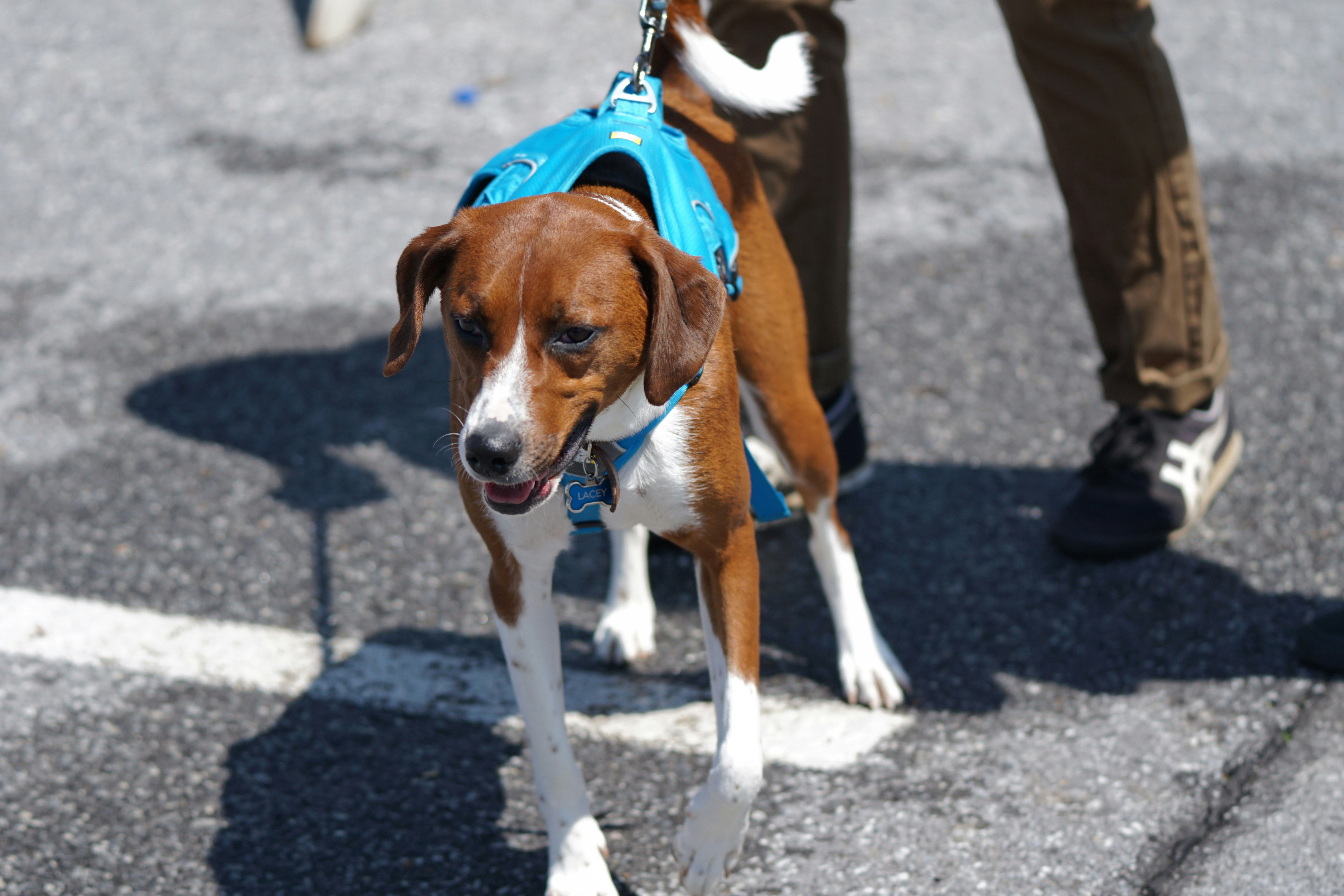
The leash attaches at the chest, so forward pulling turns the dog slightly sideways rather than letting it drive straight ahead. Most owners see an immediate reduction in pulling force.
Fit matters more than brand. The chest strap should sit across the breastbone, not across the point of the shoulder, and you should fit two fingers under every strap. A badly fitted harness restricts shoulder rotation and changes the dog’s gait, which is worth knowing before you buy the cheapest one available.
Head halters
Effective for large, strong dogs, and genuinely useful for someone who physically cannot hold their dog. Two cautions: most dogs dislike them at first and need a slow, food-based introduction over several days, and a hard lunge against a head halter torques the neck. Use them with a short, loose leash, never with a long line or a retractable.
Prong and choke collars
This deserves a direct answer, because it is the question most owners eventually reach.
A 2024 study walked 23 dogs on four types of equipment while measuring pulling force with a strain gauge. Dogs pulled most on the flat-style collar. Between the front-clip harness, a plastic prong-style collar, and a metal prong collar, there was no statistically significant difference in how much the dogs pulled.
That is the finding worth sitting with. The main argument for a prong collar is that it works better than the alternatives. In the only study to measure this directly, it did not outperform a front-clip harness.
The AVSAB’s current position is that only reward-based methods should be used for dog training, including for behavior problems. Combine that with equipment that is not measurably more effective, and there is little left to justify the trade.
Leash length
An underrated factor. A four-foot leash on a normal-sized dog guarantees tension, because the dog reaches the end of it just walking normally. Use six feet as a minimum for training, and a long line of five to ten meters in open spaces where the dog can move freely.
Avoid retractable leashes for this work entirely. They function by maintaining constant tension, which teaches the dog that a tight leash still moves it forward, the exact opposite of what you are training.
The training method
Equipment buys you control. This is what actually changes the behavior.
Start indoors or in the garden. Not on the street. A dog that cannot do this in a hallway will not do it outside a park.
1. Decide on your position. Pick a side and a rough zone, with the dog’s shoulder somewhere near your leg. Be specific with yourself, because you are about to reward it hundreds of times.
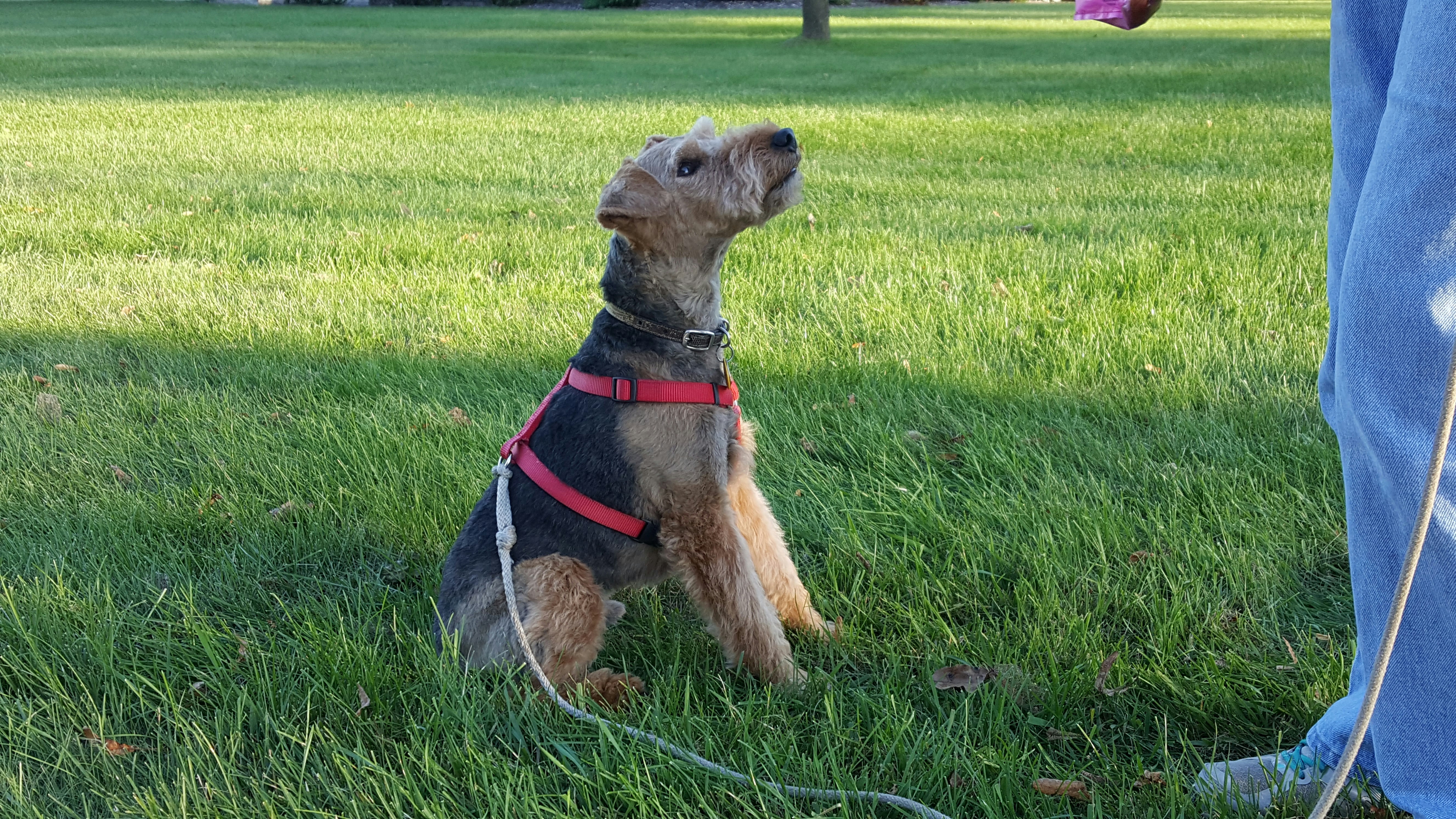
2. Mark and pay the position, not the absence of pulling. Every few steps that the dog is in the zone with a loose leash, say yes and deliver a treat at your leg on the dog’s side. Delivering the treat there is what builds the habit: the dog learns that the place beside your leg is where good things appear.
3. Reward frequently at first. Every two or three steps in the beginning. This feels excessive. It is the fastest route through the early stage, and you thin it out quickly.
4. When the leash goes tight, stop dead. Say nothing. Do not yank. Just become an anchor. Wait for the leash to soften, and the dog will eventually shift its weight or glance back. The moment it does, say yes, reward at your leg, and walk on.
5. Change direction instead of standing there. If stopping produces a dog straining at the end of the leash for a full minute, turn and walk the other way instead. The dog has to reorient to you, and the moment it catches up you mark and pay. This is faster than stop-and-wait for most dogs.
6. Thin the rewards out. Once the dog is holding position, move from every three steps to every five, then ten, then randomly. Random reinforcement is what makes a behavior durable.
7. Add difficulty one variable at a time. Quiet street before busy street. Busy street before a park with dogs. If the dog cannot do it, the environment is too hard, so go back a step rather than repeating a failure.
Two details that decide whether this works
Never let a tight leash produce forward movement. Not once. This is the whole method compressed into one rule, and it is where most owners fail: a dog strains toward a bush, the owner gives in just this once, and the previous week’s work is undone. Intermittent rewards are the strongest kind of reinforcement, which is exactly why occasionally caving teaches pulling more effectively than consistently caving would.
Use food the dog actually cares about. Dry kibble does not compete with a street full of smells. Chicken, cheese, or liver, in small pieces, delivered fast.
Sniffing is not a distraction from the walk — for a dog it is much of the point. See how to tire out a dog without walking more.
The half of the walk most owners skip
If you enforce a strict heel for the entire walk, you are removing the dog’s main reason to enjoy it, and you will fight the dog every day.
Research comparing dogs doing nosework with dogs doing heelwork found that only the nosework group became measurably more optimistic on a cognitive bias test. Sniffing and foraging are not a distraction from the walk. They are the part that does the dog good.
Split the walk. Structured loose-leash walking on the way out. Then, in a suitable spot, a release cue such as go sniff, a longer leash, and ten to fifteen minutes where the dog chooses where to go and how long to smell it.
This does two things. It gives the dog what it actually wants, and it turns sniffing into something you grant rather than something the dog has to pull to reach. That alone reduces pulling on the structured portion.
A dog that has had a proper sniffing session usually comes home more settled than one that has been route-marched twice the distance.
Common mistakes
- Buying equipment and stopping there. A no-pull harness manages the symptom for a couple of weeks. Without training, the dog learns to pull in the harness too.
- Training only on walks. Ten minutes in the garden, twice a day, beats one frustrating hour on a busy street.
- Talking too much. Repeating the dog’s name and heel while it drags you along teaches the dog that those words are background noise.
- Yanking the leash. Opposition reflex means the dog braces against it. You get a harder-pulling dog and a sore neck.
- Inconsistency between handlers. If one person in the household allows pulling, the dog learns that pulling works with that person, and tries it with everyone.
- Practicing in an environment that is too hard. Every walk the dog spends pulling is a walk spent practicing pulling.
Troubleshooting
He is fine until he sees another dog, then I lose him. That is usually not a pulling problem. See the section below on reactivity.
He is perfect in the garden and hopeless outside. Normal. The behavior has not generalized yet. Find a middle step: a quiet street at 6am, or the far end of a car park.
He walks nicely for ten minutes then falls apart. He is either tired of concentrating or you have thinned the rewards too fast. Shorten the structured portion and release him to sniff earlier.
He pulls hardest in the first five minutes. Very common. Do two minutes of training in the doorway before you leave, and do not open the door until the leash is slack.
Nothing works and he is too strong for me. Get a head halter or a well-fitted front-clip harness for management while you train, and get hands-on help. Physical safety comes before training philosophy.
Free tool
Loose-Leash Walking Calculator
Score seven factors behind pulling and get an estimated week range for your dog, your equipment and your usual walking environment.
How long does it take?
Expect visible improvement in two to four weeks of short daily sessions, and reliable loose-leash walking in quiet environments in roughly two to three months. Busy, high-distraction environments take longer, often six months or more for a strong adolescent dog with a long pulling history. Our guide on how long dog training takes covers the wider picture.
Adolescent dogs between six and eighteen months typically regress. This is developmental, not a failure of your training, and it passes.
A dog that has pulled for five years will take longer than a puppy, but the method is the same. Older dogs are not too late. They simply have more practice at the old behavior.
That pattern has its own guide: see why your dog barks and lunges at other dogs on the lead.
When it is not pulling
Some dogs lunge, bark, and strain at specific triggers such as other dogs, bicycles, or men in hats, but walk reasonably otherwise. That is reactivity, and it is an emotional response rather than a training gap.
Loose-leash technique will not fix it, and a prong collar or a leash correction can make it considerably worse by adding pain to the dog’s existing association with the trigger. Reactivity needs distance management and gradual counter-conditioning, usually with professional guidance. Our guide to socialization and managing reactivity covers the approach.
The tell is the pattern. Consistent pulling in all directions is a training problem. Sudden, intense, trigger-specific explosions are something else.
Watch the training in action
PawMastery on YouTube — 149,000+ subscribers following along with real training sessions.
Frequently asked questions
Do no-pull harnesses actually work?
They reduce pulling force immediately, which makes walks manageable. They do not teach the dog anything by themselves. Use one while you train, not instead of training.
Are prong collars more effective?
In the one study that measured pulling force directly across equipment types, the prong collar did not perform significantly better than a front-clip harness. Veterinary behavior organizations recommend reward-based methods instead.
Is a harness better than a collar?
For a dog that pulls, yes. The research on eye pressure and neck tissue pressure is fairly consistent. For a dog that already walks on a loose leash, either is fine.
Should I let my dog sniff on walks?
Yes, and deliberately. Sniffing is measurably good for a dog’s wellbeing, and building it into the walk as something you release the dog to do reduces the pulling that comes from being denied it.
My dog only pulls at the start of the walk. Why?
Excitement. Train the first thirty seconds separately: leash on, wait for calm, door opens only when the leash is slack. Close the door and repeat if the dog surges.
Can I train an older dog not to pull?
Yes. It takes longer because the habit is more practiced, but the method does not change.
Should I use a retractable leash?
Not for this. They work by keeping constant tension on the leash, which teaches exactly the wrong lesson, and the thin cord causes injuries.
If your dog’s pulling is accompanied by lunging, barking, or growling at specific triggers, or if you cannot safely hold your dog, work with a qualified trainer or a veterinary behaviorist. Sudden changes in a dog’s behavior on walks can also have medical causes, pain in particular, and are worth mentioning to your vet.
Sources