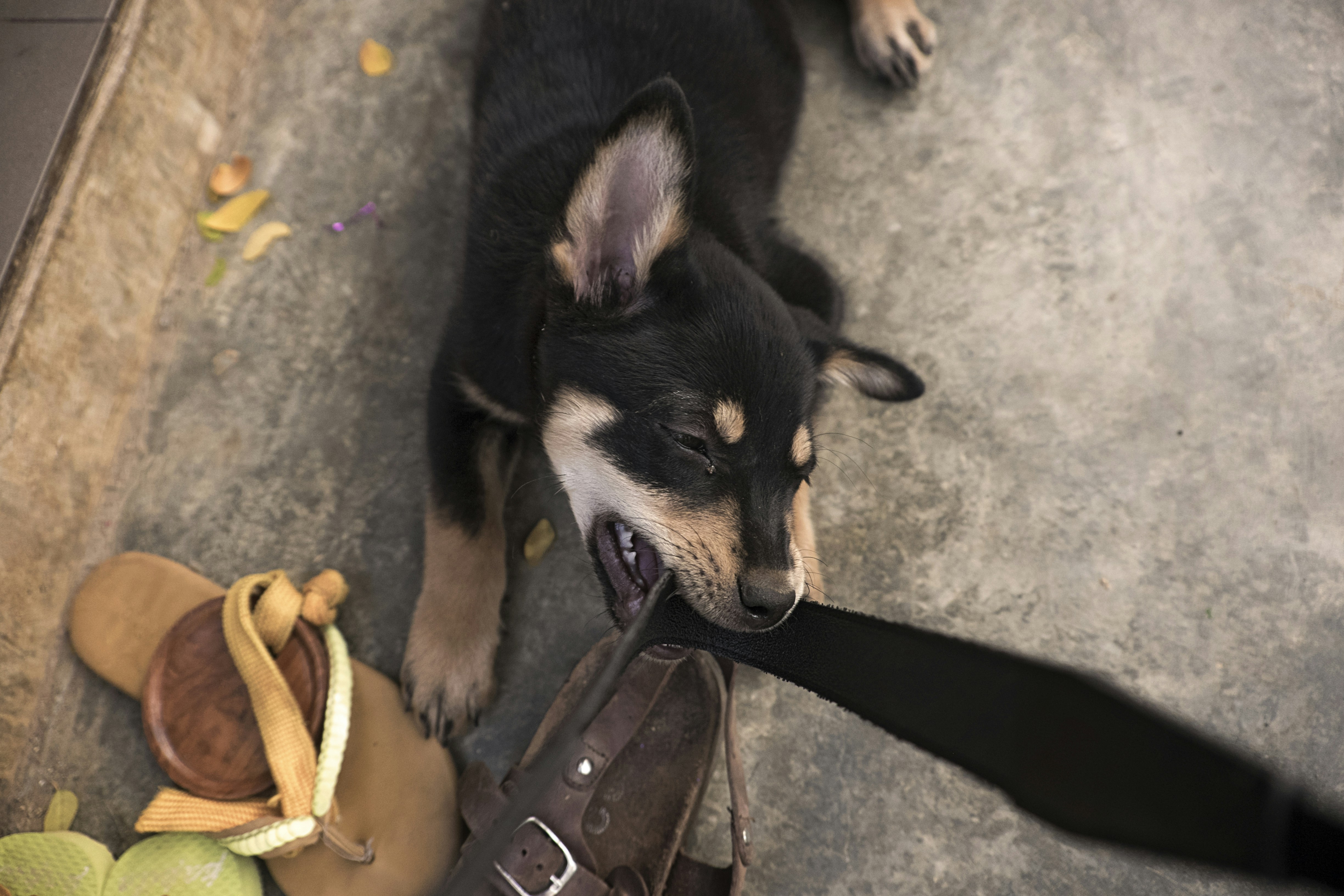
An adult dog that bites is doing something different from a puppy that mouths your hands. Puppy biting is developmental and it passes. Adult biting is communication: the dog is telling you it is frightened, in pain, or defending something, and the earlier signals it gave were missed or punished.
That distinction matters because the fix is different. Puppy mouthing responds to training. Adult biting needs the cause identified first, and the single most overlooked cause is not behavioral at all.
Short answer: start with a veterinary appointment, because pain is present in a large share of referred aggression cases and it is treatable. Never punish a growl, since removing the warning is how a dog becomes one that bites without notice. Manage first with gates, leashes and a conditioned basket muzzle, and get a veterinary behaviorist involved rather than working from an article. Most dogs that have bitten once can be managed safely; the plan has to be built around your specific household.
Start with pain, not training
Before any behavior plan, your dog needs a veterinary examination. This is not a formality.
A review of behavior caseloads estimated that around a third of referred dog cases involve some form of painful condition, and in some caseloads the figure approached 80%. Pain lowers a dog’s threshold for aggression and drives defensive responses that look like temperament problems.
In a study of twelve dogs referred for pain-related aggression, musculoskeletal pain was the main cause in 75% of cases, most often hip dysplasia. And osteoarthritis affects roughly 20% of dogs over one year old, not just elderly dogs.
Researchers reviewing these cases identified a recognisable pattern:
- Owners describe the dog as having a changeable, unpredictable temperament, often using the phrase Jekyll and Hyde
- The aggression happens when the dog is approached, and frequently when it is lying down
- There is a broader reluctance to move: avoiding stairs, stopping on walks, hesitating at the car
- Bites are directed at limb extremities such as hands and feet rather than the face or torso
- The incidents are short and easy to interrupt
- Targets are less specific, including both familiar and unfamiliar people
That last cluster is the tell. A dog delivering brief, easily interrupted bites to whichever hand reaches toward it, while also being slower on the stairs, is far more likely to be hurting than to be dominant.
One more distinction from the same research: dogs that had not been aggressive before the painful condition began were more impulsive, more likely to bite when handled, and more likely to adopt a defensive posture. Their owners were also less able to see it coming, because they had no history of it.
The encouraging part: when pain is identified as the cause, the outcomes are generally good. It is treatable in a way that a vague behavior label is not.
If the behavior happens on walks and is directed at other dogs rather than people, see leash reactivity instead.
The other real causes
Once pain has been ruled out or treated, adult biting usually falls into one of these.
Fear. The most common cause by a wide margin. The dog tried to retreat, could not, and escalated. Look for a lowered body, tucked tail, ears back, weight shifted backwards, and a freeze immediately before the bite. Cornering, looming over, reaching for the collar, and unfamiliar visitors are typical triggers.
Resource guarding. Food, a chew, a stolen sock, a bed, sometimes a person. The dog stiffens over the item, eats faster as you approach, or freezes with a hard stare. This is a normal canine behavior that becomes a household problem, and it responds well to a structured plan.
Guarding is common enough, and misunderstood enough, to deserve its own treatment: see resource guarding in dogs and why the usual advice backfires.
Handling and restraint. Nail clipping, ear cleaning, grooming, being lifted, being pushed off furniture. Often overlaps with pain.
Redirected aggression. The dog is highly aroused by something it cannot reach, usually another dog through a window or fence, and bites whoever is nearest. Owners often report it as unprovoked; it was provoked, just not by the person bitten.
Territorial and barrier frustration. At the door, the gate, or the car window. Distance and barriers amplify it.
Notice what is absent from this list: dominance. A dog biting when you reach for its bowl is protecting a resource, not making a claim on household rank. The framing matters, because owners who read it as a challenge respond with confrontation, and confrontation is what turns a warning into a serious bite. See our guide to training methods and the evidence behind them.
Reading these signals is a skill in its own right, and research suggests dog owners are not automatically good at it. Our guide to reading dog body language covers the full escalation ladder.
The warning signals you are probably missing
Almost no dog bites without warning. What happens is that the early signals are quiet, and people learn to ignore them.
Roughly in order of escalation:
- Turning the head away, blinking, yawning when not tired
- Lip-licking, sniffing the ground for no reason
- Walking away, or trying to
- Freezing, going still
- Whale eye, where the whites show as the dog looks sideways
- Stiff body, closed mouth, hard stare
- Growling
- Snapping at the air
- Biting
Most owners only notice from step six onwards. The dog has usually been asking for space since step one.
Never punish a growl
This is the most damaging mistake in this whole subject.
A growl is information. It tells you the dog is uncomfortable and is choosing to warn rather than bite. Punish it and you do not remove the discomfort. You remove the warning, and you get a dog that goes from still to biting with nothing in between.
When your dog growls, the correct response is to stop what you are doing, create distance, and then work out what caused it.
Free tool
Seven questions, and it grades the incident on the Dunbar scale with a clear set of next steps for that level.
The warning ladder
Dogs escalate in a fairly predictable order. Owners tend to notice the last two rungs and describe everything before them as nothing.
| What you see | What it means | What to do |
|---|---|---|
| Turning the head away, lip licking, yawning | Mild discomfort, asking for space politely | Stop what you are doing and give room |
| Freezing, hard stare, whale eye | Serious. The dog has stopped negotiating | Back away without reaching or leaning in |
| Moving away, hiding behind furniture | The dog is using the option it has | Never follow. Let it leave |
| Growling | A clear warning and useful information | Increase distance. Never punish it |
| Snapping in the air | Deliberate miss. A final warning | End the situation and plan differently |
| Contact without damage | Inhibited bite, the dog chose not to injure | Manage strictly and call a professional |
| Contact with puncture | Escalation past warning | Vet appointment, then a veterinary behaviorist |
A dog that skips rungs has usually been punished for the earlier ones. The ladder can be rebuilt, but it takes a professional and it takes time.
How serious was the bite?
Owners are usually either far too alarmed or far too dismissive. There is an objective scale used by trainers and veterinary professionals, developed by veterinarian Ian Dunbar, which grades a bite by the physical damage rather than by how frightening it felt.
- Level 1: aggressive behavior such as growling, lunging, or snapping, with no skin contact by teeth
- Level 2: teeth touch skin but do not puncture it. Possible nicks and slight bleeding from sideways tooth movement
- Level 3: one to four punctures from a single bite, none deeper than half the length of the dog’s canine tooth
- Level 4: a single bite with punctures deeper than half the canine tooth, often with bruising or tearing from clamping and shaking
- Level 5: multiple level 4 bites in one incident, or repeated incidents
- Level 6: the victim dies
The proportion matters as much as the levels: well over 99% of bite incidents fall into levels 1 and 2, meaning the skin is not broken. A dog at those levels has intact bite inhibition, is unlikely to cause serious injury, and has a good outlook with proper work.
Levels 3 and above change the picture considerably and need professional involvement immediately, not eventually. At levels 5 and 6 the honest professional consensus is that the dog is not safe around people.
Knowing the level is not about labelling your dog. It is what a behaviorist will ask you first, and it determines how urgent the situation is.
What to do immediately after a bite
Treat the wound properly. Dog bites carry a high infection risk even when they look minor. Puncture wounds are the worst offenders because they seal over. Wash thoroughly, and get medical attention for any puncture, any bite to the hand or face, any wound in someone elderly or immune-compromised, and anything showing redness, swelling, or heat over the following days. Tetanus status matters.
Separate calmly. Put the dog in another room or a crate. Do not punish it after the fact. The bite is over, the dog will not connect a delayed correction to it, and you will add fear to a situation already driven by fear.
Write down exactly what happened. Where, who, what was happening in the ten seconds before, what the dog’s body was doing, how long it lasted. Memory reshapes these events quickly, and this record is the most useful thing you can hand a professional.
Manage immediately. Whatever the trigger was, prevent it from happening again while you get help. Every repetition rehearses the behavior.
If the trigger is unfamiliar people specifically, see our guide to dogs afraid of strangers.
One management tool deserves its own explanation, and it is the most misunderstood piece of equipment in dog ownership. See our guide to muzzle training.
Management comes before training
Training takes weeks or months. Management works today, and it is what keeps everyone safe in the meantime.
- Baby gates and closed doors. Simple, and they remove entire categories of trigger.
- A house line. A light leash left on indoors, so you can move the dog without reaching for its collar. Collar grabs cause a great many bites.
- Muzzle training. Not a punishment and not an admission of failure. A properly conditioned basket muzzle lets a dog walk, pant, drink, and take treats, and it means an incident cannot become an injury. Condition it slowly with food over weeks, well before you need it. A muzzle forced onto a dog in a crisis makes the dog worse.
- Remove the contested item. If the dog guards a particular chew, that chew stops appearing while you work on the problem.
- Brief visitors. The dog goes away before the door opens. Do not ask guests to do anything requiring judgment.
None of this fixes anything. All of it buys you the time to fix it safely.
If the behavior only ever happens when your dog is left alone, you may be dealing with a different problem entirely. See our guide to separation anxiety and what the research shows.
Households with children
This combination accounts for a disproportionate share of serious injuries, and the rules that reduce it are not complicated. They are just non-negotiable.
- Separate with barriers, not supervision alone. Supervision means somebody has to react in time, every time. A gate does not get distracted.
- The dog gets a room children never enter. A place it can leave to, that nobody follows it into.
- Nobody approaches the dog while it eats, chews or sleeps. This covers a large share of household bites on its own.
- No hugging, no lying on the dog, no faces close to faces. These are the postures in most of the photos parents share and most of the incidents that follow.
- Teach children to call an adult rather than to handle the dog. Taking things from a dog’s mouth is an adult job, and often not even that.
- Treat any growl at a child as a serious event. Not a discipline problem. Get help that week.
If the household cannot maintain these while the behavior work happens, say so plainly to the professional you hire. A plan that assumes supervision nobody can deliver is worse than no plan.
Who to call
Your veterinarian first, always. Pain and medical causes have to be excluded before a behavior plan means anything, and a plan built on top of untreated arthritis will fail.
Then a veterinary behaviorist (Dip. ACVB or the ECAWBM equivalent) or a certified applied animal behaviorist. These are the qualified professionals for aggression. They can diagnose, they can prescribe where medication is appropriate, and they work with your vet.
A certified trainer such as CBCC-KA or an IAABC member can implement the plan, but aggression is not an obedience problem and general obedience training will not resolve it.
Get help urgently if: the bite broke skin, a child was involved, it has happened more than once, the severity is increasing, you cannot identify the trigger, or anyone in the house is now afraid. That last one is enough on its own.
Forcing an item from the mouth is avoidable entirely with training. See how to teach drop it safely.
What will not work
Confrontation. A survey of 140 owners of dogs with behavior problems recorded aggressive responses to confrontational techniques at high rates: hitting or kicking 43%, growling at the dog 41%, forcing an item from the mouth 39%, alpha rolls 31%. Non-confrontational methods produced aggressive responses in 0 to 6% of cases. With a dog that already bites, those odds are not acceptable.
Board and train. Behavior learned in a trainer’s facility transfers poorly to your home, and you cannot observe what is done to your dog. For aggression specifically, this is the wrong format.
Waiting for it to pass. Puppy mouthing passes. Adult biting has a cause, and the cause does not resolve on its own.
Rehoming without disclosure. The problem follows the dog, and the next household will not know what to watch for.
What recovery realistically looks like
Prognosis depends on cause, severity, how long it has been happening, and how consistently the household can manage it.
Pain-related aggression that is diagnosed and treated often improves markedly, sometimes dramatically. Resource guarding responds well to structured protocols. Fear-based aggression improves with counter-conditioning but usually needs lifelong management of the specific trigger rather than a cure.
Realistic success is a dog whose triggers are known, avoided where possible, and managed reliably where not. That is a normal life for the dog and a safe one for the household. Expecting a dog that has bitten to become a dog that could never bite is not the right target.
Some cases end in decisions nobody wants to make, particularly at the higher bite levels with children in the home. Those decisions belong with a veterinary behaviorist who has assessed your actual dog, not with an article.
Watch the training in action
PawMastery on YouTube — 149,000+ subscribers following along with real training sessions.
Frequently asked questions
Why did my dog bite me for no reason?
There was a reason, and the two most common are pain and a missed warning signal. A veterinary examination comes first, because painful conditions frequently present as sudden, out-of-character aggression.
Should I punish my dog for biting?
No. Punishment after the fact teaches nothing, and confrontational handling produces aggressive responses at high rates. It also suppresses the warnings you need the dog to keep giving.
My dog growls at me. Is that aggression?
It is communication, and it is useful. Stop what you are doing, create distance, and find the cause. A dog punished for growling learns to skip straight to biting.
Can an adult dog that has bitten be rehabilitated?
Often yes, particularly at bite levels 1 and 2, which account for over 99% of incidents. Outcomes depend on the cause, the severity, and consistent management.
Is a muzzle cruel?
A well-fitted basket muzzle that the dog has been conditioned to accept allows panting, drinking, and eating. It gives an anxious dog more freedom, not less, because it makes outings possible.
How is this different from puppy biting?
Puppy mouthing is play and exploration and it resolves with age and training. See how to stop puppy biting. Adult biting has an underlying cause that needs identifying.
Do I have to report a dog bite?
Reporting requirements vary by country and locality. Check your local rules, and be aware that medical professionals treating a bite may report it regardless.
This article is general information, not a behavior plan for your dog. Aggression is a safety issue with frequent medical causes. If your dog has bitten someone, see your veterinarian and ask for a referral to a veterinary behaviorist. Do not attempt to work through aggression from an article alone.