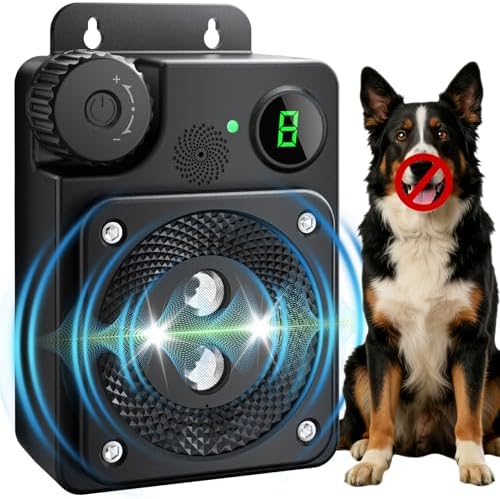
Barking is not a malfunction. It is the thing dogs were selected to do.
Compared with wolves and jackals, domestic dogs bark in far more contexts and far more often — a change that came with domestication. Barking expanded to carry meanings that wolves express through howls, growls and whines. Your dog is not broken. It is talking.
Which is why the first question is never how do I stop the barking. It is which bark is this — because the six common types need six different responses, and the treatment for one will make another worse.
Short answer: identify which of six kinds of barking you have before doing anything, because the fixes are different and the wrong one makes things worse. Count the episodes for a week rather than guessing. Then manage the trigger, teach something the dog cannot do while barking, and pay the quiet gaps. Bark collars suppress the sound without touching the cause, and the cause is usually fear, frustration or boredom.
Dogs bark in recognizable categories, and you can hear the difference
This is measurable, not folklore.
Researchers recorded barks from dogs in six situations — a stranger appearing, attacking a human, being left alone, before a walk, asking for a ball, and playing with people — then played them to human listeners who had to identify the situation and rate the dog’s emotional state.
Listeners categorised them accurately. Acoustic analysis showed the barks genuinely differ between contexts in pitch, tonality and the interval between barks. Low-pitched barks were consistently heard as aggressive and came from the stranger and attack situations.
A later study measured dogs’ heart rates during bark playback and found dogs discriminate between bark types too. They tell an alone-bark from a stranger-bark.
There is even research on which barks annoy people most: high-pitched barks, and low-pitched fast-pulsing barks, scored highest for nuisance. High-pitched barking typically comes from strongly stressful situations — fear, despair, being separated from the owner.
Worth sitting with: the barking that drives owners to breaking point is often the barking produced by a distressed dog.
Barking aimed at other dogs on walks is a distinct case with distinct tactics. See leash reactivity.
Two of these six are anxiety-driven rather than habit. See the five types of dog anxiety.
The six types, and what each one needs
1. Alarm barking
Triggered by a specific event — the doorbell, someone at the gate, a noise outside. Sharp, repetitive, usually stops when the trigger goes.
What it needs: manage the trigger first. Frosted film on the window the dog patrols. Move the bed away from the front door. Then teach an alternative: doorbell rings, dog goes to a mat and gets paid.
What makes it worse: shouting. To the dog, you have joined in.
2. Demand barking
Aimed directly at you. For attention, food, the ball, the door. Often a distinctive insistent rhythm.
What it needs: the behavior has been reinforced, probably by you, probably inconsistently. Stop paying it. Turn away, no eye contact, no speaking. Then reward the silence — the moment the dog stops, that is what gets paid.
Expect it to get worse first. An extinction burst is normal: the dog escalates before it gives up, because escalating used to work. Giving in during that burst teaches the dog that louder and longer is the winning strategy. This is the single most common way owners accidentally train a demanding barker.
3. Frustration barking
The dog wants something it cannot reach: another dog across the road, a squirrel, a person behind a fence. Often accompanied by lunging, spinning, or biting the leash.
What it needs: distance work, not silence work. This is closer to reactivity than to noise. See our guide to socialization and reactivity.
4. Boredom barking
Monotonous, rhythmic, goes on for long stretches with no obvious trigger. Common in under-stimulated working breeds and in dogs left alone for long periods.
What it needs: mental work rather than more walking. Scent games, puzzle feeders, training sessions, chews. See our guide to high-energy breeds.
5. Distress barking
Happens when the dog is alone. Often high-pitched, sometimes howling, frequently with pacing, drooling, or destruction at exit points.
This is not a barking problem. It is a separation-related problem, and no anti-bark technique will touch it. See our guide to separation anxiety and what the research shows.
Suppressing this barking without addressing the cause leaves you with a silently panicking dog.
6. Fear barking
Directed at something specific, with a body that says retreat: weight back, tail low, ears flat, sometimes backing away while barking.
What it needs: distance and counter-conditioning. Punishing a frightened dog for barking adds a second thing to be frightened of, and removes the warning. Our guide to reading dog body language covers the difference between a fearful and a confident barker.
If the barking happens specifically during storms or fireworks, treat it as a noise fear rather than a barking problem. See what actually works for noise fears.
Barking aimed at visitors and strangers has its own protocol. See dogs afraid of strangers.
Night barking in an older dog has its own set of causes. See our guide to senior dog behavior changes.
Six types, side by side
Use this to place your dog before reading the detail below.
| Type | When it happens | What it sounds like | The first move |
|---|---|---|---|
| Alarm | Something appears or is heard | Sharp bursts, then checking | Block the view or the sound |
| Demand | You have something the dog wants | Aimed at you, insistent, paused for effect | Stop paying it, pay the pause instead |
| Frustration | Blocked from reaching something | Higher pitched, often with whining | Increase distance from the trigger |
| Boredom | Long stretches with nothing to do | Monotonous, evenly spaced | Add scent work and chewing outlets |
| Distress | Alone, usually within 30 minutes | Escalating, mixed with howling | Film it. This is a separate problem |
| Fear | A specific trigger is close | Deeper, body leaning away | Work under threshold with food |
Dogs commonly have two of these. Treat the one that happens most often first, and manage the other so it is not being rehearsed meanwhile.
Rule out pain and age first
Barking that is new, or that has changed character, deserves a veterinary appointment before a training plan.
Pain lowers tolerance for everything. Hearing loss changes how a dog vocalises and how it responds to sounds it can no longer place. In older dogs, night-time barking, disorientation and altered sleep patterns can indicate cognitive decline, which has management options that training alone does not provide.
A dog that has started barking in the last month is a different case from a dog that has barked for three years.
Free tool
Dog Training Progress Calculator
Get a realistic week range for reducing barking, and a diagnosis if you have stalled.
The protocol
Once you know the type, the mechanics are consistent.
Step 1: Count, do not guess
For three days, note when the barking happens, what preceded it, how long it lasted, and what you did. Most owners discover the pattern is narrower than they thought — usually two or three specific triggers, not constant noise.
Step 2: Manage the trigger
Every bark rehearses the behavior. Block the window view. Use white noise for street sounds. Move the crate away from the front door. Change the walk route.
This is not a fix. It stops the problem getting worse while you work.
Step 3: Teach an incompatible behavior
Do not train quiet. Train something else the dog cannot do while barking.
The most useful is going to a mat. Doorbell rings, dog goes to the mat, dog gets paid there. A dog lying on a mat with food arriving is not barking at the door, and you have given it a job instead of taking one away.
Step 4: Reward the gaps
Most owners only interact with the barking. Pay attention to silence instead: any moment the dog notices something and does not bark, mark it and pay.
Sit by the window with treats and wait. Someone walks past, dog looks, dog stays quiet — mark and reward. You are paying the behavior you want, which is the part that usually never happens.
Step 5: Use quiet properly, if at all
The common version fails because owners say it while the dog is mid-bark, so the word gets attached to barking.
The order that works: dog barks, you wait for a natural pause — all dogs pause to breathe — mark that pause and pay. Once the dog is reliably pausing to look at you, add the word just before the pause you can now predict.
Say it once. Repeating it turns it into background noise. The mechanics behind cue timing are in our obedience training guide.
Bark collars: the honest evidence
Most owners reach this point eventually, so here is what the research actually shows rather than what the packaging claims.
Citronella spray collars. In a veterinary hospital setting, 76.7% of dogs wearing a citronella collar showed reduced barking, compared with 58.6% for a scentless spray collar; both beat the control significantly. A Cornell clinic study comparing citronella with shock found owners judged citronella more effective and more humane — and notably, four of eight owners said the electric shock had no effect at all; their dogs kept barking. The researchers speculated that given a dog’s sense of smell, a strange odour may be less tolerable than a painful stimulus.
Shock collars. Less effective than citronella in the direct comparison above, and carrying documented welfare costs including skin lesions, chronic stress, and fear and pain responses at higher intensities. Across the wider literature comparing shock-based training with reward-based training, the aversive tool has not shown a reliable advantage.
Habituation. A real limitation across all of these. Effects measured over days do not tell you about months, and several studies did not follow up long enough to know whether the improvement held.
The problem no collar solves
A collar punishes the sound. It does not tell the dog what to do instead, and it does not touch the reason.
That matters most for the two types where barking is a symptom. Suppress a distressed dog’s barking and the distress remains, minus the signal. Suppress a fearful dog’s barking and you have removed a warning while adding an unpleasant experience to the thing it already feared.
The AVSAB’s position is that reward-based methods should be used for training, including for behavior problems. And there is a specific objection here worth stating plainly: barking is normal species behavior. Punishing a dog for vocalizing is punishing it for being a dog.
If you are going to use a device — for instance under real pressure from neighbors or a landlord — the evidence favours citronella over shock, and every source agrees it should sit alongside a behavior plan rather than replace one.
What makes barking worse
- Shouting. Reads as joining in, and adds arousal.
- Intermittent giving in. The strongest reinforcement schedule there is. Caving on the tenth bark teaches ten barks.
- Comforting a fearful barker in a way that raises arousal. Calm proximity is fine; excited fussing is not.
- Suppressing without addressing cause. Especially in distress and fear barking.
- Letting the dog rehearse. A dog barking at the window for two hours a day is practicing for two hours a day.
- Training only at full difficulty. Start with a quiet street, not rush hour.
Neighbors, and the practical reality
Barking is a serious noise complaint category — in England, close to 30% of noise complaints to environmental health related to dog barking.
If you are under pressure, three things buy goodwill: tell the neighbor you are working on it and give a timeframe, ask them to tell you when it happens so you can identify the trigger, and use management aggressively in the meantime even if it is inconvenient.
A neighbor who knows you are working on it is far more patient than one who thinks you are ignoring it.
How long it takes
Demand barking often improves within two to three weeks, once you stop reinforcing it and survive the extinction burst.
Alarm barking takes four to eight weeks of consistent trigger management plus an alternative behavior.
Fear and distress barking take months, because you are changing an emotion rather than a habit.
And a realistic target: not a silent dog. A dog that barks two or three times and then stops when asked is a normal, well-adjusted dog. Eliminating barking entirely is neither achievable nor desirable.
Troubleshooting
The barking got worse after you started ignoring it. That is the escalation before it fades, and it is normal for demand barking. Giving in during it teaches a louder version.
It stops when you are home and continues when you leave. Different problem. Film a short absence before treating it as a barking issue at all.
Your dog barks at things you cannot see or hear. Usually sounds outside your range, or movement through a window. Test by blocking the window for a few days and comparing the counts.
It barks at the same neighbor every day. Every episode ends with the person leaving, which the dog experiences as the barking working. Manage the sightline before anything else.
You cannot be consistent because of work hours. Then start with management alone. Reducing the number of episodes is real progress even without training sessions.
Nothing has changed after eight weeks of counting. Take the counts to your vet first, particularly with an older dog, then to a qualified behavior professional.
When to get professional help
- Barking only when alone, with pacing, drooling, or damage
- Barking with lunging, growling, or snapping
- A sudden change in an adult dog — see a vet first
- Night-time barking and disorientation in an older dog
- No improvement after six weeks of consistent work
- Formal complaints or a threat to your tenancy
Watch the training in action
PawMastery on YouTube — 149,000+ subscribers following along with real training sessions.
Frequently asked questions
How do I stop my dog barking at the door?
Manage the trigger, then teach a mat behavior: doorbell rings, dog goes to the mat and is paid there. Rewarding an alternative works better than trying to suppress the bark.
Do bark collars work?
Sometimes, and unevenly. Citronella reduced barking in around three-quarters of dogs in one hospital study and outperformed shock in a clinic comparison, where half the owners said shock had no effect at all. None of them address the underlying cause, and habituation is common.
Why does my dog bark at nothing?
It is rarely nothing. Dogs hear and smell things you cannot. If it is genuinely unpredictable and new, or your dog is elderly, see your vet — hearing loss and cognitive change both present this way.
Should I ignore demand barking?
Yes, and expect it to get worse before it improves. That escalation is an extinction burst. Giving in during it teaches the dog to bark longer and louder next time.
Is it cruel to stop a dog barking?
Teaching a dog to bark less through reward-based training is not cruel. Punishing normal species behavior with an aversive device is a different matter, and veterinary behavior organizations advise against it.
Why does my dog bark more at night?
Quieter surroundings make outside sounds more noticeable. In older dogs, night barking with disorientation can signal cognitive decline and is worth a veterinary discussion.
Do some breeds bark more?
Yes. Terriers, herding breeds and many small breeds were selected for alertness and vocalizing. You can reduce it, but you will not turn a breed-typical barker into a quiet dog.
Will more exercise stop barking?
It helps with boredom barking and does little for alarm, fear, or distress barking. Mental work tends to do more per minute than extra walking.
My dog barks and I cannot tell why. Where do I start?
Keep a three-day log of when it happens and what preceded it. The pattern is almost always narrower than it feels.
Barking that begins suddenly, changes character, or occurs at night in an older dog can have medical causes including pain, hearing loss, and cognitive decline. See your veterinarian before starting a behavior program. Barking that comes with growling, lunging, or snapping needs a qualified behaviorist.
Sources
- Pongrácz et al., acoustic parameters of dog barks carry emotional information for humans, Applied Animal Behaviour Science
- Maros et al., dogs can discriminate barks from different situations, Applied Animal Behaviour Science
- Pongrácz et al., the acoustics of annoying dog barks, Bioacoustics
- Moffat et al., effectiveness of citronella and scentless spray bark collars, PubMed
- Cornell Animal Behavior Clinic, citronella versus shock collars for nuisance barking
- Evaluation of a citronella-spray collar as a treatment for barking, PubMed Central
- AVSAB Position Statements on Humane Dog Training