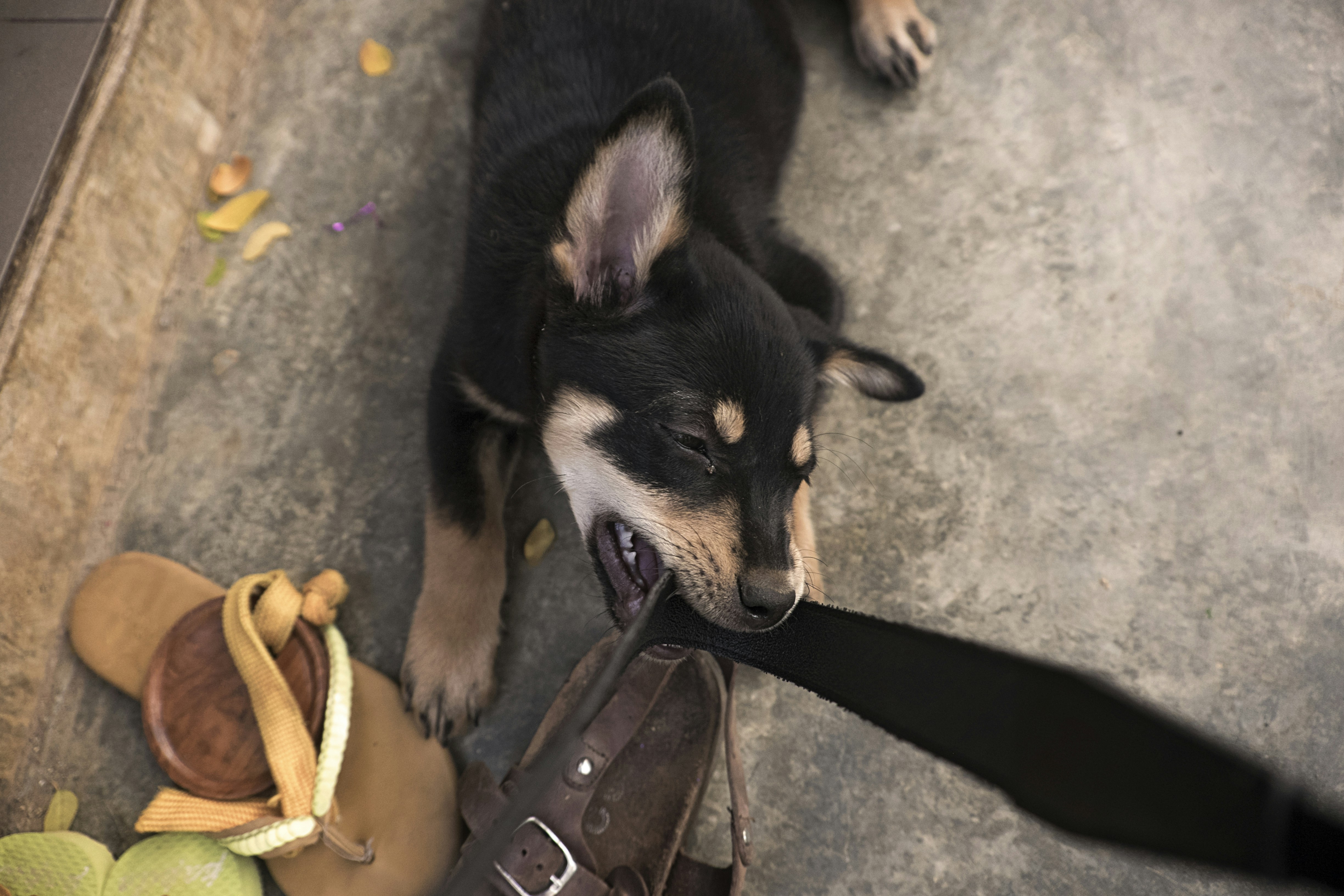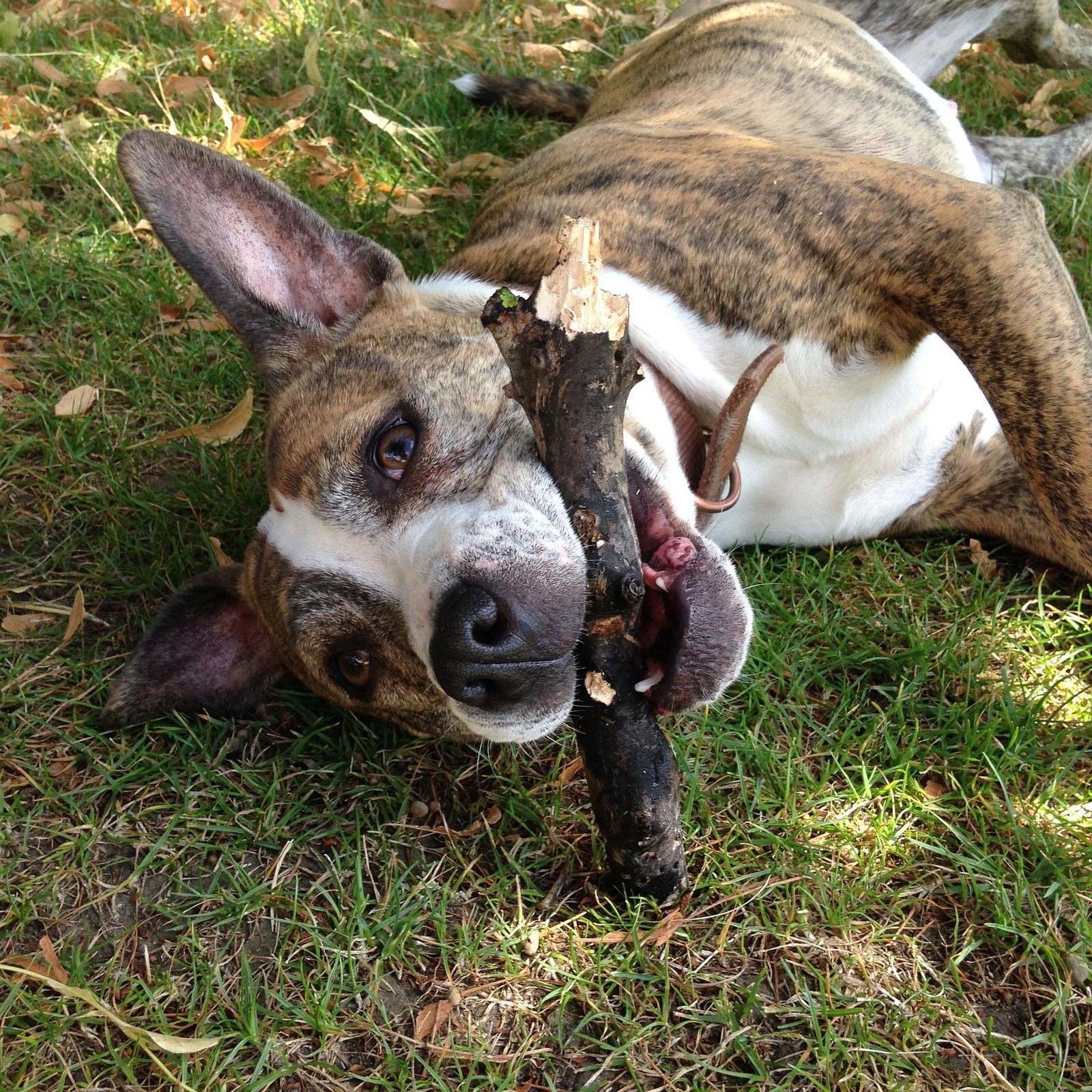
Chewing is not a behavior problem. It is a normal canine need, like sniffing or sleeping, and a dog that never chews anything is unusual rather than well-behaved.
What people actually mean by destructive chewing is a dog chewing the wrong things, at the wrong times, usually because nobody gave it a right thing or because something else is wrong. Those are two very different problems, and the second one does not respond to more toys.
Short answer: chewing is normal, so the job is redirecting it rather than stopping it. Work out which of five causes you have (teething, boredom, distress, adolescence, medical), remove unsupervised access to the wrong things, and supply chews the dog actually prefers. If you cannot dent it with a thumbnail it is hard enough to fracture a tooth. Damage that happens only in your absence, at doors and windows, is a separation problem and no chew toy will fix it.
Work out which of the five you have
The fix depends entirely on the cause, so start here rather than with a shopping list.
1. Teething. Adult teeth push through from around twelve weeks, and most puppies have a full set of 42 by six months, some finishing closer to seven or eight. Genuine teething discomfort drives chewing on objects roughly between three and six months. If your puppy is nine weeks old and shredding your hands, that is investigation and play, not teething — see our guide to puppy biting.
2. Boredom and under-stimulation. Monotonous, happens over long stretches, spread through the house, and usually starts hours into an absence. Common in working breeds and in dogs whose exercise is entirely physical.
3. Distress. Happens only when the dog is alone, usually starts within the first thirty minutes, and is concentrated at exit points — door frames, window sills, the edges of blinds. Often paired with pacing, drooling, or vocalizing.
That pattern is not a chewing problem. It is a separation-related problem, and no amount of chew toys will touch it. See our guide to separation anxiety and what the research shows.
4. Adolescence. Between roughly six and eighteen months, chewing frequently returns in a dog that had grown out of it. This is developmental and it passes.
5. Medical. Dental pain, gastrointestinal discomfort, and nutritional problems can all drive chewing, and pica — eating non-food items such as fabric, rocks, or plastic — is a veterinary question rather than a training one. A dog that suddenly starts chewing in adulthood, or that swallows what it chews rather than shredding it, needs examining.
The timing test
One question separates most cases: when does it happen?
| Pattern | Most likely |
|---|---|
| Only when alone, starts fast, at doors and windows | Distress |
| Only when alone, starts late, spread around | Boredom |
| Also when you are home | Teething, adolescence, or lack of appropriate outlets |
| Swallowing rather than shredding | Veterinary |
A camera answers this in one session and saves months of guessing.
What is safe to chew — the rule that matters
This section is more important than the training, because the wrong chew causes injuries that cost more than a sofa.
The thumbnail test: if you cannot make a dent in it with your thumbnail, it is too hard for your dog’s teeth.
The knee test: if it would hurt to be hit on the knee with it, it is too hard.
Slab fractures of the upper fourth premolar — the big chewing tooth at the back — are the classic injury, and they usually come from antlers, hooves, bones, hard nylon, and ice cubes. A fractured tooth with an exposed pulp is painful and needs extraction or root canal treatment, and dogs are very good at hiding that pain until the problem is advanced.
Generally avoid: antlers, hooves, real bones (cooked bones splinter and raw bones still fracture teeth), hard nylon chews, tennis balls as a daily chew — the fuzz is abrasive and wears teeth down — and anything small enough to swallow whole.
Generally safer: rubber toys designed for stuffing, softer rubber chews that flex, and dental chews that carry the Veterinary Oral Health Council seal, which means they have met a standard for reducing plaque or tartar rather than simply claiming to.
Size up, not down. A chew that can fit entirely into the mouth is a choking and obstruction risk. Intestinal obstruction is an emergency and often requires surgery.
Supervise, and retire things early. Once a chew is small enough to swallow or has broken into pieces, it goes in the trash. Most serious incidents involve the last third of a chew.
Chew safety, item by item
Two failure modes matter: teeth and guts. A chew that is too hard fractures a tooth; a chew that is too small blocks an intestine. Almost everything on a pet store shelf sits somewhere on that scale.
| Chew | Passes the thumbnail test | Main risk | Verdict |
|---|---|---|---|
| Antlers, hooves | No | Slab fracture of the big chewing tooth | Avoid |
| Raw or cooked bones | No | Fractures; cooked bones also splinter | Avoid |
| Hard nylon chews | No | Fractures; swallowed shards | Avoid |
| Ice cubes | No | Fractures, and popular precisely because dogs love them | Avoid as a chew |
| Tennis balls | Yes | Abrasive fuzz wears teeth down | Fetch only, not a daily chew |
| Stuffable rubber toys | Yes | Low, if sized correctly | The default choice |
| Soft flexible rubber chews | Yes | Pieces torn off by a strong chewer | Good, with supervision |
| Dental chews with a VOHC seal | Yes | Calories; gulping whole | Fine in moderation |
| Rawhide | Varies | Swallowed softened chunks; obstruction | Supervise closely, retire early |
| Sticks from the yard | Yes | Splinters and mouth punctures | Not a substitute for a chew |
Whatever you choose, size it so it cannot fit entirely inside the mouth, and retire it the moment it can. Most serious incidents involve the last third of a chew, when it has finally become small enough to swallow.
Management does most of the work
You cannot train a dog not to chew something it has unsupervised access to. Every successful chew rewards itself.
- Shrink the territory. A pen, a gated room, or a crate for short periods while you build the habit. See our guide to crate training and where the limits are.
- Remove the targets. Shoes away, cables behind furniture or in covers, remote controls up high, laundry off the floor.
- Rotate the toys. Five toys available at once become wallpaper. Two out, three away, swapped weekly, and each set feels new.
- Make the right thing better than the wrong thing. A frozen stuffed rubber toy beats a table leg. A dry toy that does nothing does not.
The frozen stuffed toy
The single most useful item for a chewer. Stuff a rubber toy with wet food, plain yogurt, or soaked kibble, freeze it solid, and give it when you need the dog occupied — when you leave, when you cook, when visitors arrive.
Frozen makes it last many times longer than unfrozen, and the licking involved is settling in a way that gnawing is not.
The swap deserves its own training rather than being improvised mid-crisis. See how to teach leave it and drop it.
Build a chew station instead of a toy pile
Owners tend to solve chewing by buying more, which produces a floor covered in objects the dog has stopped noticing. A small system works better than a big collection.
- Keep two or three items out and the rest away. Swap them weekly. Novelty is most of a toy’s value and it is free.
- Freeze several stuffed rubber toys at once. Fill them on a Sunday with soaked kibble, wet food or plain yogurt, and keep four in the freezer so one is always ready.
- Match the chew to the moment. Something long-lasting when you leave, something quick when you need thirty seconds to answer the door.
- Keep one item exclusively for departures. It should be the best thing the dog gets all day and it should disappear when you come home.
- Put the station where the dog settles, not where you want it to settle. Dogs chew where they feel comfortable.
One caution on the departure toy: if your dog will not eat it while you are out, that is a signal about stress rather than about the recipe, and it points at the separation-related version of this problem.
Training the swap
What to do when you catch your dog with something it should not have.
Do not chase. Chasing turns a stolen shoe into a prize worth defending, and it is how ordinary theft turns into resource guarding. See our guide to resource guarding and why the common advice backfires.
Trade instead. Offer something clearly better, and when the dog releases, hand over the better thing. Where it is safe, give the original back too — that step is what stops the dog learning that letting go means permanent loss.
Interrupt, then redirect. A neutral sound to get attention, then hand the dog an appropriate chew and praise it for taking it. You are not correcting the chewing; you are relocating it.
Never punish after the fact. A dog cannot connect a telling-off to something it did twenty minutes ago. What it learns is that you are unpredictable when you come home, and the guilty look people describe is a response to your posture, not evidence of understanding.
Dog-proofing, room by room
Every successful chew rewards itself, which means an unproofed house trains the dog faster than you can.
- Living room: cables into covers or behind furniture, remotes up high, cushions off the floor when unsupervised, rugs with fringes rolled away.
- Kitchen: a lidded trash can or one behind a cabinet door, dish towels off handles, and nothing edible on a low counter.
- Bathroom: door closed. Medication, razors and toilet paper are all common and all bad.
- Bedroom: shoes in a closet, laundry in a basket with a lid, phone chargers unplugged and out of reach.
- Hallway: mail on a shelf rather than a mat, coats hung high, and the front door area kept clear if that is where distress-chewing shows up.
- Yard: check for chewable landscape edging, plastic plant pots and anything a bored dog can dismantle.
Do this before you need it. Proofing after the third destroyed cable is proofing a house the dog has already learned is full of opportunities.
Bitter sprays: modest, at best
Worth a realistic expectation. Deterrent sprays work for some dogs on some surfaces and are useless for others, and many dogs simply get used to the taste.
They are a supplement to management, not a substitute. If your plan is a bottle of spray and nothing else, the chewing will continue.
Reapply frequently, test on a hidden patch of fabric first, and never spray anything on a dog.
Under-stimulation is a common driver of chewing. See our guide to mental stimulation for dogs.
Mental work beats more walking
For boredom-driven chewing, this is where the fix actually lives.
Chewing, licking, and shredding are self-soothing activities. A dog with no legitimate outlet for them finds one. So supply it deliberately:
- Feed from puzzle toys rather than a bowl. A meal that takes twenty minutes of problem-solving does more than an extra mile of walking.
- Scatter feeding. Throw the meal into grass and let the dog hunt it.
- Snuffle mats and cardboard boxes stuffed with paper and a few treats. A dog allowed to shred a box on purpose is less interested in shredding your mail.
- Short training sessions. Learning something new is more tiring than repeating known cues.
For working breeds this is not optional — see our guide to high-energy breeds.
A first week that changes the pattern
Days 1–2. Proof the rooms and set up the chew station. Shrink the dog’s unsupervised space to one gated area with nothing chewable except its own things.
Day 3. Film or watch what happens during a short absence. Ten minutes of footage answers the boredom-or-distress question that months of guessing will not.
Days 4–5. Add mental work to the daily routine: feed at least one meal from a puzzle or scattered in grass, and run two short training sessions.
Day 6. Practice the swap deliberately, on low-value items, several times, so it exists before you need it in a hurry.
Day 7. Review. Less damage means keep going for another three weeks. No change at all, or damage concentrated at exits, means the cause is not the one you assumed.
Common mistakes
- Giving old shoes as toys. Dogs do not distinguish between the old shoe and the new one. Same for socks and knotted clothing.
- Punishing after the event. Teaches unpredictability, not restraint.
- Assuming more exercise fixes it. It helps with boredom and does nothing for distress or teething.
- Leaving everything out at once, so no toy is interesting.
- Buying the hardest chew available, which is the fastest route to a fractured tooth.
- Treating separation-related chewing as a chewing problem. The most consequential error on this list.
For a persistent scavenger, a basket muzzle solves the risk immediately while the training catches up. See muzzle training.
Troubleshooting
The dog ignores every toy you buy. Usually texture rather than boredom. Try something with a different feel entirely, and try food-stuffed rather than empty. Toys that do nothing are not competitive with a table leg.
It chews only one specific thing. Look at what that object has in common with its own chews: the sofa corner, the door frame edge, the chair leg. Then supply that texture legitimately and block access to the original for several weeks.
It stops when you enter the room and starts again when you leave. That is not guilt. It has learned the behavior is unsafe near you rather than unrewarding, which usually means punishment has been part of the history. Switch to management and redirection.
It shreds and eats the pieces. Stop giving destructible items and speak to your vet. Swallowing is a different risk category from shredding.
A settled adult has suddenly started. Something changed: a schedule, a household member, a noise, or the dog’s health. Rule out pain and dental disease before treating it as a training problem.
It got worse around eight months. Adolescence. Tighten management for a few months rather than concluding the earlier work failed.
When to see a vet
- Your dog swallows what it chews rather than shredding it
- It eats non-food items such as fabric, stones, or plastic
- Vomiting, straining, loss of appetite, or lethargy after chewing — possible obstruction, and an emergency
- Reluctance to chew on one side, dropping food, pawing at the mouth, or bad breath — possible dental pain
- Chewing that begins suddenly in an adult dog
- Chewing that happens only in your absence, with distress signs
Affiliate recommendation
Brain Training for Dogs
If you want a structured program to work through, this is the one we point people to. It was built by Adrienne Farricelli, a CPDT-KA certified trainer, and it is force-free throughout — no dominance, no prong or shock collars. The focus is mental stimulation and impulse control, which is the foundation most training problems come back to.
One honest caveat: the sales page talks about eliminating problems quickly. Ignore that part. Real behavior change takes weeks to months, as every guide on this site says.
See the program · We earn a commission at no extra cost to you. See our affiliate disclosure.
Watch the training in action
PawMastery on YouTube — 149,000+ subscribers following along with real training sessions.
Frequently asked questions
How do I stop my dog chewing everything?
Work out the cause first, then manage the environment so the wrong things are unavailable, and supply appropriate chews that are better than the alternatives. Training alone will not beat unsupervised access.
Are antlers and bones safe for dogs?
They are among the most common causes of slab fractures of the large chewing teeth. If you cannot dent it with your thumbnail, it is too hard.
At what age do puppies stop chewing?
Teething-driven chewing eases as the adult teeth finish coming through, usually by six to eight months. Expect a return during adolescence.
Do bitter sprays work?
Sometimes, on some dogs, on some surfaces. Treat them as a supplement to management rather than a solution.
My dog only chews when I am out. What does that mean?
Check when it starts. Damage at doors and windows within the first half hour points to a separation-related problem rather than boredom, and needs a different approach entirely.
Is it safe to give my dog a tennis ball to chew?
For fetch, yes. As a daily chew, no — the fuzz is abrasive and wears the teeth down over time.
Should I punish my dog for chewing?
No, and especially not after the fact. Interrupt, redirect to an appropriate chew, and reward the dog for taking it.
How do I know if a chew is too small?
If it can fit entirely inside your dog’s mouth, it is a choking and obstruction risk. Size up, and discard any chew once it has worn down.
How long should I leave a chew down for?
Twenty to thirty minutes is plenty for most dogs, then put it away. Chews that stay available all day lose their value and get worn down to a swallowable size without anyone noticing.
Can I give my dog a frozen toy every day?
Yes, provided the filling comes out of the daily food allowance rather than on top of it. Licking a frozen toy is one of the few genuinely settling activities you can supply on demand.
Is rawhide safe?
It is one of the higher-risk options because it softens and gets swallowed in chunks. If you use it, supervise every minute and take it away once it is small enough to gulp.
My dog chews the sofa only in the evening. What is that?
Very often an outlet problem at the point in the day when the dog has energy left and nothing to do with it. Move a training session or a puzzle feed into that hour and see whether it changes.
Does neutering stop destructive chewing?
No. Chewing is not driven by sex hormones, and neutering is not a treatment for it. Discuss the decision with your vet on its own merits.
Swallowed objects can cause intestinal obstruction, which is a surgical emergency. If your dog is vomiting, straining, off its food, or lethargic after chewing something, contact your veterinarian immediately. Sudden onset chewing or eating non-food items in an adult dog also warrants a veterinary examination.